

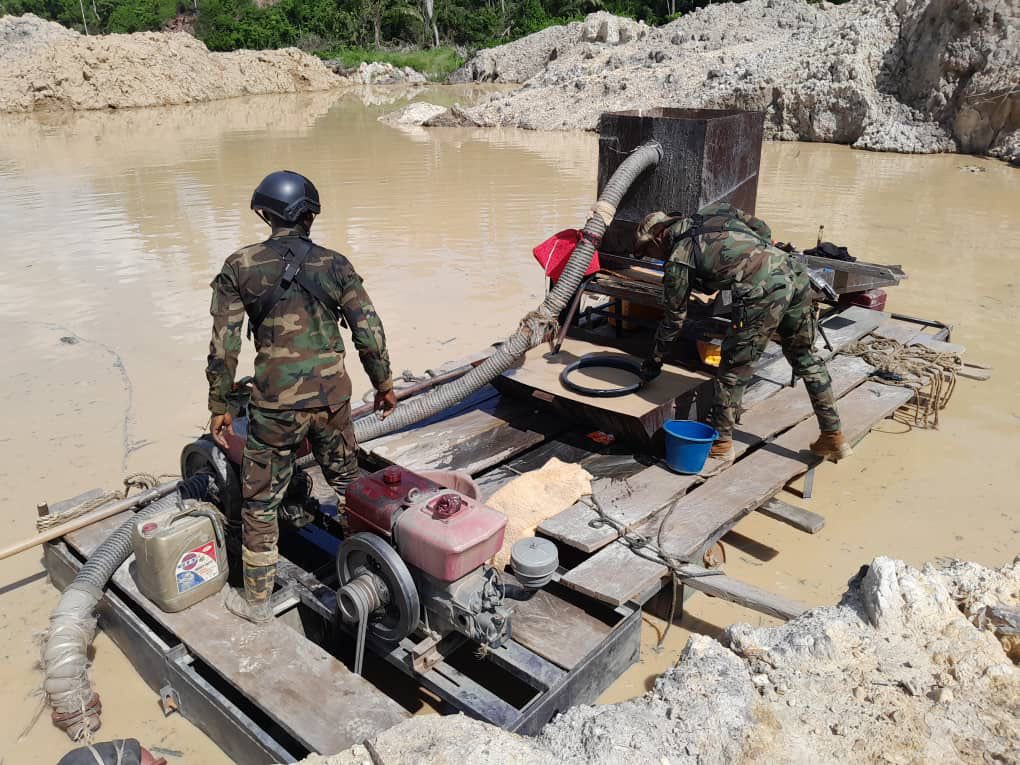
The Forestry Commission reports that over 5,200 hectares have been lost in the last three years due to illegal mining, sometimes referred to as galamsey, which has devastated approximately 9,000 hectares of Ghana’s forest reserves.
According to a recent Commission survey, the total area affected by illegal mining in forest reserves grew by 5,252.9 hectares between 2021 and 2024, reaching 8,923.8 hectares as of December 31, 2024.
The survey also showed that the Western North Region and the Ashanti Region had the highest levels of forest degradation, underscoring the increasing strain on some of the most important forest ecosystems in the nation.
Dr. Hugh Brown, the Chief Executive Officer of the Forestry Commission, told reporters on Wednesday, March 4, 2026, that operational difficulties, such as the removal of military assistance in anti-galamsey operations, were partially to blame for the increase.
On November 1st, the military withdrew, leaving us on our own. Dr. Brown stated, “We had to strengthen our rapid response teams quickly, sometimes putting them in situations where they were not well-equipped,”
He added that in order to effectively combat illegal mining activities, Ghana’s current forest protection methods need to be urgently modernised.
“We cannot continue protecting forests as we did in the 1920s and 1930s, when forest guards held cutlasses and patrolled boundaries to detect offences. There has been insufficient investment in modern protection measures,” he clarified.
The Forestry Commission’s conclusions highlight the ongoing difficulty in protecting Ghana’s forest reserves since illegal mining keeps growing in spite of enforcement actions.
Stronger logistics, better surveillance systems, and increased cooperation between security and environmental authorities are all necessary to solve the issue, according to officials.
Source: newsthemegh.com