
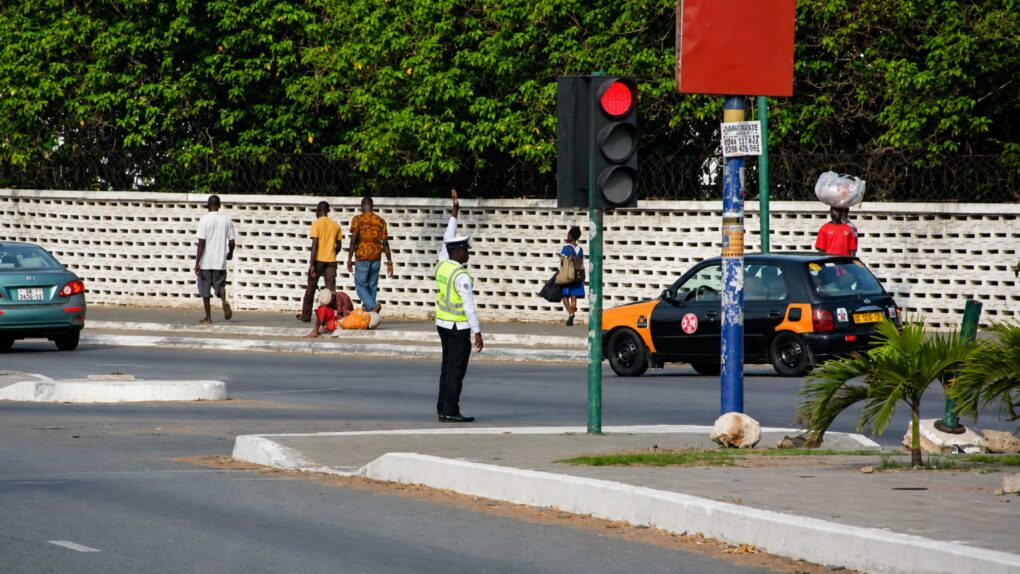
CUTS International Accra, a research and public policy think tank, has urged the government to postpone the full enforcement of TRAFFITECH-GH, which is scheduled to commence on October 1, 2026, until traffic infrastructure at enforcement locations has been properly inspected and repaired.
The organisation said it supports the use of technology in road traffic enforcement to improve compliance with traffic regulations and reduce road crashes. However, it stressed that motorists should only be penalised when traffic signals, speed limits and road markings are clearly visible and understandable.
CUTS Raises Concerns Over Traffic Lights in Accra
According to CUTS, several traffic lights across Accra are currently obstructed by overgrown vegetation, while others are damaged, displaced or not functioning.
The think tank also identified junctions where one traffic signal is operational while another at the same location is faulty. It said faded lane markings and stop lines are creating additional uncertainty for drivers and other road users.
CUTS argued that these infrastructure problems could create risks for motorists and pedestrians even before automated traffic cameras are activated to detect violations.
The organisation particularly mentioned traffic lights along the Nsawam-Accra Road near the Apenkwa-Achimota overhead bridge and at the Police Training Academy junction in Tesano.
CUTS said traffic signals at these locations have reportedly shifted from the clear line of sight of approaching drivers, although the TRAFFITECH-GH cameras appear to have been correctly positioned.
Government Urged to Inspect TRAFFITECH-GH Locations
CUTS has called on the Ghana Police Service and the Department of Urban Roads to inspect every TRAFFITECH-GH enforcement point from the actual position of approaching drivers before automated enforcement begins.
The inspection, it said, should cover every affected lane and determine whether traffic signals and other road signs are clearly visible during daytime, nighttime and rainy weather conditions.
Authorities should also document the condition of traffic lights, road signs, lane markings and stop lines before automated fines are activated at each location.
The think tank said traffic infrastructure requiring repairs should be addressed before motorists are subjected to automated penalties.
Repairs Needed Before Automated Traffic Fines
CUTS has urged authorities to take practical steps to improve road conditions at TRAFFITECH-GH locations.
These measures include:
- Repairing and realigning displaced traffic lights
- Restoring damaged or non-functioning signal heads
- Trimming trees and vegetation blocking traffic signals
- Repainting faded lane markings and stop lines
- Ensuring road signs are clearly visible to motorists
- Confirming that every relevant traffic signal is operational
The organisation maintained that automated traffic fines for a particular offence should only be introduced at a location after the road infrastructure needed for drivers to comply with the relevant traffic rule is functional and clearly visible.
CUTS Raises Speed Limit Signage Concerns
CUTS also expressed concern about the visibility of speed limits at locations where TRAFFITECH-GH speed cameras are expected to operate.
The think tank referred to Regulation 211 of the Road Traffic Regulations, 2026 (L.I. 2519), which establishes general speed limits based on the type and location of a road.
It noted that Regulation 212 provides additional speed limits for specific categories of vehicles, while Regulation 213(3) makes provisions relating to speed cameras and safety signage.
However, CUTS stressed that the existence of these regulations does not remove the need for motorists to be clearly informed about the applicable speed limit on a particular road.
Clear Speed Limit Signs Needed Near Cameras
CUTS said drivers who are unfamiliar with a particular area may not immediately know where a built-up area begins or where a lower speed limit applies.
This, it noted, could be particularly important around schools, markets and areas with heavy pedestrian activity, where different speed restrictions may apply.
The organisation therefore called for clear speed-limit signs to be installed before every TRAFFITECH-GH speed camera and at locations where the applicable speed limit changes.
According to CUTS, motorists should receive adequate and visible information about the applicable speed limit before an automated system imposes a traffic fine.
TRAFFITECH-GH Should Prioritise Road Safety
CUTS said it supports the overall objective of TRAFFITECH-GH, particularly its potential to improve traffic law compliance and enhance road safety in Ghana.
However, the think tank maintained that effective automated traffic enforcement must be supported by functional and visible road infrastructure.
It is therefore urging government agencies to complete inspections and necessary repairs before the full implementation of automated traffic enforcement.
CUTS said TRAFFITECH-GH should ultimately focus on its core objective of reducing road crashes, improving driver compliance and making Ghana’s roads safer, rather than penalising motorists because traffic signals, speed limits or road markings were unclear or difficult to see.
Source: newsthemegh.com