
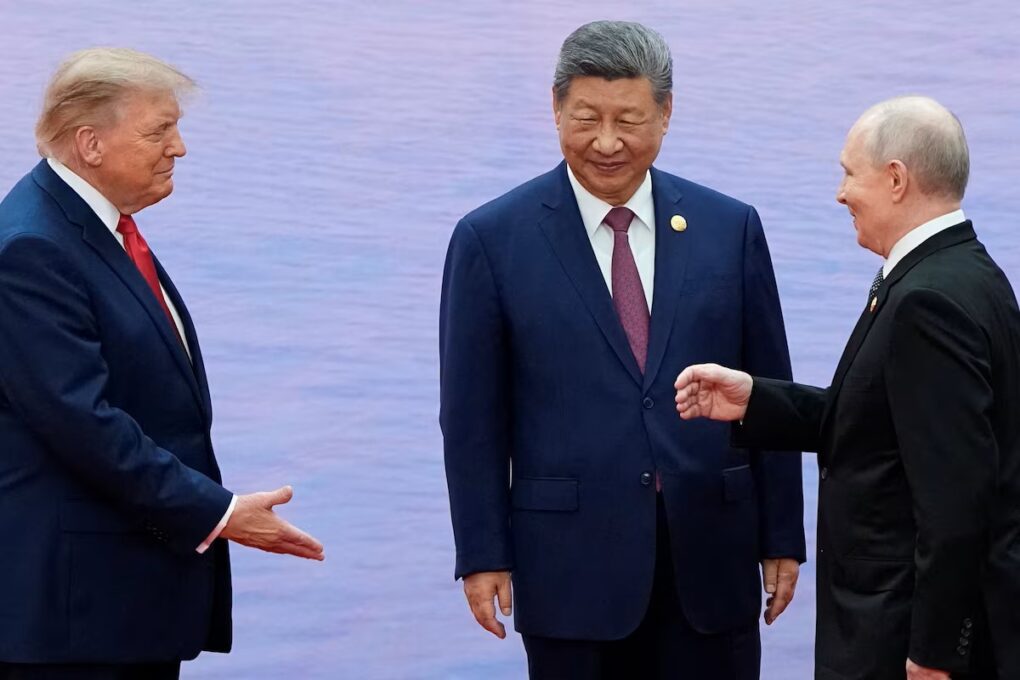
The leaders of APEC member economies wore custom red and blue silk scarves from Hangzhou, in eastern China, as they posed for the summit’s traditional family photo.
Hangzhou’s local government said in a statement the scarves allowed the region’s cultural and creative products to be showcased on an international stage.
The tradition dates back to 1993, when then-US President Bill Clinton gave fellow APEC leaders leather bomber jackets at the first leaders’ meeting in Seattle.
It has since evolved into a custom of dressing leaders in clothing or accessories reflecting the host country’s culture and traditions.
Hosting APEC is something of a coming-out party for this southern Chinese city, which the Communist Party used as an early testbed for business and market economics.
Shenzhen was a semi-rural backwater in 1980, when former Chinese leader Deng Xiaoping designated it as one of the People’s Republic’s first special economic zones.
It is now the country’s Silicon Valley, crowded with gleaming skyscrapers. The city is the base of several leading Chinese auto and tech giants, such as BYD, Huawei and Tencent.
Billboards along the city’s thoroughfares read: “Gather in Shenzhen, Witness the Wonders.” Driverless taxis weave through traffic while delivery drones fly coffee orders to customers in a park.
Both domestic and international reasons govern China’s choice of Shenzhen, said Chim Lee, senior analyst at the Economist Intelligence Unit.
As part of China’s Greater Bay Area home to Hong Kong and Macau, which Beijing seeks to establish as a global hub for technology and innovation, the city offers a platform to showcase China’s vision for development and trade.
It also highlights Shenzhen’s resilience to geopolitical turbulence, Lee added.
Source: reuters.com