

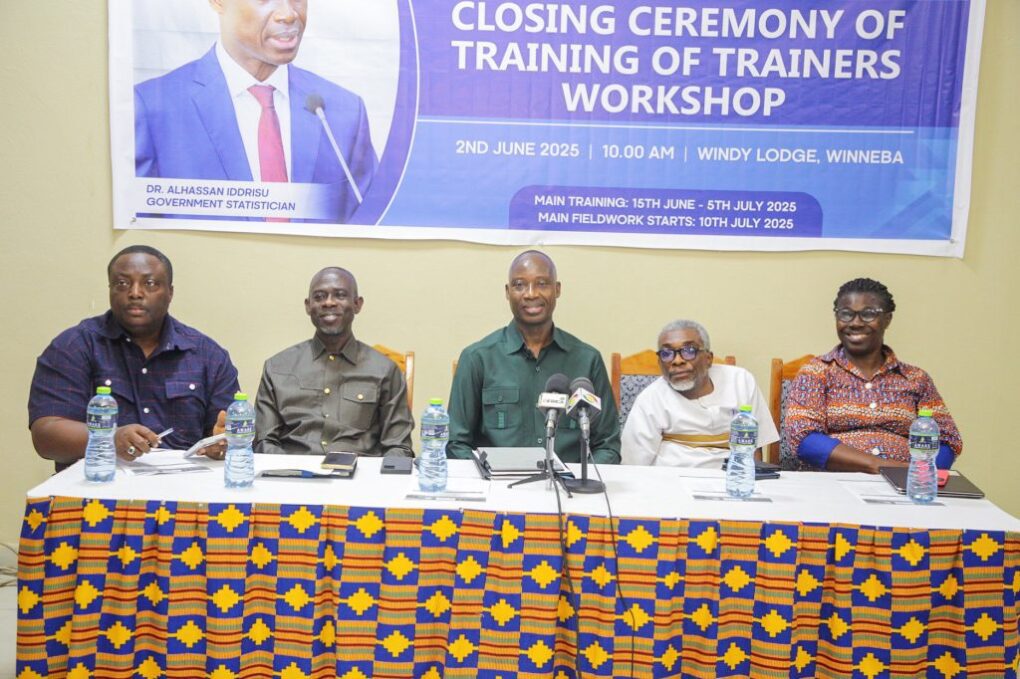
The government’s 24-hour economy project would be monitored by the Ghana Statistical Service (GSS), according to Government Statistician Dr. Alhassan Iddrisu.
Through a three-shift approach, the monitoring seeks to determine the initiative’s efficacy, pinpoint areas for development, and make sure it achieves its goals of promoting economic activity and growth.
“We’ve had initial engagement with the executives with regards to the 24-hour economy, and definitely the information or the data we collect from the IBES would definitely inform the implementation of the 24-hour economy,” he said.
The comments were given by Dr. Iddrisu in answer to a query on the significance of the 2025 Ghana Integrated Business Establishment Survey II (IBES II) from the Ghana News Agency.
On Monday, he was addressing on the fringes of the 2025 IBES II training-of-trainers workshop, which was conducted in Winneba.
There were 240 national and regional trainers equipped by the workshop.
Technical know-how and resources to assist field operations for gathering data from more than 40,000 businesses around the country were given to participants in the program.
Data on capital formation, employment, company innovation, production value and structure, and sector-specific issues will be gathered by enumerators.
As part of the Service’s rebranding, Dr. Iddrisu stated that GSS would create data that informs decision-making at all development levels, including monitoring, evaluation, and policy implementation, going beyond conventional data collecting and analysis.
“The data we gather through IBES II will serve multiple critical purposes. Therefore, the outcomes will help shape policy, inform investment decisions, and support Ghana’s investment agenda,” he said.
“We’ll be able to know the type of employment that existing businesses are employing, the type of people existing businesses are employing, and tell the type of jobs that are required for businesses to function properly,” he added.
IBES II Project Coordinator Dr. Anthony Kraka stated that the poll would yield data to evaluate the 24-hour economic initiative’s advancement.
“We’re going to measure the impact of the policies that are implemented going forward. This will help us to understand the business challenges and know where they are in terms of their operations in the 24-hour economy,” he said.
Additionally, Dr. Kraka stated that the rebasing of important macroeconomic indicators, such as the Index of Industrial Production (IIP), the Producer Price Index (PPI), and the Gross Domestic Product (GDP), would be supported by IBES data.
Source: newsthemegh.com