
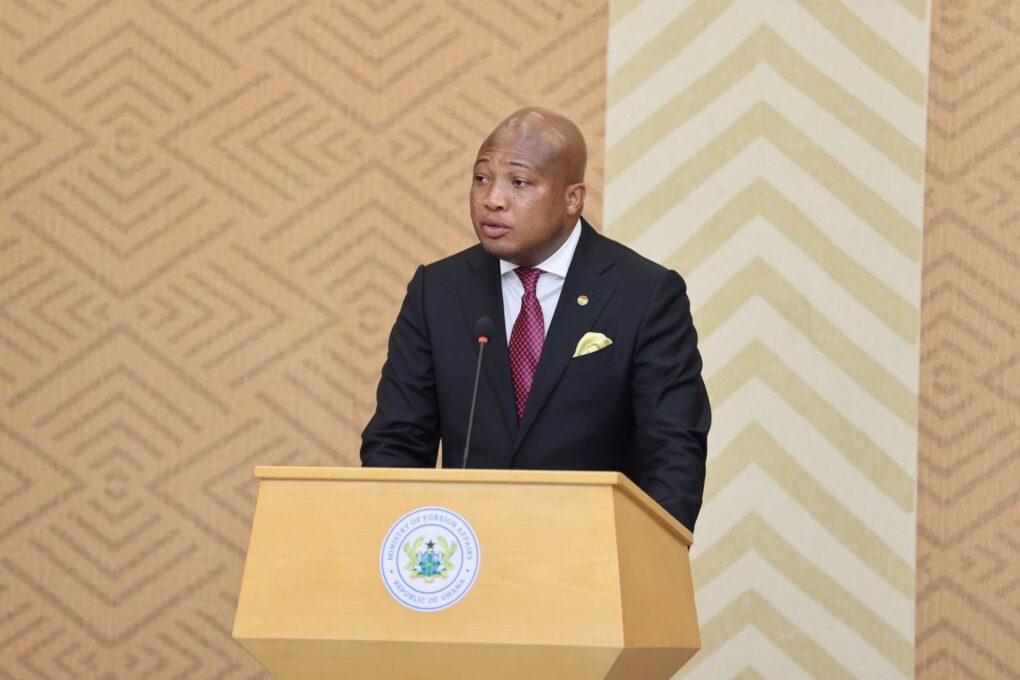
Samuel Okudzeto Ablakwa, Ghana’s ambition-driven Minister of Foreign Affairs, has disregarded diplomatic norms by disclosing security information in what many have called “okro-mouth.”
By openly disclosing Ghana’s purported involvement in a recent US-led counterterrorism operation in Nigeria, he caused uproar.
On March 9, 2026, Mr. Ablakwa made the decision to exchange Ghana’s shield of invisibility for a moment of global applause while speaking at the opulent podium of Chatham House in London.
He disclosed that in 2025, Ghana helped the United States bomb ISIS targets in Sokoto, Nigeria, on Christmas Day.
Security experts contend that by making this public disclosure, the Minister of Foreign Affairs not only shared what he saw as a success story but also signified a risky departure from the same stealth that has kept Ghana safe.
Ghana’s security plan, which depended on “strategic ambiguity” to remain under the radar, may be jeopardised by this one instance of indiscretion and diplomatic error.
Opponents contend that the Minister’s revelation may have put the nation at risk and jeopardised Ghana’s covert collaboration with foreign allies.
“Strategic Ambiguity” is a golden rule that has always guided Ghana’s security architecture in the shadow world of counterterrorism.
Ghana was an island of relative quiet for many years, even as the Sahelian flames licked at its northern boundaries.
Security experts claim that this was not a coincidence but rather the outcome of quiet competence and a purposeful strategy of working with foreign allies like the United States and Nigeria while maintaining complete secrecy.
Operational Security (OPSEC) is the first victim of the Minister’s revelation.
Extremist organisations like the Islamic State Sahel Province (ISSP) and JNIM rely on stories of foreign meddling, as security experts have recently noted.
To explain their expansion into the Gulf of Guinea, these organisations look for symbolic targets.
Experts contend that Mr. Ablakwa has pushed Ghana from the logistical periphery to the operational center in the eyes of these terror cells by revealing the nation as a kinetic partner in a drone or missile strike.
They claim that the nation has changed from being a neighbour observing the fire to helping to light the match.
They questioned why, in a time of border infiltrations and lone wolf attacks, a sovereign state would willingly draw attention to itself in a public forum in London through its praise-seeking Foreign Affairs Minister.
Political observers contend that the issue of Ghana’s democratic foundation goes beyond the physical danger.
The legitimacy of the Minister’s disclosure has been called into doubt by the Minority in Parliament, led by Mr. Samuel Abu Jinapor, Ranking Member on the Foreign Affairs Committee.
He declared, “This is a matter of grave national concern with far-reaching implications for our country’s foreign policy position and Ghana’s national security.”
He questioned the legal and policy framework that is alleged to have permitted the government to permit the conduct of such a military operation from Ghanaian territory.
Mr. Jinapor, the Member of Parliament (MP) for Damongo, claims that Parliament was not informed about this important issue.
According to him, the Minority will want to know if Ghana and the US have a legal agreement that permits Ghanaian land to be used for military operations abroad.
Citing Article 181 of the 1992 Constitution, which states that international business or security agreements with significant implications must be ratified by the representatives of the people, Mr. Jinapor pointed out that the country’s constitution requires such agreements to receive parliamentary approval before they can take effect.
He questioned, “If there was any such agreement, why has the government not tabled it before Parliament for ratification or otherwise?”
Concerns regarding the potential effects of the purported cooperation on national security were also voiced by the minority.
Mr. Jinapor cautioned that Ghana would be vulnerable to reprisals if it is permitted to serve as a base for military operations against terrorist organisations.
“Does Ghana become a target for ISIS or other terrorist organisations? What measures have been put in place to ensure that our citizens are protected?” he asked.
Further clarification was provided by Mr. Dominic Nitiwul, the former Minister of Defence and Member of Parliament for Bimbilla, who revealed that prior defence cooperation agreements between Ghana and the United States prohibited the use of Ghanaian territory as a launching pad for operations against other nations.
He clarified that such military actions were not permitted by previous agreements signed between 1998 and 2018, such as the Defence Cooperation Agreement controlling the status of US personnel in Ghana.
“In all these agreements, at no point was the United States or any other country allowed to use the territory of Ghana as a launch pad to attack any individual, nation, group or organisation,” he insisted.
Even the use of armed military aircraft in Ghana would need the government’s express consent, Mr. Nitiwul continued.
He cautioned that Ghana might be in danger if the purported arrangement was approved without a formal agreement, particularly at a time when terrorist organisations are still active in a number of West African nations.
The former defence minister pointed out that extremist organisations already operate in nations like Nigeria, Mali, Burkina Faso, and Togo, thus Ghana must refrain from taking any steps that would attract unwelcome attention from these groups.
As a result, the Minority demanded that the Foreign Affairs Minister come before Parliament right away to provide the House an update on the purported cooperation with the United States.
Additionally, the caucus wants the government to guarantee that the reported military action has not put Ghana at unnecessary risk for security concerns.
Source: newsthemegh.com