

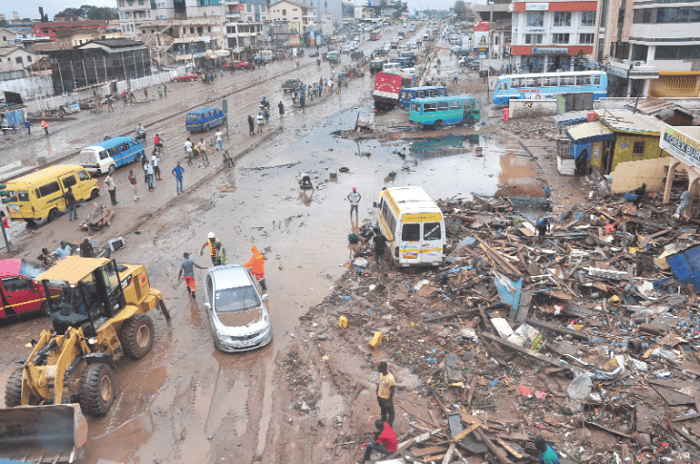
Today marks ten years since a terrible flood and fire combo rocked the heart of Accra, leaving the nation in shock and killing 154 people.
An already serious flood disaster became a national tragedy on the evening of June 3, 2015, when an explosion at the GOIL filling station near Kwame Nkrumah Circle occurred as the city was being battered by severe rains.
At the gas station, hundreds of people who were caught in the rain and rising floodwaters had taken refuge. However, fuel escaped from the station and drifted to the surface as water levels rose.
Suddenly, a spark set off a huge explosion that engulfed the area in flames.
Bodies were strewn all over the streets, and others were discovered in open drains days later, creating a bleak aftermath.
Working for weeks to clean the destruction was a terrifying undertaking for emergency responders.
Three days of national mourning were announced by the administration.
Following the catastrophe, a commission created by the government began looking into what started the fire and how future tragedies may be prevented.
The sequence of events leading up to the explosion was described in their report.
The investigation stated that the fire’s remote cause was Kwame Nkrumah’s flooding.
The intermediate cause was determined to be the fuel spillage from the GOIL station.
The investigations indicate that the last spark was caused by a person named Seth Kwesi Ofosu, who allegedly threw a lit cigarette into the fuel-laced floodwaters.
Five buildings, including the filling station, were damaged in the explosion, and an additional 154 people were injured.
The estimated total property loss was GHS 1.65 million.
The Odaw River and its tributaries, which are prone to overflowing during rainy seasons, should be dredged and desilted, among other substantial drainage projects, the committee advised.
In order to support the enforcement of waste management and environmental legislation, it also suggested the establishment of a sanitation police unit.
Even while there have been some corrective actions over the years, many people think the more fundamental structural problems that led to the catastrophe have not been fixed.
The city is still at risk from uncontrolled construction, poor urban drainage, and insufficient trash management.
Survivors, the families of the victims, and civil society organizations are once again demanding responsibility and ongoing action to guarantee that a tragedy like the one that occurred on June 3 never occurs again as the country commemorates its tenth anniversary.
Source: newsthemegh.com