
The government has launched a comprehensive process to reclaim illegally acquired public lands as part of broader reforms aimed at conserving Ghana’s natural resources and restoring public trust in land administration.
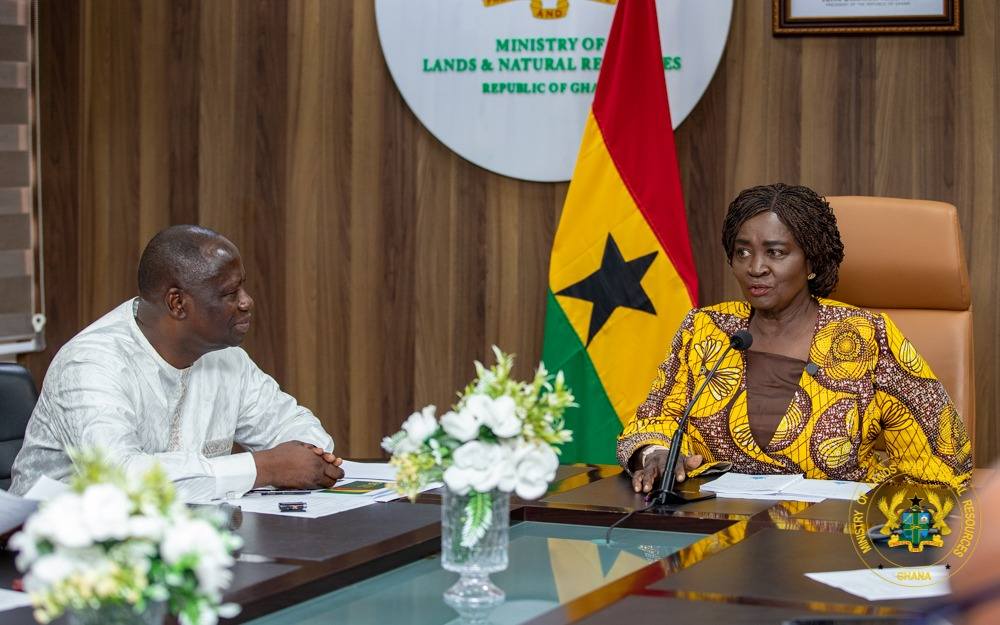
Mr Emmanuel Armah-Kofi Buah, Minister of Lands and Natural Resources, said this in Accra on Tuesday, January 28, at a meeting with the Vice President, Professor Naana Jane Opoku-Agyemang, and her team.
He stated that Cabinet has approved a comprehensive review of all previous public land sales or allocations.
He stated that any transaction that did not follow due process or did not deliver value for money would be annulled, and partial or unfinished processes would be automatically revoked.
According to Mr. Buah, the purpose of the reforms was to make sure that no public figure would consider purchasing state land for private purposes.
In order to promote socioeconomic development, he restated the ministry’s responsibility to guarantee the sustainable management and use of Ghana’s lands, minerals, forests, and wildlife.
Regarding forestry, the minister disclosed that although Ghana has 288 forest reserves, 44 of them had been totally destroyed in recent years, resulting in the loss of around 16% of the nation’s forest cover in just eight years.
He revealed that more than 8,000 football fields of forest land had been degraded, mostly in the Ashanti, Western, and Western North areas.
He also mentioned that several forest reserves had turned into red zones under the authority of armed organisations.
In response, Mr. Buah stated that more than 28 million saplings were planted in the first year of the government’s Tree for Life Reforestation Initiative.
Nine forest reserves have since been regained from red zones and put under safer conditions, he continued.
The minister added that Ghana was now the first nation in Africa permitted to sell legal timber to the European market, a move that he claimed showed better forest governance.
Regarding land administration, Mr. Buah acknowledged that many Ghanaians have encountered significant difficulties with the system.
He noted that in order to minimise delays brought on by missing data, the Lands Commission was receiving assistance in digitising all land records and services.
He declared that land administration services were being decentralised, with plans to open offices in 110 districts around the country and 36 new offices now open.
The minister stated that the largest issue facing the industry is illegal mining, also referred to as galamsey.
He claimed that among the issues the ministry acquired were contaminated waterways, devastated cocoa plantations, and grave health hazards.
Mr. Buah disclosed that several water treatment facilities had to close due to water turbidity levels that were far higher than permissible standards.
He stated that the ministry had implemented a five-pronged approach to deal with the issue, emphasising law enforcement, land restoration, regulatory reforms, stakeholder engagement, and alternative livelihoods.
He revealed that more than 255 small-scale mining licenses had been cancelled, that mining in waterways and forest reserves was prohibited, and that new surveillance systems for large mining machinery had been implemented.
Professor Naana Jane Opoku-Agyemang, the vice president, praised the ministry and its agencies for the advancements made thus far and said that their efforts are essential to the country’s survival.
She pointed out that the ministry’s portfolio had an impact on residents’ day-to-day lives and hence merited full government support.
Professor Opoku-Agyemang emphasised that preserving the environment was not just a moral obligation but also a question of survival, cautioning that environmental degradation, especially from illegal mining, posed grave risks to future generations’ health and means of subsistence.
Source: newsthemegh.com