
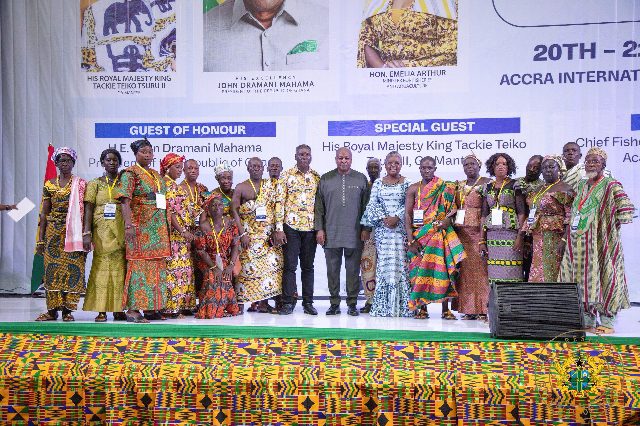
The government is taking moves to formally incorporate traditional chief fisherman and queen fishmongers into the country’s fisheries co-management systems.
President John Dramani Mahama launched the proposal on Friday, November 21, 2025, at the National Chief Fisherman and Queen Fishmonger Conference, calling it as a significant transformation in how fisheries governance will function in the coming years.
He stated that the decision combined traditional authority with modern regulation, recognizing the long-standing leadership role that community figures have had in supporting the sector.

“No reform will succeed without your leadership,” President Mahama informed the audience.
He emphasized that chief fisherman and queen fishmongers have traditionally maintained discipline in coastal communities by allocating landing spots, enforcing non-fishing days, settling conflicts, and maintaining order at landing sites and markets.
Although market developments and less institutional support have harmed their impact in recent years, he emphasized that their authority and legitimacy remain robust.
Mahama promised that his administration would restore, respect, and formalize the duties of fisher leaders under a new fisheries governance structure.
As part of the reforms, the president issued directions to bolster conventional leadership structures.
Chief fisherman and queen fishmongers will have formal representation in all fisheries co-management organizations, which is the first step in institutionalizing their participation.
He also stated that traditional councils and district assemblies will receive assistance in formalizing and enforcing community ordinances regarding non-fishing days, restricted fishing gear, and local monitoring.
The goal, he explained, was to transform current customary standards into fully enforceable regulations.
The government will also develop direct reporting lines to strengthen community-based surveillance networks, allowing for faster discovery of illegal fishing activity.
To better strengthen traditional leaders, Mahama announced that the fisher leadership would receive structured training at the Arnaburg Fisheries College in fisheries law, compliance and enforcement, conflict settlement, and financial management.
The president also emphasized how traditional ecological knowledge is incorporated into coastal planning, resource assessment, and more general coastal resource management.
He pointed out that Andrew Wilson’s nomination as an international advisor on indigenous knowledge and traditional practices was influenced by this.
Mahama urged chief fishermen and queen fishmongers to spearhead community education, impose discipline, and encourage ethical fishing methods, saying, “The future of Ghana’s fisheries depends on what we commit to today.”
Source: newsthemegh.com