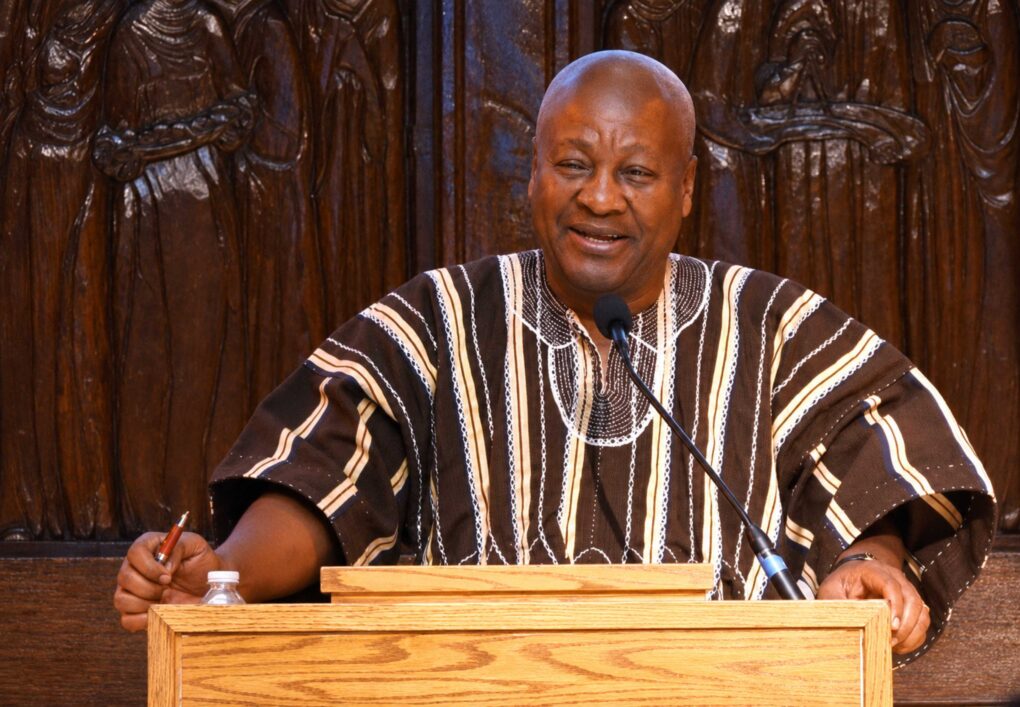
President John Dramani Mahama has called for a broader national discussion on the regulation of TikTok and other new media platforms, saying the rapid spread of digital content has created new challenges for information integrity, freedom of expression and online accountability.
President Mahama made the comments during a town hall meeting with the Ghanaian community in New York on Friday, September 25, 2026, as part of his engagements around the 81st United Nations General Assembly. The meeting was scheduled as part of his New York programme.
The President said the widespread availability of smartphones has effectively democratised the production and distribution of information, allowing individuals to reach large audiences without going through traditional media organisations.
Mahama Raises Information Integrity Concerns
According to President Mahama, “information integrity” has become an increasingly important issue as social media platforms continue to influence public discourse.
He said TikTok was not only a Ghanaian issue, noting that countries around the world are grappling with how to address the spread of information on emerging digital platforms while protecting legitimate freedom of expression.
Courtesy of @tv3_ghana
The President explained that traditional media organisations operate under professional and editorial standards, with journalists and media houses having reputations to protect.
He cited established media organisations such as the Daily Graphic and Channel One as examples of outlets where journalists are professionally accountable for information they publish. Recent reporting also quoted him highlighting Channel One as an example of responsible journalism.
By contrast, President Mahama said individuals using smartphones can publish content directly to social media, after which platform algorithms can amplify the material to a much wider audience.
Social Media Algorithms and Misinformation
The President said the ability of social media algorithms to rapidly distribute content creates an additional challenge because information can reach thousands or even millions of people without necessarily undergoing the editorial checks traditionally associated with professional journalism.
This has raised broader concerns about misinformation, harmful digital content, anonymous social media accounts and online abuse.
President Mahama said some anonymous accounts are being used to publish insulting and offensive material, adding that Ghana needs to determine how such conduct should be addressed without undermining the constitutional right to freedom of expression.
Mahama Says TikTok Regulation Is Not About Protecting Him From Insults
President Mahama stressed that his call for discussions on TikTok regulation and new media governance was not driven by a desire to prevent criticism of him personally.
He said he has experienced political criticism, insults and public attacks throughout his career and that such comments do not concern him.
The President, however, said he had become aware through media reports of cases involving people who had allegedly been arrested over social media activity, including claims that some arrests were linked to insults directed at him.
He said this raised an important question about where authorities should draw the line between legitimate criticism and speech or conduct that may require intervention.
Mahama Calls for National Discussion on Social Media Regulation
President Mahama said Ghana could choose to adopt a completely unrestricted approach to online expression, including instructing the police not to arrest people solely over what they say.
However, he argued that the country needs to collectively determine whether that is the approach Ghanaians want to adopt.
He therefore called for stakeholders to examine the issue and establish a clear framework for dealing with social media abuse, harmful online content and freedom of expression.
GJA and MFWA Asked to Lead Stakeholder Engagement
President Mahama proposed that the Ghana Journalists Association (GJA) and the Media Foundation for West Africa (MFWA) bring together relevant stakeholders for a workshop or national forum on new media regulation.
He said such a forum should examine questions including whether the police should intervene in certain cases, how digital platforms should be regulated and how Ghana can protect freedom of expression while addressing genuinely harmful content.
The proposal follows a September 22 directive in which the President tasked the GJA and MFWA to convene a national stakeholder engagement on hate speech, abusive language and harmful content on social media and emerging digital platforms.
The recommendations from the proposed engagement, according to the President, could then be presented to government to help shape the country’s approach to new media regulation.
Freedom of Expression Versus Harmful Online Content
President Mahama also emphasised that Ghanaians value freedom of expression, but argued that the right should be considered alongside the potential consequences of certain forms of speech.
His comments have added to the ongoing national debate over TikTok regulation in Ghana, social media laws, online speech, misinformation and digital accountability.
The broader issue is how Ghana can develop an approach to emerging media platforms that protects free expression while also addressing harmful, misleading or abusive digital content.
Source: newsthemegh.com