
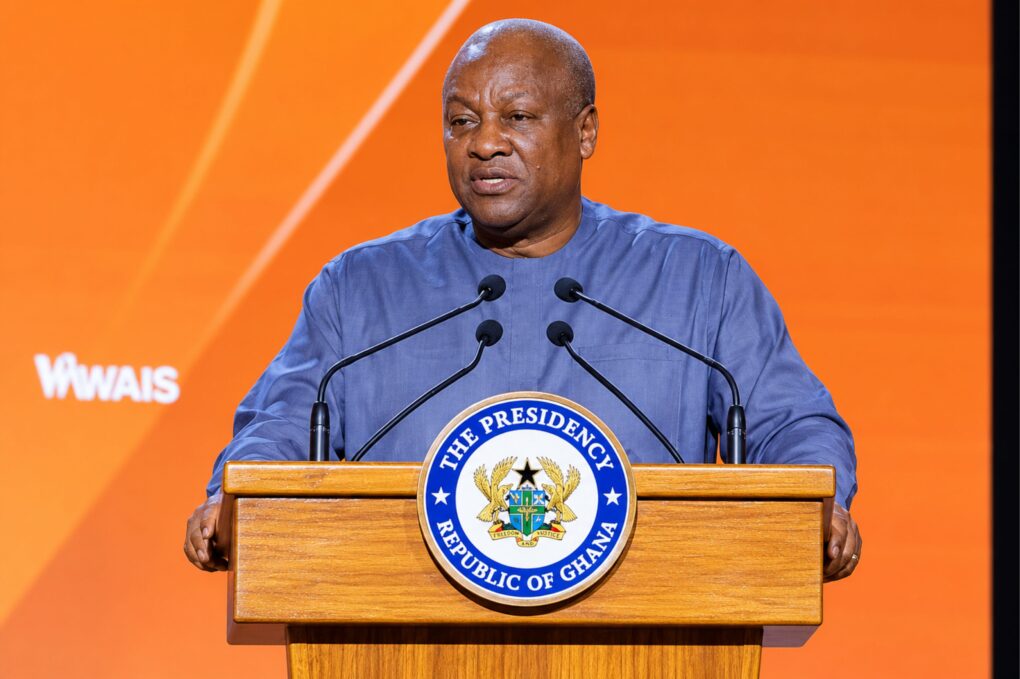
President John Dramani Mahama has proposed a gradual introduction of the ECO, the proposed single currency for West Africa, allowing countries that satisfy the required economic convergence criteria to adopt it without waiting for all ECOWAS member states.
Under the proposed arrangement, countries that meet the necessary economic benchmarks would begin using the common currency, while other nations would join the monetary union once they achieve the required conditions.
President Mahama made the proposal while addressing the West African Integration and Investment Summit (WAIIS) in Freetown, Sierra Leone.
He explained that efforts to establish a common West African currency had faced repeated delays because of difficulties in meeting the economic convergence requirements across the 15-member Economic Community of West African States (ECOWAS).
According to him, the number of countries meeting the agreed criteria has fluctuated over the years, making it challenging for the entire sub-region to satisfy the collective requirements for launching the ECO.
President Mahama recalled that the number of qualifying countries had previously changed from two to five, then three and seven, before fluctuating again.
He noted that discussions about introducing a common West African currency had continued for decades without the expected progress.
Mahama and Sierra Leone President Propose New ECO Currency Strategy
President Mahama disclosed that he and Sierra Leonean President Julius Maada Bio had presented a proposal at the previous ECOWAS summit to address the prolonged delay in establishing the regional monetary union.
The proposal recommends allowing countries that are economically prepared to introduce the ECO while maintaining their existing national currencies.
Other ECOWAS member states would subsequently join the arrangement when they satisfy the required economic convergence conditions.
Under the proposed system, the ECO would initially operate alongside participating countries’ national currencies and facilitate trade payments and financial settlements within the region.
President Mahama explained that the arrangement could reduce the dependence of West African countries on the United States dollar for transactions involving trade among themselves.
He said the phased approach would provide a practical alternative to waiting for all ECOWAS countries to meet the convergence requirements simultaneously.
The President also commended President Julius Maada Bio for convening the West African Integration and Investment Summit, describing it as an important platform for bringing together political leaders, financial institutions, businesses and regional development partners.
Mahama Identifies Poor Transport Infrastructure as Major ECOWAS Trade Challenge
Beyond monetary integration, President Mahama identified inadequate transport and logistics infrastructure as one of the biggest obstacles to expanding intra-African trade.
He observed that although the African Continental Free Trade Area (AfCFTA) has created opportunities for increased regional commerce, inadequate ports, railways, highways and other transport facilities continue to restrict the movement of goods across African countries.
According to figures cited by the President, intra-African trade has increased from approximately 11 per cent when the AfCFTA agreement was signed to about 15 per cent.
However, he noted that the figure remains considerably lower than trade within the European Union, where intra-regional commerce accounts for approximately 50 to 60 per cent.
President Mahama argued that improving transport infrastructure and logistics networks was essential to unlocking the full economic benefits of the African free trade agreement.
He questioned whether West African countries had developed sufficient port facilities, railway networks and road infrastructure to support the movement of goods and services across national borders.
Abidjan-Lagos Highway Project Still Awaiting Full Implementation
President Mahama also expressed concern about the slow progress of major regional infrastructure projects, particularly the proposed Abidjan-Lagos Highway corridor.
He recalled that discussions about the transport corridor began in the late 1990s when he was a young government minister.
The project was subsequently linked to broader plans for an Abidjan-Dakar Highway connecting countries along West Africa’s Atlantic coastline.
However, he lamented that decades after the initial discussions, the Abidjan-Lagos corridor remained largely unimplemented.
Reflecting on the prolonged delays, President Mahama noted that he had progressed from serving as a minister to Vice President and eventually President, yet the major regional highway project was still awaiting substantial implementation.
He described the situation as an indication that West African regional integration had remained largely focused on political declarations rather than the execution of practical development projects.
The President therefore urged regional leaders to accelerate infrastructure development to improve cross-border transportation, facilitate international trade and strengthen economic cooperation.
Mahama Calls for Integrated Road Networks and Common Border Posts
President Mahama called for the development of an interconnected West African road network supported by common border facilities and simplified customs procedures.
He also advocated removing unnecessary police and security checkpoints that delay the movement of people and goods across national borders.
According to him, reducing these barriers would lower transportation costs, improve trade efficiency and encourage businesses to expand their operations across the ECOWAS region.
He stressed that completing the Abidjan-Lagos corridor would provide an important foundation for extending regional transport connections towards Dakar and other West African destinations.
The President maintained that political leaders must demonstrate stronger commitment to implementing regional infrastructure projects instead of repeatedly making declarations without tangible results.
WAIIS Targets Investment and Economic Integration Across West Africa
The West African Integration and Investment Summit, convened under the leadership of Sierra Leonean President Julius Maada Bio, is designed to accelerate regional economic integration through practical projects, investment commitments and coordinated development strategies.
The summit brings together African Heads of State, government ministers, investors, development finance institutions, business executives and project developers.
Its objective is to align regional economic priorities with investment opportunities and establish mechanisms for monitoring the implementation of agreed projects.
West Africa represents a regional market of more than 450 million people, with economic growth estimated at 4.7 per cent and an investment pipeline exceeding US$180 billion across four strategic pillars.
President Mahama’s proposals on the ECO common currency, regional highways, transport infrastructure and cross-border trade highlight the need for stronger economic cooperation among ECOWAS member states.
The successful implementation of these initiatives could help reduce trade barriers, encourage foreign direct investment, improve regional connectivity and strengthen West Africa’s position in the global economy.
Source: newsthemegh.com