
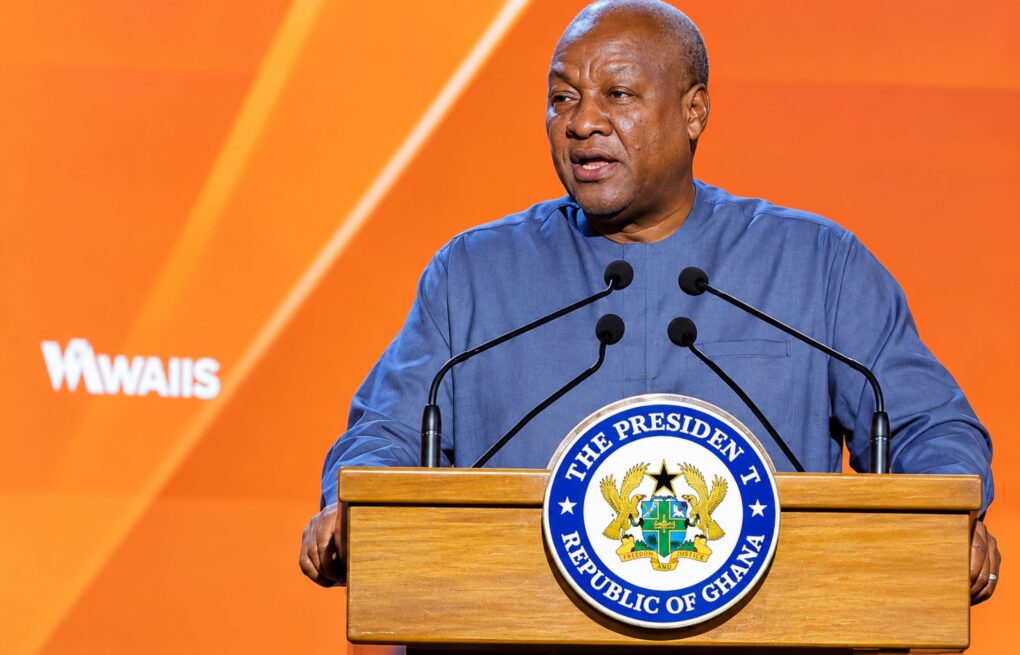
President John Dramani Mahama has revealed that Ghana’s decision to channel all gold exports through the Ghana Gold Board (GoldBod) has significantly increased the value of small-scale gold production retained in the domestic economy.
The policy, introduced to strengthen Ghana’s control over its mineral resources, seeks to prevent illegal and uncontrolled gold exports while ensuring that the country derives greater economic benefits from its gold mining industry.
President Mahama made the disclosure on Tuesday while addressing the West Africa Integration and Investment Summit (WAIIS) in Lungi, Sierra Leone.
According to the President, before the introduction of the Ghana Gold Board law, artisanal and small-scale gold miners could export gold through various individuals and groups without adequate government oversight. This made it difficult for the country to properly monitor gold exports and maximise revenue from the sector.
He explained that the government subsequently amended the legal framework to require all gold exports to pass through the Gold Board, warning that individuals who violate the law risk having their gold confiscated and facing imprisonment.
President Mahama disclosed that Ghana’s artisanal and small-scale mining sector produced approximately 64 tonnes of gold, valued at US$4.6 billion, in 2024.
However, following the implementation of the Gold Board policy, production increased to 104 tonnes, generating an estimated US$10.8 billion in value for the Ghanaian economy.
The President said the development demonstrates how stronger government regulation and effective management of natural resources can increase national revenue and ensure that mineral wealth benefits the Ghanaian people.
He emphasised that Ghana must exercise sovereignty over its natural resources, including gold and diamonds, to secure greater economic benefits for present and future generations.
President Mahama also highlighted changes to the royalty arrangements for large-scale gold mining companies.
He explained that the government had moved away from fixed royalty rates of three per cent under certain development and stability agreements to a sliding-scale system ranging between five and 12 per cent, depending on prevailing international gold prices.
According to him, the revised royalty framework has enabled Ghana to collect GH¢7.8 billion in royalties from large-scale gold mining operations since the law was passed in 2026.
The President urged other African governments to reconsider their mining agreements and strengthen policies governing the exploitation and export of mineral resources.
He maintained that African countries must negotiate better mining agreements, improve natural resource management and ensure that a larger proportion of the wealth generated from gold, minerals and other natural resources remains within their domestic economies.
The Ghana Gold Board policy is expected to play a significant role in strengthening gold export regulation, improving foreign exchange earnings, increasing mining revenue and supporting Ghana’s broader economic development agenda.
Source: newsthemegh.com