
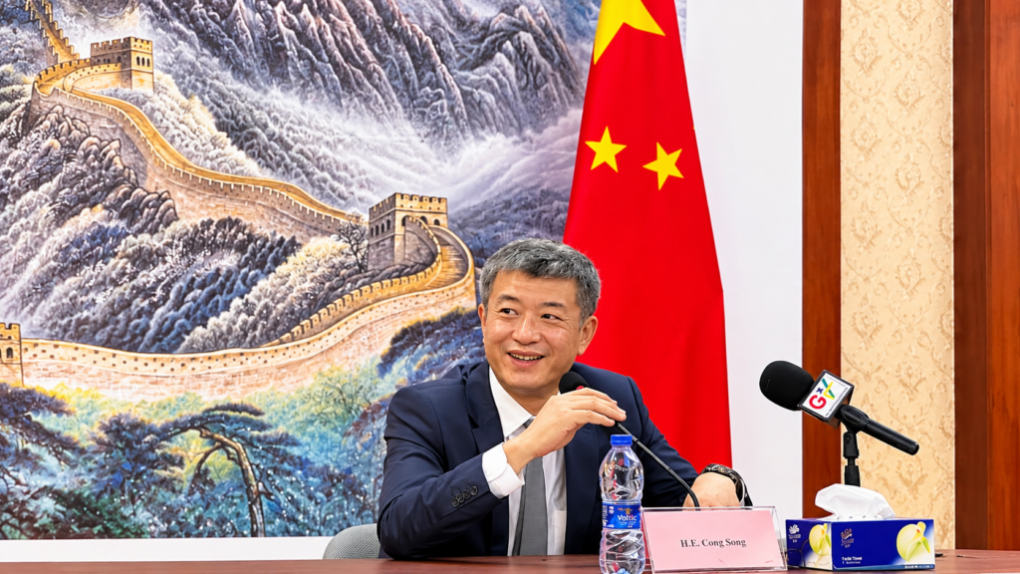
China has announced its readiness to support Ghana’s US$10 billion New Economy Programme through strategic investments and cooperation in artificial intelligence (AI), green technology, industrial development, agriculture, mining and other emerging industries.
Chinese Ambassador to Ghana, Mr Cong Song, said Ghana and China had significant opportunities to strengthen bilateral economic relations by collaborating in high-growth sectors capable of accelerating Ghana’s industrialisation and economic transformation.
He explained that China was prepared to share its development experience, transfer relevant technologies and support Ghana in developing local technical expertise, strengthening innovation and building the capacity of its workforce.
The Ambassador made the remarks at a press briefing in Accra on Monday, where he discussed the outcomes of the Fifth Plenary Session of the 20th Central Committee of the Communist Party of China (CPC), held in Beijing from October 26 to 29.
Responding to questions about China’s potential contribution to Ghana’s New Economy Programme, Mr Cong said the two countries could align China’s 15th Five-Year Plan with Ghana’s 24-Hour+ Economy and the government’s Reset Ghana Agenda.
He identified artificial intelligence, green technology, industrial upgrading, sustainable agriculture and responsible mining as important areas where both countries could establish mutually beneficial partnerships.
Ghana’s US$10 Billion New Economy Programme
Ghana’s New Economy Programme is a US$10 billion economic transformation initiative designed to accelerate industrialisation, expand domestic production, create jobs and strengthen the private sector.
The programme, announced by Finance Minister Dr Cassiel Ato Forson during the presentation of the 2027 Budget Statement to Parliament, is expected to run from 2027 to 2030.
It represents an estimated annual investment of US$2.5 billion over the four-year implementation period.
For 2027, the government has earmarked GH¢30 billion, equivalent to 1.5 per cent of Gross Domestic Product (GDP), to support the initiative.
The economic transformation programme is built around eight strategic pillars:
- Commercial agriculture.
- Energy infrastructure.
- Critical minerals and value addition.
- Tourism and creative arts.
- Textiles and garment manufacturing.
- Pharmaceuticals and biomanufacturing.
- Technology and innovation.
- Macroeconomic stability and affordable financing.
The initiative seeks to increase local manufacturing, promote value addition, expand employment opportunities and position private businesses as major contributors to Ghana’s economic growth.
China Targets AI Development and Technology Transfer in Ghana
Mr Cong said Ghana’s progress in developing its National Artificial Intelligence Strategy and implementing the One Million Coders Programme presented opportunities for deeper technological cooperation between the two countries.
He explained that China could support Ghana through technology transfer, specialised training, research partnerships and the development of skilled professionals.
The Ambassador also identified smart healthcare and other technology-driven services as potential areas for cooperation.
According to him, China’s experience in scientific research, industrial transformation and technological innovation could provide valuable lessons for Ghana as the country seeks to modernise its economy and expand productive capacity.
He cited China’s rapid development in artificial intelligence, electric vehicles and other emerging industries as evidence of the importance of sustained investment in research, innovation and technology.
Providing figures on China’s technology sector, Mr Cong disclosed that the country’s AI industry was valued at more than 1.2 trillion yuan in 2025, representing a 40 per cent increase compared with the previous year.
He added that China had more than 6,600 artificial intelligence companies, accounting for approximately 15 per cent of the global total.
China has also developed an extensive artificial intelligence ecosystem covering foundational technology platforms, AI models, software frameworks and practical industry applications.
China Offers Electric Vehicle Industry Support to Ghana
The Chinese Ambassador also highlighted opportunities for Ghana to benefit from China’s experience in electric vehicle manufacturing and electric mobility.
He disclosed that China produced approximately 16.6 million electric vehicles and recorded sales of nearly 16.5 million units in 2025, maintaining its position as the world’s largest electric vehicle producer and seller for the 11th consecutive year.
Mr Cong said China’s achievements in the electric vehicle industry demonstrated how investment in research, technology and domestic manufacturing could transform an economy.
He encouraged Chinese electric vehicle manufacturers operating in Ghana to move beyond importing and selling vehicles by investing in local maintenance facilities, technical training and skills development.
He further called on Chinese companies to collaborate with Ghanaian educational institutions to establish specialised training programmes and research and development centres to support the country’s growing electric mobility sector.
The Ambassador cited ongoing discussions between Chinese businesses and Ghanaian educational institutions, including the Kumasi Technical Institute, on possible partnerships in electric vehicle training and technical skills development.
Such partnerships, he said, would help equip Ghanaian workers with the expertise required to participate in the emerging electric vehicle industry.
China Promotes Local Processing and Value Addition in Ghana’s Mining Sector
On the mining industry, Mr Cong said China wanted its economic partnership with Ghana and other African countries to move beyond the extraction and export of raw minerals.
He stressed the importance of establishing local mineral processing facilities, promoting manufacturing and increasing the value of natural resources before they are exported.
According to him, Africa’s mineral resources belong to Africans, and international partnerships must support national development priorities through sustainable investments and mutually beneficial agreements.
He said Chinese companies were being encouraged to introduce environmentally friendly mining technologies, establish processing facilities in Ghana and train local workers.
The objective, he explained, was to ensure that Ghana and other African countries obtained greater economic benefits from their mineral resources through job creation, technology transfer and industrial development.
The proposed cooperation could support Ghana’s efforts to expand local processing of critical minerals, strengthen the mining value chain and attract investment into mineral-based industries.
China’s Zero-Tariff Policy Could Boost Ghanaian Exports
The Chinese Ambassador also highlighted China’s zero-tariff policy for African countries, describing it as an opportunity to increase African exports to the Chinese market and attract more Chinese investment into the continent.
He said Ghanaian agricultural products, cocoa, handicrafts and mineral resources could benefit from improved access to the Chinese market.
However, he emphasised that China’s broader objective was not limited to importing African products but also involved encouraging Chinese businesses to establish operations in African countries.
He said increased Chinese investment in Ghana could support local manufacturing, create employment opportunities, promote technology transfer and strengthen domestic value addition.
The Ambassador maintained that attracting Chinese companies to establish production facilities in Ghana would contribute significantly to the country’s industrialisation and economic development agenda.
China Reaffirms Commitment to Ghana-China Economic Relations
Mr Cong reaffirmed China’s commitment to working with Ghana to implement agreements and understandings reached between Chinese President Xi Jinping and Ghanaian President John Dramani Mahama.
He recalled the October 2025 meeting between the two leaders in Beijing, describing it as an important foundation for strengthening diplomatic relations and expanding economic cooperation.
According to him, the longstanding friendship between Ghana and China provides a strong platform for partnerships in technology, agriculture, manufacturing, mining, infrastructure and other emerging industries.
He said both countries would continue identifying areas where their national development priorities could be aligned to promote investment, industrial growth and shared prosperity.
The Ambassador reiterated China’s willingness to support Ghana’s industrialisation and economic modernisation through strategic partnerships that deliver practical benefits to businesses, workers and citizens.
China’s proposed cooperation in artificial intelligence, electric vehicles, green agriculture, mining and manufacturing could provide additional opportunities for Ghana to attract foreign direct investment, expand local production and achieve the objectives of its US$10 billion New Economy Programme.
Source: newsthemegh.com