

Source: dw.com
Four days after the quake struck near Marrakech, hopes of finding more survivors in the rubble are starting to fade. Some people in remote mountain villages say they are still waiting for help to arrive.
The Red Cross launched an emergency appeal on Tuesday to raise 100 million Swiss francs (€104 million, $112 million) to support victims of the earthquake in Morocco.
More than 2,800 people have been killed, and many more are still missing.
“In this appeal, we are seeking 100 million CHF to be able to deliver on the most pressing needs at this time,” including
water, sanitation and shelter, Caroline Holt, global director of operations at the International Federation of Red Cross and Red Crescent Societies (IFRC), told reporters in Geneva.
“We need to make sure that we avoid a second wave of disaster.”
The 6.8-magnitude quake struck in the High Atlas mountains on Friday night, flattening entire villages and blocking access roads.
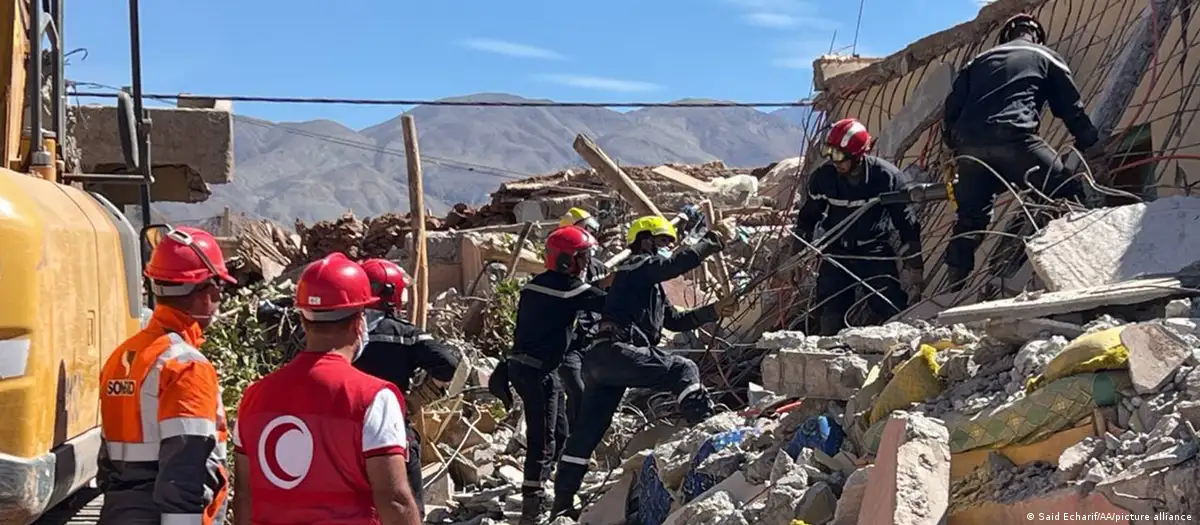
Four days on, rescue teams are still searching for survivors in the rubble, while health workers scramble to treat the thousands of people with injuries.
“This emergency response, as with many earthquakes, is a marathon,” Holt said. “The people affected by the earthquake will need support for the weeks and months to come, and we will need to continue to show that solidarity and support not only now but in the future.”
Rescue teams race against time
Rescue teams from Spain, Britain, Qatar and the United Arab Emirates have arrived in Morocco to assist local teams. Many other nations have also offered help.
“The big difficulty is in zones remote and difficult to access, like here, but the injured are choppered out,” Annika Coll, who heads the Spanish team, told AFP news agency from the quake-hit community of Talat Nyacoub.
Spain sent additional help of five canine rescue teams comprising “31 specialists, 15 search and rescue dogs and 11 vehicles,” which was expected to arrive on Tuesday.
Schools have suspended classes in the Al-Haouz province, which has some of the worst-affected villages.
A makeshift hospital has been prepared under canvas in Amizmiz, a large village at the foot of the mountains,
after the local hospital was declared unsafe due to possible aftershocks.
Locals say efforts not enough
Despite rescue and search efforts, some citizens say they feel abandoned by authorities, with little aid reaching some remote areas.
Mohammed Bouaziz, from the village of Moulay Brahim south of Marrakech, one of the hardest-hit areas, told AFP news agency, “We have received some help… but it’s not enough.” He is part of a local group attempting to address the needs of over 600 homeless residents.
The group, known as Intikala, has established nine makeshift camps and has tried to salvage items such as mattresses, blankets, and cooking utensils from remains of homes.
A number of unofficial groups have sprung up to help with the rescue effort and to provide survivors with basic necessities. Citizens have also been lining up at health care facilities to donate blood.
The quake was Morocco’s deadliest since a 1960 earthquake on its Atlantic coast that killed more than 12,000 people.
tg/nm (AFP, AP, Reuters)