

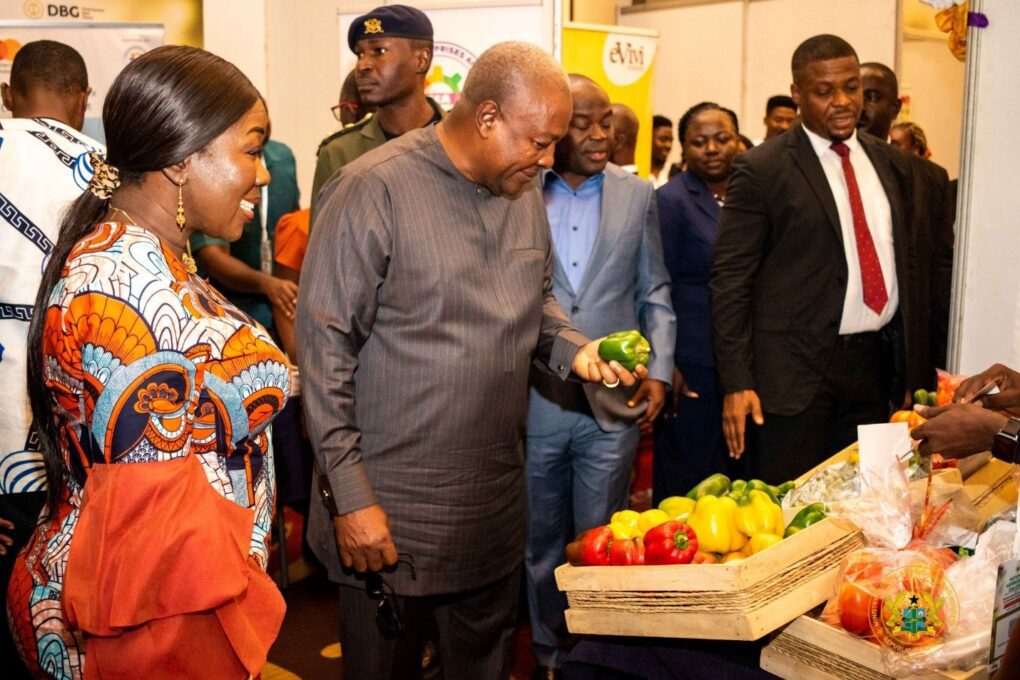
President John Dramani Mahama has declared that import taxes on agricultural processing equipment will be eliminated in an effort to reduce expenses and spur investment in domestic agri-processing.
According to Mahama, who was speaking at the first National Agribusiness Dialogue in Accra, the action is intended to increase private sector involvement, increase access to contemporary technologies, and increase the efficiency of the agribusiness value chain.
“In the short term, import duties on agri-processing machinery will be waived to reduce costs and incentivise local processing; this will enhance efficiency, improve technology uptake, and stimulate private sector investment,” President Mahama stated.
Through targeted assistance to Ghana’s indigenous manufacturing sector, he continued, the medium- to long-term strategy will concentrate on enhancing domestic capacity for the manufacture and delivery of agri-processing equipment.
With over a third of the workforce employed and an approximate GDP contribution of 20%, agriculture is a vital industry in the community.
However, post-harvest losses and growth are still hampered by inadequate infrastructure and limited processing capacity.
The President stated that measures are being made to shift the economy away from a basis of raw commodities and toward one that is fueled by value addition and exports, in accordance with the government’s goal for industrial transformation.
President Mahama declared, “Our commitment to agribusiness is evident in the recent realignment of the Ministry of Trade and Industry into the Ministry of Trade, Agribusiness, and Industry; this was not a cosmetic change. It was a deliberate policy shift intended to place agribusiness at the heart of our industrial strategy.”
A strategic reorientation centered on value chain integration, he added, is reflected in the inclusion of agribusiness, which he feels has the potential to drastically alter the nation’s economic course.
According to President Mahama, Ghana needs to strategically position itself to claim a competitive share by utilizing its agricultural potential, since the global agribusiness industry is expected to rise between US$4.4 trillion and US$5.8 trillion by 2033.
He emphasized the necessity of filling up the gaps in the agricultural value chain, especially by enhancing the availability of raw materials and consciously creating local, sustainable production systems.
“This is indispensable to achieving full-scale implementation of our 24-hour economy initiative,” the President said. “Our agribusiness strategy must be integrated with industrial policy, logistics, and export development if we are to fully realise our national potential.”
President Mahama also revealed that the creation of a national framework for agribusiness policy is being led by the Ministry of Trade, Agribusiness, and Industry.
“This comprehensive framework will guide policy, investment, and implementation across the agribusiness ecosystem,” he stated. “It will focus not just on value addition but also on high-quality raw material production, processing standards, competitiveness, and supply chain resilience.”
According to him, the goal of the strategy is to provide sustainable and respectable jobs locally while putting Ghanaian agribusinesses in a position to compete internationally.
The Ministry of Trade, Agri-Business, and Industry organized the National Agribusiness Dialogue, which has as its theme “Resetting Agribusiness for Inclusive and Sustainable Industrial Growth.”
The forum aims to co-create a policy framework that addresses the actual requirements, challenges, and possibilities within the agribusiness ecosystem and to start a national dialogue, according to Sector Minister Elizabeth Ofosu-Adjare.
“We are here today because we recognise that Ghana’s agribusiness sector must move beyond its traditional confines; we must embrace innovation, invest in value addition, scale up agritech solutions, strengthen market systems, and expand access to finance,” she said.
A solid and well-thought-out policy framework, she continued, would be the cornerstone of this change, providing stability, clarity, and guidance for partnerships, investments, and long-term planning.
Speaking at the event as well, Mr. Daniel Faahene Acquaye, the CEO of Agri-Impact Group, advocated for the creation of an “Agri-Fund” in order to spur additional investment in the agribusiness industry.
He declared, “This fund will be a game-changer, derisking investments, unlocking capital, and empowering industry actors to scale with resilience and confidence and turn our staggering post-harvest losses of US$2 billion into agribusiness gains.”
Source: newsthemegh.com