
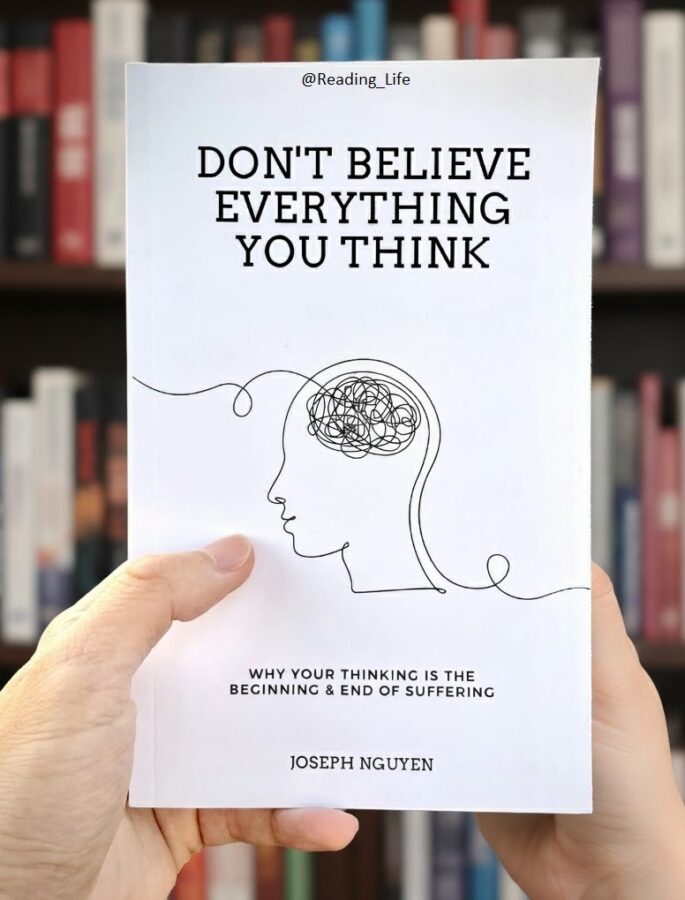
Reading Life | By Joseph Nguyen
Peace does not come from controlling life, it comes from understanding the mind that is trying to control it. That was the quiet, almost unsettling whisper this book left in my heart.
As I listened to Joseph Nguyen narrate his words, it did not feel like someone teaching me something new, it felt like someone gently removing layers I did not even know I was carrying. The voice was calm, almost too calm for the storm it was addressing. And somehow, in that calmness, I began to see something I had missed for so long, that maybe the problem was never life itself, but the way I kept thinking about it, over and over again, until it became heavier than it truly was.
1. Thinking is not the problem, believing every thought is: There is a subtle but life changing difference between having thoughts and believing them. The author makes it clear that thoughts arise naturally, like clouds passing through the sky, but suffering begins the moment we hold onto them as truth. As I listened, I could almost feel the weight of past worries, regrets, and fears, all built from thoughts I never questioned. He gently reminds us that not every thought deserves a seat at the table of our attention. And that realization alone feels like someone opening a window in a suffocating room.
2. Suffering is created, not given: One of the most piercing truths in the book is that suffering does not come directly from events, it comes from the story we attach to them. Two people can face the same situation, yet experience completely different emotional realities. Why, because of thought. The narration carries this truth so softly, yet it lands so deeply. It made me reflect on how many times I have blamed life, blamed people, blamed circumstances, when in reality, my mind was quietly scripting pain behind the scenes.
3. The mind seeks problems to justify its existence: This part felt almost uncomfortable to accept. The idea that the mind is constantly searching for problems, even when none exist, simply to stay active. It explains why peace can sometimes feel unfamiliar, even suspicious. The author’s voice, calm and almost knowing, reveals that the mind does not necessarily want you to be at peace, it wants to be engaged. And suddenly, so many restless moments began to make sense. The overthinking, the unnecessary worry, the constant mental noise, all of it part of a pattern I had unknowingly fed.
4. You are not your thoughts, you are the awareness behind them: This lesson felt like stepping outside of myself and watching my mind from a distance. If thoughts can be observed, then they cannot be who we are. That simple shift creates space, breathing space. The narration carries a kind of stillness here, as if inviting you to pause and actually experience that separation. And in that pause, there is relief. Because if I am not my thoughts, then I am not bound by every fearful or negative idea that passes through my mind.
5. Letting go is not an action, it is the absence of holding on: So many times, we struggle to let go, trying harder and harder, only to feel more stuck. But the author reframes it in such a gentle way. Letting go is not something you do, it is something that naturally happens when you stop holding onto thoughts. As I listened, it felt like being given permission to stop fighting. To stop forcing peace. To simply allow thoughts to pass without gripping them so tightly. And in that allowance, there is a quiet freedom that cannot be forced.
6. Clarity comes in the absence of overthinking: We often believe that thinking more will bring answers, but the book turns that belief upside down. True clarity does not come from excessive thinking, it comes when the mind is quiet. The author’s narration almost embodies this truth, slow, steady, unhurried. It made me realize how many decisions I have complicated by overanalyzing, when the answer was already there, buried under layers of unnecessary thought. Sometimes, the wisest thing we can do is to step back and allow clarity to find us.
7. Peace is always available, but thought blocks it: This final lesson felt like coming home. Peace is not something we need to chase or create, it is already there, beneath the noise of thinking. The tragedy is not that peace is absent, but that we are too consumed by thought to notice it. As the author’s voice gently carries this truth, it feels less like a concept and more like an invitation. An invitation to experience life without the constant interference of the mind. And in that space, even if only for a moment, there is a deep, undeniable sense of calm.
Book/Audiobook: https://amzn.to/4lQg5qp
You can access the audiobook when you register on the Audible platform using the l!nk above.
Peace does not come from controlling life, it comes from understanding the mind that is trying to control it. That was the quiet, almost unsettling whisper this book left in my heart. As I listened to Joseph Nguyen narrate his words, it did not feel like someone teaching me something new, it felt like someone gently removing layers I did not even know I was carrying. The voice was calm, almost too calm for the storm it was addressing. And somehow, in that calmness, I began to see something I had missed for so long, that maybe the problem was never life itself, but the way I kept thinking about it, over and over again, until it became heavier than it truly was.
1. Thinking is not the problem, believing every thought is: There is a subtle but life changing difference between having thoughts and believing them. The author makes it clear that thoughts arise naturally, like clouds passing through the sky, but suffering begins the moment we hold onto them as truth. As I listened, I could almost feel the weight of past worries, regrets, and fears, all built from thoughts I never questioned. He gently reminds us that not every thought deserves a seat at the table of our attention. And that realization alone feels like someone opening a window in a suffocating room.
2. Suffering is created, not given: One of the most piercing truths in the book is that suffering does not come directly from events, it comes from the story we attach to them. Two people can face the same situation, yet experience completely different emotional realities. Why, because of thought. The narration carries this truth so softly, yet it lands so deeply. It made me reflect on how many times I have blamed life, blamed people, blamed circumstances, when in reality, my mind was quietly scripting pain behind the scenes.
3. The mind seeks problems to justify its existence: This part felt almost uncomfortable to accept. The idea that the mind is constantly searching for problems, even when none exist, simply to stay active. It explains why peace can sometimes feel unfamiliar, even suspicious. The author’s voice, calm and almost knowing, reveals that the mind does not necessarily want you to be at peace, it wants to be engaged. And suddenly, so many restless moments began to make sense. The overthinking, the unnecessary worry, the constant mental noise, all of it part of a pattern I had unknowingly fed.
4. You are not your thoughts, you are the awareness behind them: This lesson felt like stepping outside of myself and watching my mind from a distance. If thoughts can be observed, then they cannot be who we are. That simple shift creates space, breathing space. The narration carries a kind of stillness here, as if inviting you to pause and actually experience that separation. And in that pause, there is relief. Because if I am not my thoughts, then I am not bound by every fearful or negative idea that passes through my mind.
5. Letting go is not an action, it is the absence of holding on: So many times, we struggle to let go, trying harder and harder, only to feel more stuck. But the author reframes it in such a gentle way. Letting go is not something you do, it is something that naturally happens when you stop holding onto thoughts. As I listened, it felt like being given permission to stop fighting. To stop forcing peace. To simply allow thoughts to pass without gripping them so tightly. And in that allowance, there is a quiet freedom that cannot be forced.
6. Clarity comes in the absence of overthinking: We often believe that thinking more will bring answers, but the book turns that belief upside down. True clarity does not come from excessive thinking, it comes when the mind is quiet. The author’s narration almost embodies this truth, slow, steady, unhurried. It made me realize how many decisions I have complicated by overanalyzing, when the answer was already there, buried under layers of unnecessary thought. Sometimes, the wisest thing we can do is to step back and allow clarity to find us.
7. Peace is always available, but thought blocks it: This final lesson felt like coming home. Peace is not something we need to chase or create, it is already there, beneath the noise of thinking. The tragedy is not that peace is absent, but that we are too consumed by thought to notice it. As the author’s voice gently carries this truth, it feels less like a concept and more like an invitation. An invitation to experience life without the constant interference of the mind. And in that space, even if only for a moment, there is a deep, undeniable sense of calm.
Source: newsthemegh.com