
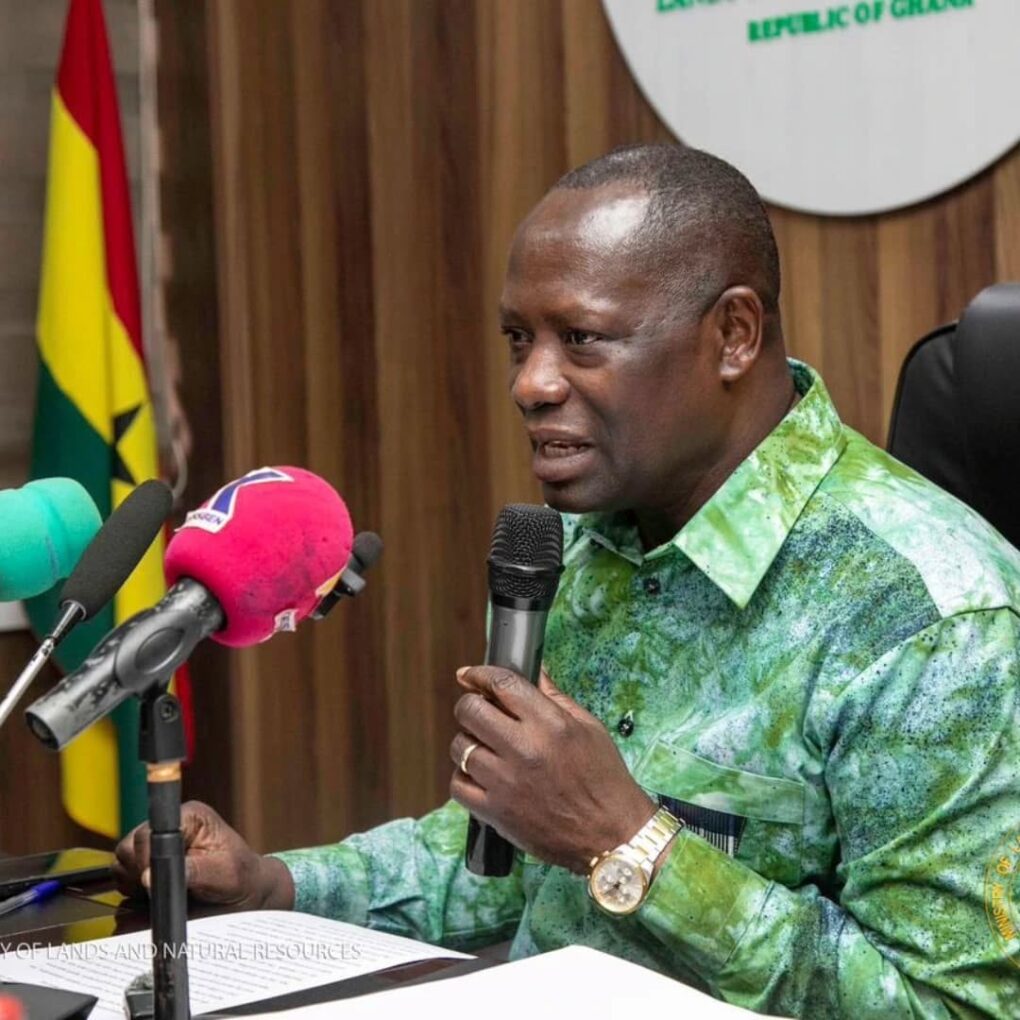
The government has announced plans to end the exportation of raw minerals by 2028 as part of an ambitious industrialisation strategy aimed at expanding local mineral processing, creating jobs and maximising economic benefits from Ghana’s natural resources.
The Minister of Lands and Natural Resources, Emmanuel Armah-Kofi Buah, said the government was targeting the domestic refining of at least 70 per cent of artisanal and small-scale gold production by December 2027, with the proportion expected to reach 100 per cent by December 2028.
For manganese and bauxite, the government intends to process at least 50 per cent of production locally by 2028 before increasing domestic processing to 100 per cent by 2030.
Mr Buah said Ghana could no longer depend on exporting unprocessed mineral resources when the country had the potential to develop its own refining, smelting and manufacturing industries.
He stressed that the government was committed to establishing local refineries, smelters and steel plants to transform the mining industry and retain a greater share of mineral revenues within the economy.
The minister made the announcement during an Industrialisation Day celebration organised by the Trades Union Congress (TUC) in Accra last Tuesday.
According to him, the policy would be supported by significant investments in local mineral processing facilities, infrastructure development and increased participation by Ghanaian businesses.
Government Announces $1.5 Billion Mineral Processing Investment
Mr Buah disclosed that the government had committed financial resources to the mineral value addition agenda under the critical minerals pillar of the New Economy Programme.
The initiative includes a planned investment of $1.5 billion in domestic processing capacity for gold, manganese, bauxite and lithium.
The investment is expected to strengthen Ghana’s industrial capacity, reduce dependence on raw mineral exports and create employment opportunities across the mining and manufacturing sectors.
The government also plans to establish a 24-hour critical mineral processing enclave in the Western Region to support continuous industrial operations.
Additionally, railway infrastructure development will form part of the strategy to improve mineral transportation and connect mining areas to processing facilities and other industrial centres.
Ghana Expands Local Gold Refining Capacity
The Lands and Natural Resources Minister revealed that the Ghana Gold Board had already signed gold refining agreements with the Gold Coast Refinery and the Royal Ghana Gold Refinery.
Both facilities have the capacity to refine up to one tonne of gold each per week, providing additional opportunities for domestic gold processing and value addition.
The arrangements form part of efforts to increase local refining capacity and ensure that more economic value is generated before gold is exported.
Meanwhile, the Ghana Integrated Aluminium Development Corporation (GIADEC) is pursuing plans to establish an integrated aluminium industry to support the local processing of bauxite into higher-value products.
The Ghana Integrated Iron and Steel Development Corporation (GIISDEC) is also leading efforts to identify and develop iron ore deposits in the Oti Region and other parts of the country to support the establishment of a domestic iron and steel industry.
Government Targets Local Lithium Processing
On lithium development, Mr Buah said the government’s Green Minerals Policy required companies to explore opportunities for processing minerals and their by-products locally.
The policy is intended to ensure that Ghana benefits from additional economic activities associated with critical mineral production rather than relying mainly on the export of raw materials.
Domestic lithium processing is expected to create opportunities for industrial development, technology transfer and increased investment in the country’s emerging critical minerals sector.
Ghanaian Businesses to Benefit From Mining Industry Reforms
The minister further highlighted the government’s commitment to strengthening local content in the mining industry by expanding opportunities for indigenous businesses.
He said Ghanaian companies must be positioned to participate meaningfully in mining procurement, equipment supply and other activities along the mineral value chain.
According to him, the success of the local content policy would depend on the ability of indigenous enterprises to compete for complex and high-value contracts.
He also emphasised the importance of equipping Ghanaian workers with technical and professional skills that could be transferred across different sectors of the economy.
As part of the broader reforms, the government is pursuing a new mining policy and a proposed Mining Act currently before Parliament.
The reforms are intended to strengthen local participation, improve the management of mineral resources and ensure that mining activities deliver sustainable economic benefits to Ghanaians.
TUC Calls for Industrial Transformation Through Local Mineral Processing
The Secretary-General of the Trades Union Congress, Joshua Ansah, has also called for a shift away from Africa’s longstanding dependence on exporting unprocessed natural resources.
Mr Ansah argued that exporting raw minerals deprives African countries of significant opportunities to create jobs, develop technology and establish competitive manufacturing industries.
He said African governments must prioritise domestic mineral processing, industrial manufacturing, technology transfer and technical skills development to maximise the benefits of their natural resources.
According to him, workers and organised labour must also be recognised as important partners in designing and implementing industrialisation policies.
Minister Calls for Transparency in Mining Agreements
Mr Buah also stressed the need for greater transparency in mineral agreements, export pricing and beneficial ownership arrangements within the mining industry.
He warned that illicit financial flows, tax avoidance and unclear ownership structures could undermine government revenue mobilisation and reduce the resources available for national development.
The government believes that stronger regulatory oversight, improved accountability and increased local participation will be essential to ensuring that Ghana derives greater benefits from its gold, manganese, bauxite, lithium and other mineral resources.
The proposed shift towards domestic mineral processing represents a major component of Ghana’s industrialisation ambitions, with the government seeking to move the country beyond raw material exports towards refining, manufacturing and higher-value production.
Source: newsthemegh.com