
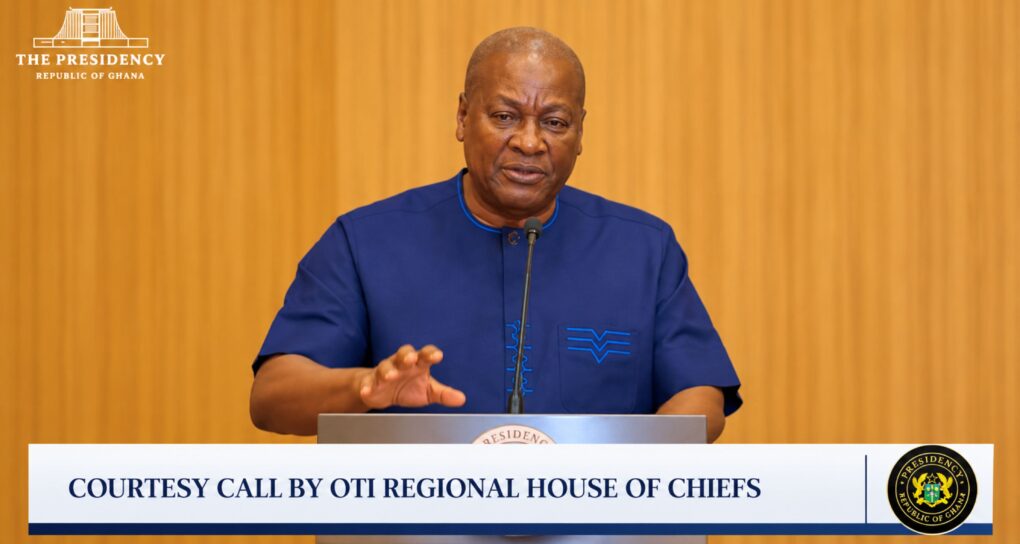
President John Dramani Mahama has defended the constitutional restriction barring traditional rulers from engaging in active partisan politics, saying the provision is necessary to protect the dignity, neutrality and authority of Ghana’s chieftaincy institution.
The President said chiefs must remain above partisan political competition while continuing to contribute to local governance, community development and national progress.
Speaking during a courtesy visit by the Oti Regional House of Chiefs on Friday, November 20, 2026, President Mahama explained that the constitutional restriction was introduced for good reasons and had been upheld by the Supreme Court of Ghana.
“The 1992 Constitution, for very good reason, decided that chiefs should not take part in partisan politics, and it was affirmed by the Supreme Court in its interpretation of what partisan politics is,” he said.
Mahama Explains Why Chiefs Should Stay Out of Partisan Politics
President Mahama questioned whether it would be appropriate for traditional rulers, particularly paramount chiefs, to compete in district assembly elections against ordinary members of their communities.
He argued that such political contests could undermine the authority and respect traditionally associated with the chieftaincy institution.
“I believe that to maintain the respect of the institution, I believe that that particular clause is appropriate because can you imagine, let’s say we’re doing district assembly elections and the whole paramount chief is standing against some small student or some butcher or some teacher or something. It doesn’t all go very well,” the President stated.
He stressed that maintaining the political neutrality of chiefs would help preserve their traditional authority and enable them to serve as unifying figures within their communities.
Chiefs to Maintain Representation in District Assemblies
Despite defending the constitutional restriction on active party politics, President Mahama said chiefs should continue to participate in local governance through constitutionally recognised representation on district assemblies.
He explained that government had retained provisions allowing traditional authorities and other relevant groups to occupy appointed positions within the assemblies.
According to the President, the appointment process would promote inclusivity by ensuring representation for chiefs, women, young people and persons with disabilities.
He encouraged traditional rulers to nominate representatives who would actively participate in district assembly deliberations and communicate decisions to their respective traditional authorities.
Mahama Urges Chiefs to Monitor District Assembly Development Projects
President Mahama also called on chiefs to strengthen collaboration with district chief executives and monitor how local authorities utilise public funds for development projects.
He said traditional rulers possess extensive knowledge of the needs and challenges facing their communities and could help district assemblies prioritise projects that would improve living conditions.
The President urged chiefs to take an active interest in local development planning, infrastructure projects, public spending and community welfare initiatives.
What Ghana’s Constitution Says About Chiefs and Politics
Article 276(1) of Ghana’s 1992 Constitution prohibits chiefs from participating in active party politics. It also provides that a chief seeking election to Parliament must abdicate the stool or skin before contesting the election.
A 2022 Supreme Court interpretation clarified the distinction between permissible political engagement and prohibited partisan political activity.
Under the interpretation, chiefs are permitted to comment on government policies, programmes and national issues. However, openly endorsing political parties or candidates constitutes active partisan politics.
President Mahama maintained that protecting the political neutrality of traditional rulers would safeguard the chieftaincy institution while allowing chiefs to contribute to governance, community development and the country’s democratic process.
Source: newsthemegh.com