
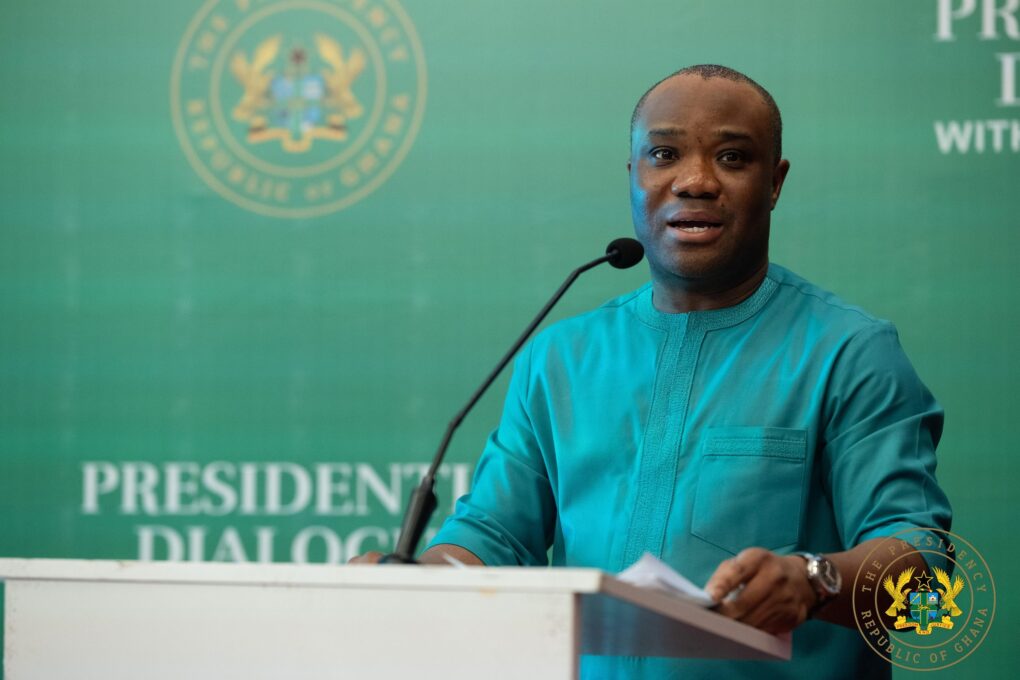
The government has announced plans to transform the Ghana Broadcasting Corporation (GBC) into a modern, technologically advanced media organisation within the next 24 months, with plans to leverage the corporation’s lands and other assets to attract private-sector investment.
Minister for Government Communications, Felix Kwakye-Ofosu, announced the initiative on Thursday at the GBC 2026 Stakeholder Conference in Accra, where the state broadcaster unveiled its five-year strategic plan.
The conference, held at the Coconut Grove Regency Hotel, brought together media stakeholders to discuss the future of public broadcasting, digital transformation and the financial sustainability of Ghana’s national broadcaster.
Mr Kwakye-Ofosu explained that the government could not finance the entire modernisation programme through the national budget because of prevailing economic constraints.
He disclosed that GBC had not received significant capital investment from the state for approximately 25 years, with its last major support involving studio facilities and outside-broadcasting vans.
GBC to Use Land and Assets to Attract Private Investors
Under the proposed transformation programme, GBC will leverage some of its valuable land holdings across the country to attract private investors and generate funding for its modernisation agenda.
The minister stressed that proceeds from the investment arrangements would go directly to GBC rather than the central government.
The funds are expected to finance the construction and upgrading of modern broadcasting studios, the acquisition of advanced production equipment and improvements to the corporation’s television, radio and digital broadcasting services.
The initiative forms part of a broader government strategy to restructure and improve the performance of state-owned media organisations.
According to Mr Kwakye-Ofosu, the GBC transformation programme is the first major project under the wider reform agenda, developed in collaboration with the GBC Board, the National Media Commission and the State Interests and Governance Authority (SIGA).
Government Clears GH¢30 Million GBC Electricity Debt
The Minister for Government Communications also revealed that the government had settled approximately GH¢30 million in outstanding electricity bills owed by the Ghana Broadcasting Corporation.
The debt settlement followed engagements involving the Electricity Company of Ghana (ECG), the Minister for Energy and the Chief of Staff.
However, Mr Kwakye-Ofosu emphasised that GBC management must ensure the corporation pays its subsequent electricity bills promptly to prevent the accumulation of fresh debts.
The intervention is expected to improve GBC’s financial position and support its efforts to deliver uninterrupted public broadcasting services.
GBC’s Public Broadcasting Role and Nationwide Coverage
The Ghana Broadcasting Corporation remains one of the country’s major public media institutions, with a broadcasting network covering 27 Ghanaian languages through 17 stations.
Its responsibilities include providing public-interest information, educational programmes, national development coverage and broadcasts of important government and local governance activities.
Among its public-service commitments is the live coverage of Metropolitan, Municipal and District Assembly (MMDA) meetings to improve transparency, public participation and accountability in local governance.
The corporation is currently led by Director-General Professor Amin Alhassan.
The government’s latest modernisation announcement follows President John Dramani Mahama’s visit to GBC headquarters in January, during which discussions focused on institutional reforms, debt relief and digital transformation.
GBC-Led Consortium Wins 2026 FIFA World Cup Broadcast Rights
Mr Kwakye-Ofosu also praised GBC for leading a consortium of 60 broadcasting stations that successfully secured the rights to broadcast the 2026 FIFA World Cup.
He described the collaborative arrangement as an important model for future negotiations involving major international sporting competitions and broadcasting rights.
The minister disclosed that Cabinet had directed that GBC-led broadcasting partnerships should handle future bids for major sporting events and other international competitions.
The government has also approved the provision of equipment to support GBC’s broadcasting modernisation programme.
The development is expected to strengthen collaboration among Ghanaian media organisations while improving access to major international sporting events for viewers across the country.
National Media Commission Calls for Responsible Public Broadcasting
Executive Secretary of the National Media Commission (NMC), George Sarpong, challenged broadcasters in Ghana to demonstrate that their programmes serve the public interest.
He referred to broadcasting regulations in the United States, where television and radio stations are expected to demonstrate how their programming addresses community needs when their broadcasting licences come up for renewal.
Mr Sarpong questioned how many Ghanaian broadcasting stations would retain their licences if similar public-interest requirements were strictly applied in the country.
He nevertheless commended GBC for maintaining its commitment to public-service broadcasting and recognised the contributions of past and present board members, management and employees in sustaining the institution.
The National Media Commission has previously raised concerns about inappropriate television content and called on broadcasters to maintain acceptable standards of programming.
GBC Five-Year Strategic Plan to Drive Media Transformation
The GBC 2026 Stakeholder Conference provided a platform for media professionals, government representatives and other industry stakeholders to discuss the corporation’s future direction.
The newly launched five-year strategic plan is expected to guide GBC’s institutional reforms, infrastructure investment, digital broadcasting expansion and financial sustainability.
With the government targeting a 24-month transformation period, the proposed use of GBC’s land assets, private-sector partnerships and investment in modern broadcasting technology will be central to the corporation’s efforts to compete in Ghana’s evolving media industry.
The initiative also seeks to strengthen public broadcasting, improve television and radio production quality and expand access to reliable news and information across the country.
Source: newsthemegh.com