
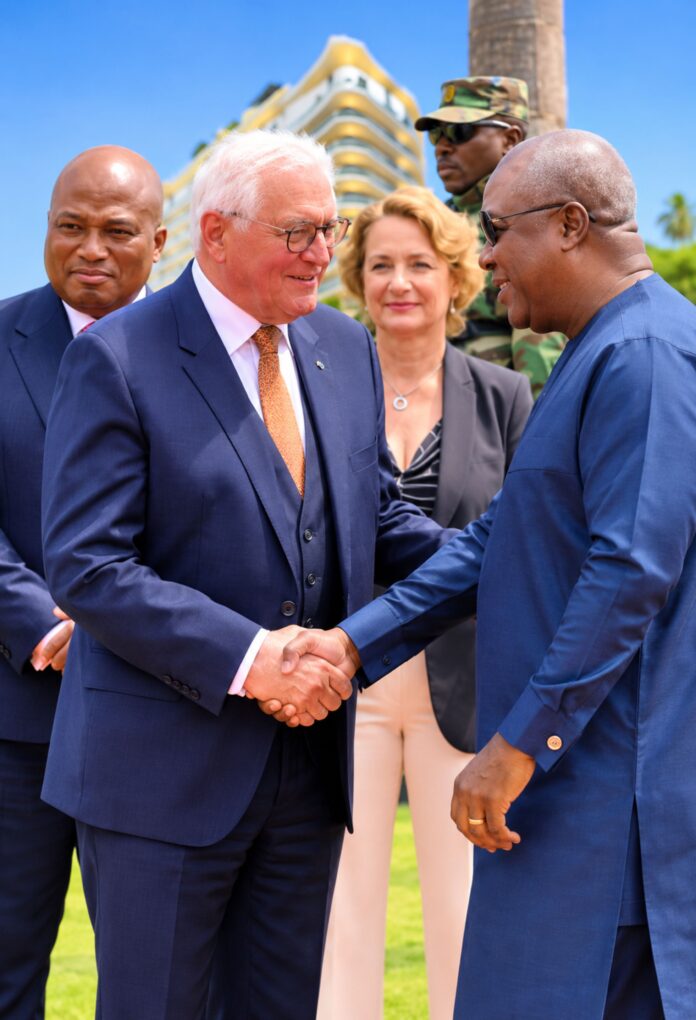
President John Dramani Mahama has called on German companies to increase their investments in Ghana’s agriculture, manufacturing, energy, technology and other strategic sectors, describing the government’s US$10 billion New Economy Programme as a major opportunity for international business partnerships.
The initiative, scheduled to run from 2027 to 2030, forms part of the government’s broader strategy to accelerate industrialisation, expand domestic production, attract foreign direct investment and create employment opportunities for Ghanaians.
Speaking at the 6th German-African Business Summit in Accra, President Mahama said Ghana was prepared to leverage German technology, technical expertise and financial resources to strengthen its industrial capacity and position itself as a competitive manufacturing and investment destination in Africa.
He disclosed that the government intends to commit US$10 billion over four years, from 2027 to 2030, towards implementing the New Economy Programme.
President Mahama identified agriculture, agro-processing, manufacturing, energy, infrastructure, pharmaceuticals, tourism, creative industries, digital innovation and mineral beneficiation as priority sectors offering significant investment opportunities for German businesses.
The President also called for a transformation of Ghana’s trade relationship with Germany, stressing the need to move away from exporting predominantly raw materials and unprocessed agricultural products towards producing and exporting higher-value manufactured goods.
He revealed that Ghana’s exports to the European Union increased by 23.2 per cent in 2025, generating a trade surplus of €418 million in favour of the country.
However, he noted that Ghana’s current trade structure, which involves exporting raw materials and agricultural commodities while importing German machinery, chemicals and manufactured products, presents considerable opportunities for stronger industrial collaboration.
According to him, Ghana wants to increase local processing and manufacturing to ensure that more economic value is retained within the country before products enter international markets.
President Mahama further encouraged German investors to consider Ghana as a strategic gateway to the African Continental Free Trade Area (AfCFTA), which provides access to a continental market of approximately 1.4 billion people, with a combined gross domestic product estimated at more than US$3.5 trillion.
He explained that German companies could establish manufacturing facilities in Ghana and use the country as a production and distribution hub to access markets across Africa under the AfCFTA framework.
The President urged German businesses to view Africa as an interconnected network of investment, manufacturing and supply chain opportunities rather than treating individual countries as separate markets.
Highlighting Ghana’s improving economic performance, President Mahama cited the country’s 6 per cent economic growth in 2025, alongside a significant reduction in inflation from 23.8 per cent in December 2024 to 5.2 per cent in September 2026.
He also disclosed that Ghana’s international reserves stood at approximately US$12.94 billion as of June 2026, describing the economic developments as evidence of efforts to restore macroeconomic stability and strengthen investor confidence.
President Mahama maintained that Ghana was becoming an increasingly attractive destination for foreign investment, assuring international businesses that the country remained committed to creating a stable and supportive business environment.
Acknowledging concerns about infrastructure deficits, high borrowing costs, regulatory bottlenecks and energy reliability, he pledged additional government reforms to improve the ease of doing business.
He said the government would focus on strengthening public institutions, improving administrative efficiency and promoting transparency, accountability and predictability in business operations.
The President also called for increased collaboration with German financial institutions, development finance organisations and commercial banks to create sustainable financing arrangements for commercially viable projects in Ghana.
Citing the North Shore Apparel Factory in Savelugu in the Northern Region as an example of successful Ghana-Germany business cooperation, President Mahama explained that financial support from Germany’s KfW, together with assistance from Ghana Exim Bank, contributed to the establishment of the factory.
The facility currently employs more than 2,000 people, with women accounting for approximately 80 per cent of its workforce, demonstrating the potential of international investment partnerships to generate jobs and promote industrial development.
President Mahama concluded by urging participants at the German-African Business Summit to translate discussions and investment proposals into tangible business partnerships, factory establishments and long-term financial commitments.
He stressed that the success of the summit should be measured by the investments secured, businesses established and employment opportunities created in Ghana and across Africa.
The government’s US$10 billion New Economy Programme is expected to play a central role in Ghana’s industrial transformation agenda, with increased German investment potentially supporting local manufacturing, technology transfer, export growth and sustainable job creation.
Source: newsthemegh.com