
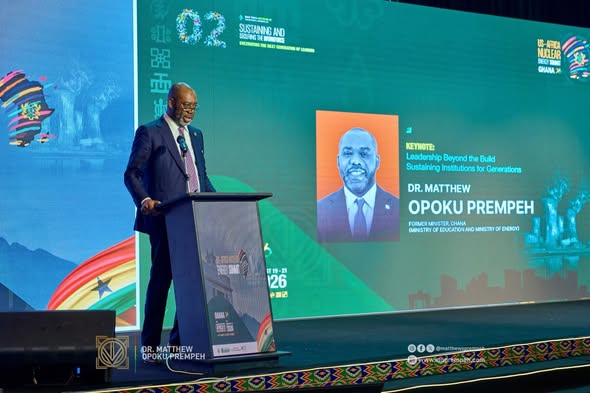
Former Ghanaian Education and Energy Minister Dr Matthew Opoku Prempeh has urged African countries to look beyond the construction of nuclear reactors and focus on developing the skilled workforce and strong institutions needed to sustain nuclear energy programmes for generations.
Dr Opoku Prempeh, popularly known as NAPO, made the call while delivering the keynote address at the 2026 US-Africa Nuclear Energy Summit in Accra.
The high-level Pan-African summit, organised by the United States, brought together nuclear energy experts and representatives from international institutions, including the Atlantic Council, to discuss the future of nuclear power in Africa.
The summit was held under the theme “Building and Sustaining Africa’s Nuclear Workforce”, with discussions focused on developing the human capital needed to support Africa’s long-term energy independence.

NAPO: Nuclear energy development begins in the classroom
In his keynote address, titled “Cultivating the Next Generation of Leaders; Leadership Beyond the Build – Sustaining Institutions for Generations,” Dr Prempeh stressed that building nuclear facilities is only the beginning of a successful nuclear energy programme.
“Nuclear begins in the classroom,” he said, emphasising the importance of preparing young people early for careers in the highly specialised nuclear energy industry.
Drawing on his experience in both Ghana’s education and energy sectors, the former minister said a successful nuclear programme depends heavily on a country’s education system, talent development and human capital.
He argued that African countries must establish strong educational and professional pathways capable of producing scientists, engineers, regulators, managers and future leaders for the nuclear sector.
Africa’s nuclear ambitions require skilled workers
Dr Prempeh acknowledged that interest in nuclear power in Africa is growing, driven by the continent’s demand for reliable low-carbon electricity and its significant uranium resources.
However, he cautioned that nuclear ambitions could fail without sufficient investment in human capital.
According to him, the transition to nuclear energy represents more than a technological change. It is also a major socio-economic transformation requiring a skilled, locally developed and sustainable workforce.
He identified the shortage of qualified personnel as one of the biggest risks facing the global nuclear industry.

Workforce shortage a major nuclear industry risk
Dr Prempeh warned that even technologically advanced nuclear projects could struggle if countries fail to develop strategies to attract, train and retain skilled professionals.
He called for a shift away from short-term recruitment towards long-term workforce planning, talent development and employee retention.
Rather than simply training workers to operate nuclear facilities, he said countries should prepare professionals capable of becoming future leaders in the sector.
The former Energy Minister said African countries should establish clear career progression opportunities to encourage talented young people to pursue long-term careers in nuclear science and technology.
Nuclear workforce needs digital skills
Dr Prempeh proposed the creation of a broad talent pool that combines traditional nuclear science and engineering with modern digital technologies.
He specifically identified cybersecurity, data analytics and artificial intelligence (AI) as important skills for the next generation of nuclear professionals.
He said the multidisciplinary approach would prepare workers to deal with the increasingly complex demands of modern electricity systems and nuclear facilities.
According to him, the nuclear workforce of the future must be equipped to operate at the intersection of energy, technology, cybersecurity, artificial intelligence and data management.

Nuclear leadership must go beyond technical skills
The former minister also stressed that technical expertise alone would not be enough to sustain Africa’s nuclear energy ambitions.
He said future nuclear leaders must develop strong digital leadership, governance, policy and ethical decision-making skills.
Such leadership, he noted, would help ensure that nuclear institutions operate with transparency, accountability, efficiency and a strong commitment to safety.
Dr Prempeh urged African countries to identify and nurture individuals capable of navigating the complex regulatory, technological and geopolitical environment surrounding nuclear energy.
Stronger international partnerships needed
Dr Prempeh also called for stronger partnerships between African countries and international allies to accelerate the development of nuclear energy programmes.
He advocated progressive technology transfer and comprehensive legislation to establish strong safety and security frameworks for the nuclear sector.
He said cooperation with international partners, including the United States Department of Energy and the Atlantic Council, could help African countries bridge technical and institutional gaps as they develop their nuclear programmes.

Local expertise key to Africa’s nuclear future
In his concluding remarks, Dr Prempeh emphasised the importance of localisation in ensuring the long-term sustainability of nuclear energy development in Africa.
He argued that nuclear power can deliver lasting benefits to the continent only when supported by strong local expertise, institutions and public advocacy.
He encouraged African governments to empower young people to move from being followers to innovators and change-makers in the nuclear energy sector.
According to Dr Prempeh, Africa’s nuclear future should ultimately be built around a skilled African workforce capable of managing, innovating and sustaining nuclear institutions for generations.
Source: newsthemegh.com