
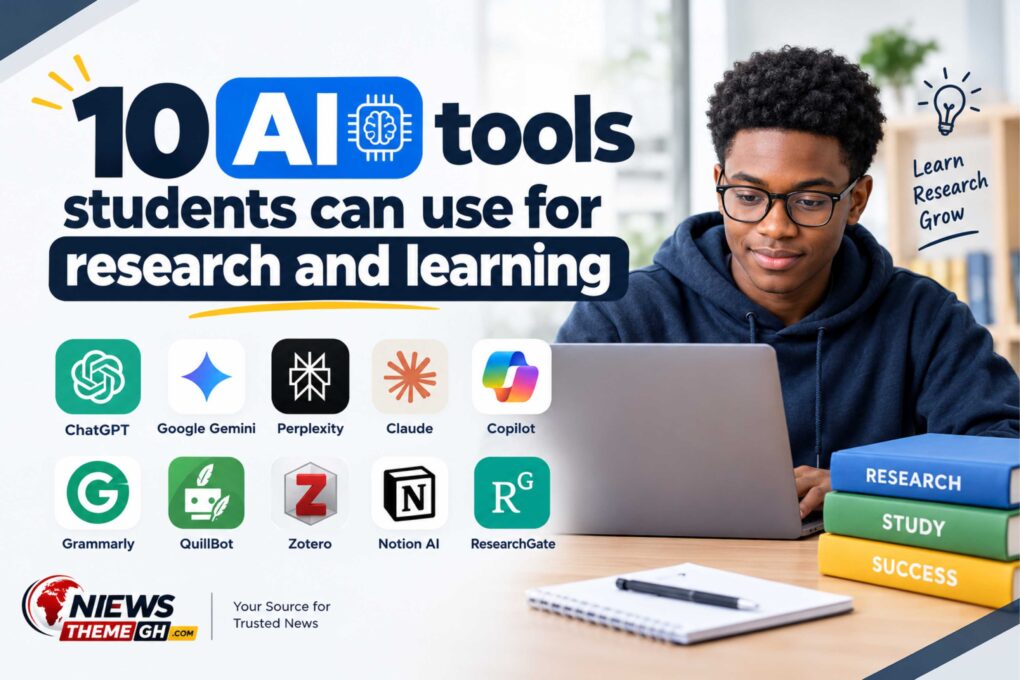
Artificial intelligence (AI) is transforming education by helping students learn faster, conduct academic research, improve their writing and manage schoolwork more efficiently.
From explaining complex subjects to summarising lecture notes and preparing for examinations, AI-powered tools are becoming valuable resources for students worldwide.
For students in Ghana and other countries, the best AI tools for education can provide additional learning support, simplify research tasks and improve academic productivity when used responsibly.
Whether you are a university student, senior high school student or researcher, these 10 AI tools can help you improve your study habits, organise academic materials and make better use of your time.
1. ChatGPT – AI Study Assistant for Students
ChatGPT, developed by OpenAI, is one of the most versatile AI tools for students. It can explain difficult concepts, answer questions, generate practice exercises and help learners understand complicated topics in simpler language.
Students can also use ChatGPT to brainstorm essay ideas, develop study timetables, summarise notes and prepare for examinations.
The tool can provide personalised explanations based on a student’s questions, making it useful for independent learning and revision.
However, students should verify important information and follow their schools’ academic integrity policies when using AI-generated content.
2. Google Gemini – AI Tool for Research and Learning
Google Gemini is an AI assistant that helps students explore academic subjects, generate ideas, summarise information and understand challenging concepts.
It can assist with assignment planning, research questions, essay outlines and revision materials. Students can also use it to explore different perspectives on a topic before conducting further research.
For learners looking for free AI tools for studying, Gemini may be a useful option, although available features and usage limits can vary.
Students should independently verify factual information before including it in assignments or research papers.
3. Microsoft Copilot – AI Productivity Tool for Schoolwork
Microsoft Copilot offers AI-powered assistance for writing, brainstorming, summarising information and organising academic tasks.
It is particularly useful for students who regularly work with Microsoft applications such as Word and PowerPoint. Depending on the version and subscription available, Copilot can help users develop documents, prepare presentation outlines and improve productivity.
Students can use it to structure reports, generate ideas for class presentations and simplify lengthy information.
By combining AI assistance with familiar productivity tools, Copilot can help make academic work more organised and efficient.
4. Perplexity – AI Search Engine for Academic Research
Perplexity is an AI-powered search and research platform that provides answers alongside links to supporting sources.
Students can use it to explore unfamiliar subjects, identify relevant websites and discover materials for further academic reading. Its source-linked responses can be useful when beginning an assignment or investigating a research question.
Unlike relying solely on a conventional search results page, students can use Perplexity to obtain a summarised starting point for further investigation.
However, it is important to open the original sources, assess their credibility and confirm that the information supports the claims being made.
5. Grammarly – AI Writing Assistant for Essays and Assignments
Grammarly is an AI-powered writing assistant that helps students improve grammar, spelling, punctuation, clarity and tone.
It can be useful when proofreading essays, research reports, scholarship applications and other academic documents.
The platform identifies writing errors and suggests improvements that can make sentences clearer and easier to understand. Some features also support rewriting and adjustments to writing style.
For students looking to improve academic writing skills, Grammarly can serve as a practical editing assistant. However, learners should review its suggestions carefully and continue developing their own writing abilities.
6. Google NotebookLM – AI Tool for Notes and Study Materials
Google NotebookLM helps students work with their own documents, notes and other source materials using AI.
Students can upload supported files and ask questions about their contents, making it easier to review lecture notes, analyse research documents and identify important information.
The tool can help organise key ideas, summarise lengthy reading materials and generate study guides from supplied sources.
NotebookLM is particularly useful for students preparing for examinations or working with large collections of academic documents.
As with other AI platforms, students should check important summaries against their original materials to avoid overlooking details or context.
7. Elicit – AI Research Assistant for Academic Papers
Elicit is an AI-powered research assistant designed to help users discover and analyse academic literature.
It can support students conducting university research by helping them find relevant papers, organise research findings and extract information from scientific studies.
The platform can be especially helpful when preparing literature reviews, developing research proposals or exploring evidence related to a particular question.
By streamlining parts of the academic research process, Elicit can reduce the time spent organising large amounts of literature.
Nevertheless, students should read original research papers before citing their findings and ensure that every reference included in an assignment is accurate.
8. Quizlet – AI-Powered Learning and Revision Tool
Quizlet helps students study through digital flashcards, practice questions and interactive learning activities. Its available AI-powered features can assist with creating revision materials from study content.
Students can use the platform to review definitions, memorise key concepts and test their understanding before examinations.
The tool supports active recall, a study technique in which learners retrieve information from memory rather than simply rereading their notes.
For students preparing for tests and final examinations, Quizlet can make revision more structured and engaging.
Its usefulness depends on the accuracy of the study materials and how consistently students practise.
9. Canva – AI Tool for Presentations and School Projects
Canva is a visual design platform with AI-powered features that help students create presentations, posters, infographics and other educational materials.
Students can use its templates and design tools to develop attractive classroom presentations, group projects and visual summaries of research findings.
AI-assisted features can help generate ideas, suggest layouts and speed up parts of the design process.
Canva is particularly useful for learners who want to present information clearly without advanced graphic design skills.
Students should still review their final projects carefully to ensure that the information is accurate, relevant and properly attributed where necessary.
10. Otter.ai – AI Lecture Transcription and Note-Taking Tool
Otter.ai provides AI-powered transcription and note-taking features that can help students organise information from lectures, meetings and study discussions.
Where recording is permitted, students can use the platform to convert spoken content into text that can be reviewed later.
Transcripts can help learners identify important topics, revisit explanations and develop more organised revision notes.
This may be particularly useful when studying complex subjects that require students to review detailed explanations.
Students must obtain the appropriate permission before recording lecturers, classmates or other individuals, and should check transcripts for errors before relying on them.
How to Use AI Tools for Studying Responsibly
Although AI tools can improve learning and productivity, students should use them as educational assistants rather than replacements for independent thinking.
Here are some practical ways to benefit from AI in education:
- Understand difficult subjects: Ask AI tools to explain complicated concepts using simpler language and relevant examples.
- Improve academic research: Use AI-powered research platforms to discover useful sources, then read the original materials.
- Prepare for examinations: Generate practice questions, flashcards and revision plans to reinforce learning.
- Improve writing skills: Use writing assistants to identify grammar mistakes and improve clarity while preserving your own ideas.
- Organise study materials: Summarise lecture notes and structure research documents for easier revision.
- Protect academic integrity: Follow your institution’s rules on AI-generated content, citations and disclosure.
- Verify information: Check statistics, quotations, factual claims and academic references against reliable sources.
- Protect personal information: Avoid uploading confidential academic records or sensitive personal data to AI platforms without understanding their privacy policies.
Can Students in Ghana Use AI Tools for Free?
Many AI platforms offer free access or limited free plans, making them accessible to students who want to improve their learning without immediately paying for a subscription.
However, free access does not always include every feature. Usage limits, advanced research functions and premium productivity tools may require a paid plan.
Students should compare the available features, check current pricing and consider their academic needs before subscribing to any AI service.
Final Thoughts: Best AI Tools for Students in 2026
AI is creating new opportunities for students to improve academic performance, develop research skills and manage their study time more effectively.
Tools such as ChatGPT, Google Gemini, Microsoft Copilot, Perplexity, Grammarly, NotebookLM, Elicit, Quizlet, Canva and Otter.ai offer different forms of support for learning, writing, research and productivity.
The best AI tool depends on the task at hand. Some are better suited to explaining concepts, while others specialise in academic research, writing assistance, revision or presentation design.
When used responsibly, these AI tools can complement traditional learning, help students become more organised and support the development of skills needed for success in education and the modern workplace.
Source: newsthemegh.com