
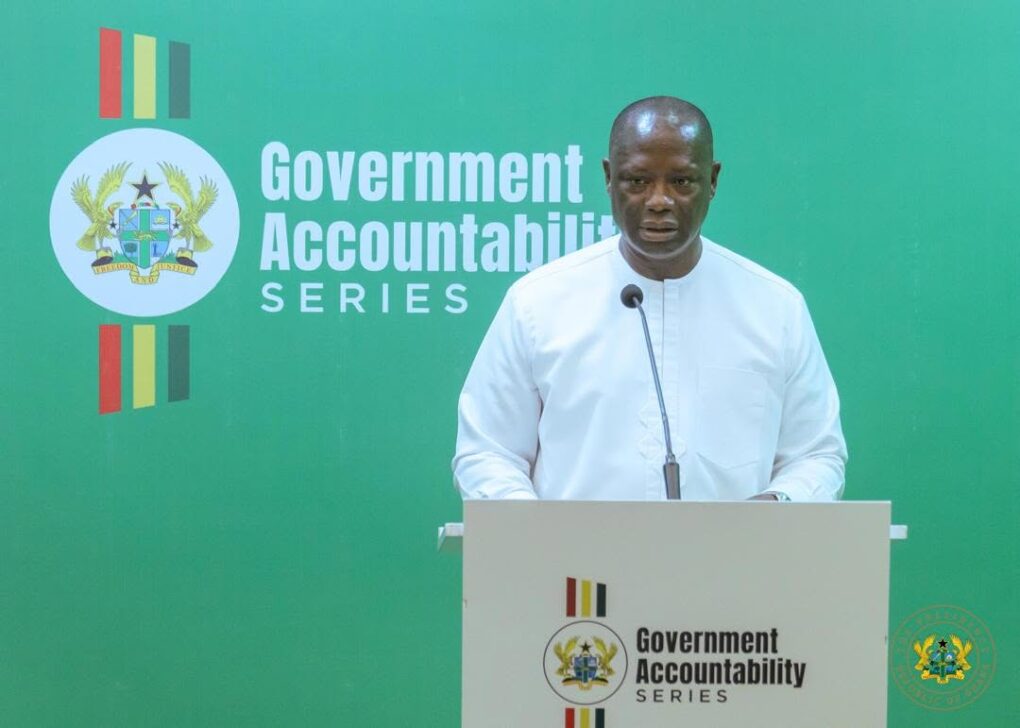
Mr. Emmanuel Armah-Kofi Buah, Minister of Lands and Natural Resources, revealed that the Minerals and Mining Policy of 2014 was updated and approved by Cabinet this year.
“This Policy seeks to indigenise mining by strengthening local content and participation through domestic value addition to minerals, improve linkages to the manufacturing industry and deal decisively with the menace of illegal mining and protection of the environment,” he said.
The announcement was made by the Minister during his speech on Wednesday at the Presidency’s Government Accountability Series Press Conference.
He stated that the Minerals and Mining Act, 2006 (Act 703), which has been in effect for 20 years, was similarly examined and approved by Cabinet before being sent to Parliament for approval after stakeholder engagements.
He said that the amended Bill offered a modern, logical, and progressive legislative framework to guarantee that mining made a significant contribution to the advancement of the country.
According to Mr. Buah, the new Act eliminated reconnaissance and prospecting licenses and replaced them with exploration permits, which have a five-year maximum term, medium-scale mining as a new category, and district mining committees as a starting point for mineral licensing.
He stated that the maximum duration of mining leases was now set at 20 years, and that community development agreements were now included in all mining leases.
According to the Minister, the Mining Sub-sector has made notable progress in strengthening regulations, boosting value addition, ensuring safety, and fighting illicit mining.
The Minerals and Mining (Royalties) Regulations (2025), L.I. 2517, which established a sliding-scale royalty payment and presented a strategically adaptable framework for both the Republic as the resource owner and mining companies as contractors and investors, he said, was a significant legislative milestone.
According to him, this system made sure that the government collected a substantial amount of money when commodity prices were rising or when production was booming. On the other hand, it relieved financial pressure on businesses during recessions by lowering rates, preventing negative cash flow, and promoting continuous operations to ensure job security.
In the end, he claimed, this self-correcting system provided investors with more predictability than a strict set rate susceptible to cycles of low prices.
“Our vision for Local Content is to ensure that Ghana’s mineral wealth creates lasting prosperity for Ghanaians. We are committed to building a mining industry where our people are not merely participants, but owners, investors, innovators, and manufacturers,” the Minister said.
He pointed out that the government was encouraging Ghanaian ownership, value addition, technology transfer, local enterprise growth, and the creation of sustainable jobs through intentional policies in order to keep the full benefits of the country’s natural resources inside its economy.
He claimed that President John Dramani Mahama’s inaugural Mining Local Content Summit in Takoradi in February of this year was inspired by this concept.
According to Mr. Buah, the summit brought together important players and strengthened the determination to go beyond the export of raw minerals in favour of industrialisation and value addition.
He declared that the government would not tolerate fronting or any arrangement that compromised the goals and spirit of the country’s Local Content policy and that it was unwavering in its commitment to safeguarding authentic Ghanaian involvement.
Source: newsthemegh.com