
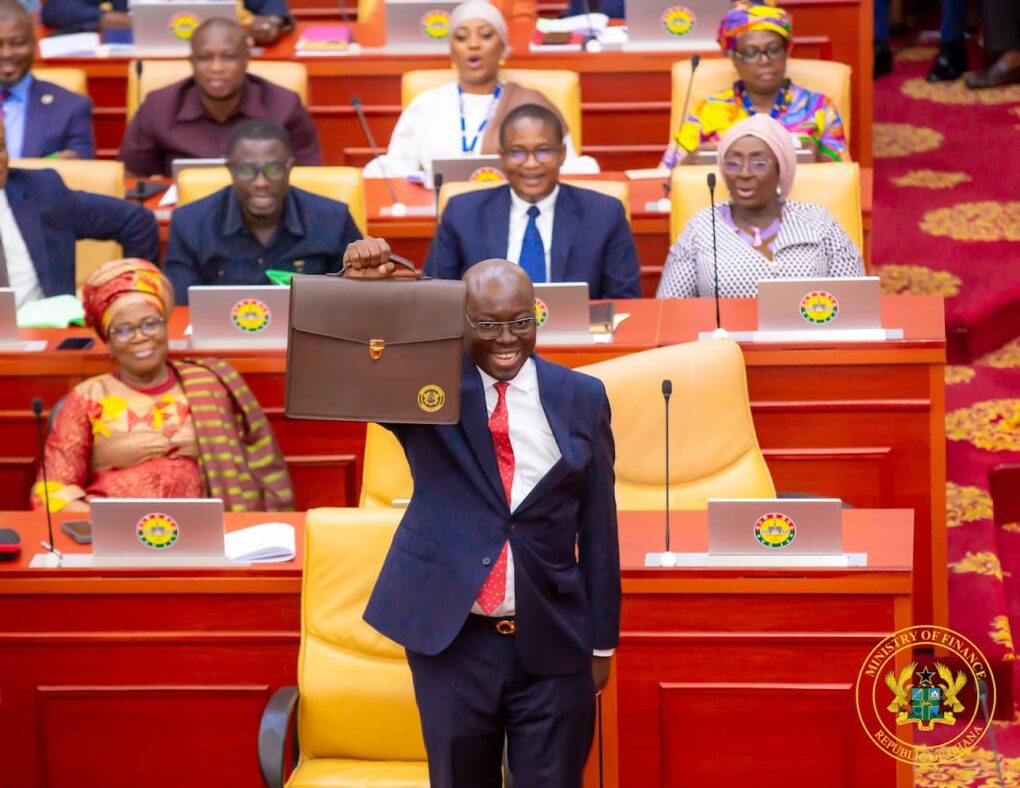
Finance Minister Dr. Cassiel Ato Forson announced that Ghana had met its statutory debt-to-GDP target of 45% years ahead of both the International Monetary Fund program timeline and the timeline established under the Public Financial Management Act, during the presentation of the 2026 Mid-Year Fiscal Policy Review to Parliament yesterday.
The public debt of the country fell precipitously from 61.8% of GDP at the end of 2024 to 44.7% by the end of 2025, then somewhat to 45.0% by the end of June 2026.
Ghana’s external and total risk of debt distress has eased from high to moderate for the first time since April 2014, and the country’s debt rating was changed from unsustainable in 2023 to sustainable with room to absorb shocks in the joint World Bank-IMF Debt Sustainability Analysis.
By the end of June 2026, the primary balance on a commitment basis had reached a further surplus of 0.9% of GDP. In 2025, it posted a surplus of 2.5% of GDP, surpassing the 1.5% target by one percentage point.
Primary spending decreased from 18.7% of GDP in 2024 to 13.2% in 2025 without impeding economic expansion.
Dr. Forson said that Ghana’s growth is “the result of superior economic management” and ascribed the recovery to conscious policy choices rather than “good fortune.”
He described a leaner government as “not merely good politics, but also sound fiscal policy” and pointed out that the administration has slashed ministries from 30 to 23 and ministers from a peak of 123 to 60.
From 23.8% in December 2024 to 5.4% at the end of 2025 and 5.3% in June 2026, inflation decreased.
While the Monetary Policy Rate decreased by a total of 1,300 basis points from 27% in January 2025 to 14% in July 2026, the rate on 91-day Treasury bills decreased from 11.09% in December 2025 to 5.73% in June 2026.
Bloomberg confirmed that the cedi was the strongest-performing currency in the world in 2025, with an increase of 40.7% against the US dollar.
In 2022, debt servicing accounted for 55.7% of domestic revenue; by 2025, that percentage had dropped to 28.8%, freeing up billions of cedis for roads, hospitals, and schools.
Following the successful issue of a GH¢2.7 billion seven-year cedi-denominated bond in April 2026, the first since the 2022 debt default, Dr. Forson said that Ghana had “overcome the original sin”—the incapacity of a nation to borrow over the long term in its own currency.
“Ghana has moved from default to credibility, from debt distress to debt sustainability, from market exclusion to renewed investor confidence,” he told Parliament.
With non-oil GDP expanding at 6.3%, Ghana’s economy expanded at 6.4% in the first quarter of 2026, far exceeding the 4.8% full-year projection.
With a 25.2% growth rate, the Information and Communication subsector contributed 26.9% of the total economic growth.
In the first half of 2026, the cumulative trade surplus reached US$8.8 billion, or 6.6% of GDP, while the current account surplus rose to US$5.1 billion.
Source: newsthemegh.com