

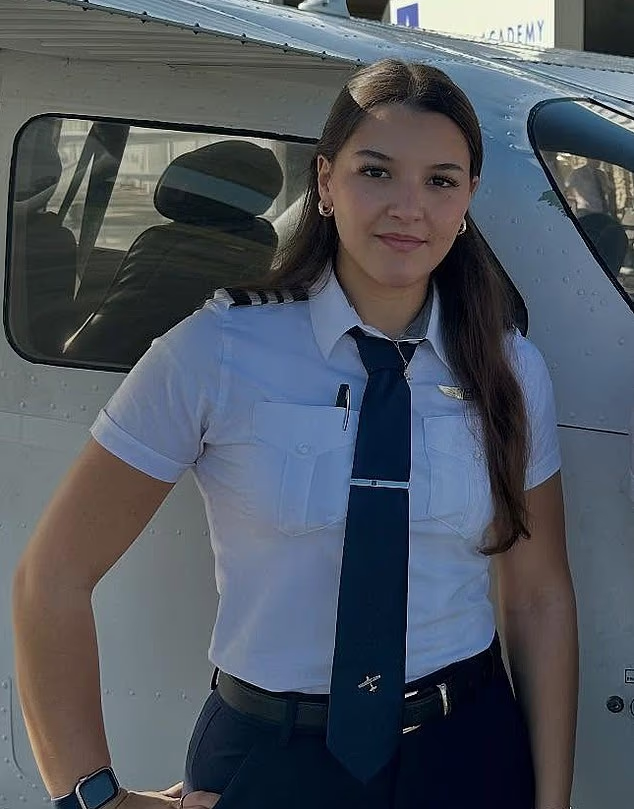
A 20-year-old co-pilot aboard a Learjet 60 aircraft that crashed in Palm Beach, Florida, reportedly warned her pilot boyfriend about severe turbulence and ice conditions shortly before the deadly accident that claimed nine lives.
Nathalia Filgueiras was reportedly exchanging text messages with her boyfriend, who is also a pilot, just minutes before the aircraft crashed on Sunday. According to her family, she sent him a concerning message saying: “I’ve got turbulence, I’ve got ice.”
The family disclosed the details in an interview with the New York Post, describing Filgueiras as a passionate and highly experienced young aviator whose life was dedicated to flying.
Despite being only 20 years old, she obtained her pilot’s licence at the age of 17 in 2023 and had accumulated more than 1,300 flight hours.
Filgueiras frequently shared photographs and videos of herself flying aircraft alongside her pilot boyfriend on social media, reflecting her enthusiasm for aviation.
Video: dailymail.com
Nine Killed in Devastating Palm Beach Private Jet Crash
The Learjet crash claimed the lives of nine people, including technology entrepreneur Adam Robinson, 45, and his wife, Helen Sharp, 40.
Other reported victims included their nanny, two friends and two children.
The aircraft was travelling from Austin, Texas, to North Eleuthera in the Bahamas when it crashed near West Palm Beach, Florida.
Flight tracking information indicates that the aircraft’s journey ended abruptly in the vicinity of Palm Beach.
The impact scattered debris across a wide area and left a large crater in the road. However, authorities confirmed that no injuries or fatalities were reported among people on the ground.
The aircraft crashed approximately eight miles from President Donald Trump’s Mar-a-Lago resort. President Trump’s Air Force One had reportedly departed Palm Beach International Airport about an hour before the accident.
Severe Thunderstorm Suspected in Fatal Learjet Accident
Although the exact cause of the aircraft crash remains unknown, preliminary assessments of flight data and radar information suggest that the Learjet encountered a rapidly developing thunderstorm.
Meteorologist Matthew Cappucci told the New York Post that the storm intensified unusually quickly on Sunday morning, with its cloud formations rising approximately 15,000 feet within 20 minutes.
By the time of the crash, around 12:50 p.m., the storm clouds had reached an estimated altitude of 48,300 feet.
Flight information reportedly showed that the aircraft’s pilot had requested permission from air traffic control to climb from 35,000 feet to 37,000 feet because of heavy rainfall.
However, the situation deteriorated shortly afterwards, leading to an emergency distress call from the cockpit.
Terrifying Final Moments Captured in Cockpit Audio
Audio recordings from the aircraft’s cockpit have provided further insight into the final moments before the fatal Learjet crash.
The recording reportedly captured Filgueiras communicating with air traffic control as the aircraft experienced serious difficulties.
At one point, she could be heard warning that the aircraft was descending at approximately 20,000 feet per minute and was heading towards the ground.
“Descending 20,000ft per minute… we’re going to crash into the ground,” she reportedly said.
In the background, the unidentified pilot could be heard reciting the Lord’s Prayer as the aircraft continued its rapid descent.
Filgueiras also reportedly informed air traffic controllers that the aircraft had banked approximately 60 degrees, suggesting that it was experiencing severe instability.
She attempted to communicate the aircraft’s changing altitude and movements while the pilots struggled to manage the emergency.
The National Transportation Safety Board (NTSB) has launched an investigation to establish the circumstances surrounding the accident.
Video: dailymail.com
Young Co-Pilot Had a Lifelong Passion for Aviation
Filgueiras was identified as the co-pilot of the crashed Learjet on Monday, with her family describing her as someone who had developed a strong interest in aviation from an early age.
After obtaining her pilot’s licence at 17 in 2023, she appeared on local television to celebrate the achievement.
Speaking to CBS12 at the time, she proudly explained that although she could not necessarily drive, she had already mastered flying.
“I definitely do brag because people say, ‘Oh, you can’t drive,’ and I’m like, ‘Yeah, but I can fly’,” she said.
Her mother, Camila, frequently shared photographs of Nathalia and her siblings travelling on private aircraft. Her father, Allan, also holds a pilot’s licence.
Speaking to The New York Times, her mother described her daughter’s love for flying and the unique experience of seeing the world from above.
“She loved the freedom. It was completely different seeing the world from the top,” Camila said.
Aviation Experts Examine Possible ‘Coffin Corner’ Phenomenon
As investigations continue, aviation experts have raised the possibility that the aircraft encountered a dangerous high-altitude flight condition known as coffin corner.
The phenomenon occurs when an aircraft’s minimum safe flying speed approaches its maximum operating speed at high altitude, leaving pilots with an extremely narrow speed range in which to maintain stable flight.
If an aircraft flies too slowly, it risks an aerodynamic stall. Flying too fast can also create dangerous aerodynamic conditions, potentially resulting in a loss of control.
Some aviation specialists have suggested that the Learjet may have encountered this situation while attempting to climb above two developing thunderstorm systems.
Former pilot Martin Varsavsky, who now operates an artificial intelligence company, also commented on the possible role of severe weather in the accident.
In a post on X, he suggested that the aircraft may have encountered dangerous weather conditions that should have been avoided.
He explained that radar information appeared to show the presence of storm cells and argued that light aircraft should maintain a safe distance from severe thunderstorms rather than attempting to fly through them.
According to Varsavsky, rapidly changing atmospheric temperatures and storm conditions can affect an aircraft’s ability to maintain stable flight, particularly at high altitudes.
However, these explanations remain preliminary observations and have not been established as the official cause of the crash.

NTSB Investigates Deadly Florida Private Jet Crash
The National Transportation Safety Board is continuing its investigation into the Palm Beach Learjet 60 accident.
Investigators are expected to examine flight data, weather conditions, cockpit communications, aircraft performance and other relevant evidence to determine what caused the aircraft to lose control.
The tragic accident has renewed attention on private jet safety, severe weather avoidance, high-altitude flight risks and the challenges pilots face when navigating powerful thunderstorms.
Until the investigation is completed, the precise circumstances that led to the deaths of the nine occupants remain undetermined.
Source: newsthemegh.com