
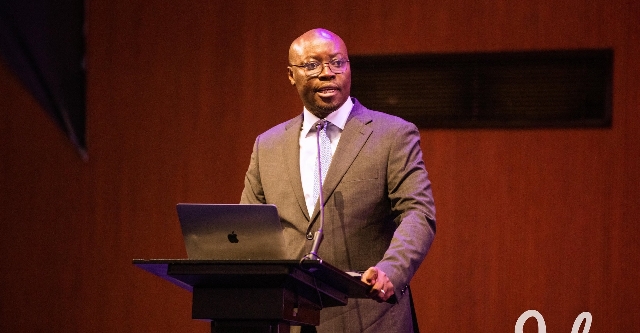
Finance Minister Dr Cassiel Ato Forson has assured Ghanaians that the government will not contract additional loans to finance its proposed New Economy Programme, insisting that the initiative will be funded entirely through domestic revenue mobilisation and savings from fiscal consolidation.
According to the Finance Minister, the government has developed a financing strategy that will support the programme without increasing Ghana’s public debt burden.
Dr Ato Forson gave the assurance during an engagement with students and members of the university community at the Kwame Nkrumah University of Science and Technology (KNUST).
He explained that the government intends to commit resources equivalent to 1.5 per cent of Ghana’s Gross Domestic Product (GDP) annually between 2027 and 2030 to finance the economic transformation programme.
The proposed funding arrangement is expected to generate at least US$13 billion over the four-year period.
How Government Intends to Finance the New Economy Programme
Addressing concerns about the source of funding, Dr Ato Forson outlined two major strategies through which the government intends to raise the required resources.
The first involves allocating 0.5 per cent of GDP annually from government revenue to support the programme.
The second strategy is to adjust the country’s primary surplus target from the current 1.5 per cent of GDP to 0.5 per cent, thereby creating additional fiscal space for development investments.
The Finance Minister explained that the combination of these measures would provide the financial resources needed to implement the New Economy Programme without resorting to additional domestic or external borrowing.
GoldBod Revenue Not Part of Programme Financing
Dr Ato Forson also clarified the role of the Ghana Gold Board (GoldBod) in the country’s public finances.
He stressed that GoldBod does not generate revenue for the Ministry of Finance or the central government and should not be considered a direct source of funding for the New Economy Programme.
He explained that government revenue continues to depend primarily on direct taxes, indirect taxes and non-tax revenue.
The clarification is intended to address misconceptions about the contribution of gold-related activities under GoldBod to the government’s regular budgetary resources.
Government Targets 45% Public Debt-to-GDP Ratio by 2028
On Ghana’s debt sustainability agenda, the Finance Minister reaffirmed the government’s commitment to reducing public debt to 45 per cent of GDP by 2028.
He cited improvements in the country’s primary fiscal balance as evidence that the government is making progress towards achieving its debt reduction targets.
Ghana recorded a primary surplus equivalent to 2.5 per cent of GDP in 2025, while another surplus of 1.5 per cent of GDP is projected for 2026.
According to the Finance Minister, the two consecutive primary surpluses are expected to contribute to a reduction in public debt equivalent to approximately four percentage points of GDP.
However, from 2027, the government intends to moderate the pace of fiscal consolidation by reducing the annual primary surplus target to 0.5 per cent of GDP.
The adjustment is expected to release additional resources for investment in infrastructure, industrial development, job creation and other priority sectors under the New Economy Programme.
Ato Forson Defends Government’s Fiscal Strategy
Dr Ato Forson maintained that the decision to moderate the pace of debt reduction does not represent a departure from fiscal discipline.
Instead, he described the approach as a strategic adjustment designed to balance public debt sustainability with the need to accelerate economic growth and improve living standards.
He explained that the government intends to rely on improved domestic revenue mobilisation, expenditure efficiency and savings from ongoing fiscal consolidation rather than accumulating additional debt.
The Finance Minister further argued that Ghana must pursue productive investments capable of transforming the economy while maintaining responsible public financial management.
The New Economy Programme is expected to support the government’s broader economic transformation agenda by directing resources towards productive sectors and growth-enhancing activities.
Dr Ato Forson’s engagement at KNUST highlighted the government’s intention to maintain macroeconomic stability while creating opportunities for investment, employment and sustainable economic development.
Under the proposed framework, the government will allocate 1.5 per cent of GDP annually to the programme from 2027 to 2030, with funding coming from domestic revenue and adjustments to the primary surplus target.
The government has also maintained that no additional loans will be contracted for the initiative, while GoldBod proceeds will not form part of its funding arrangements.
The overall strategy seeks to achieve economic transformation, strengthen Ghana’s fiscal position and gradually reduce public debt while supporting long-term development.
Source: newsthemegh.com