
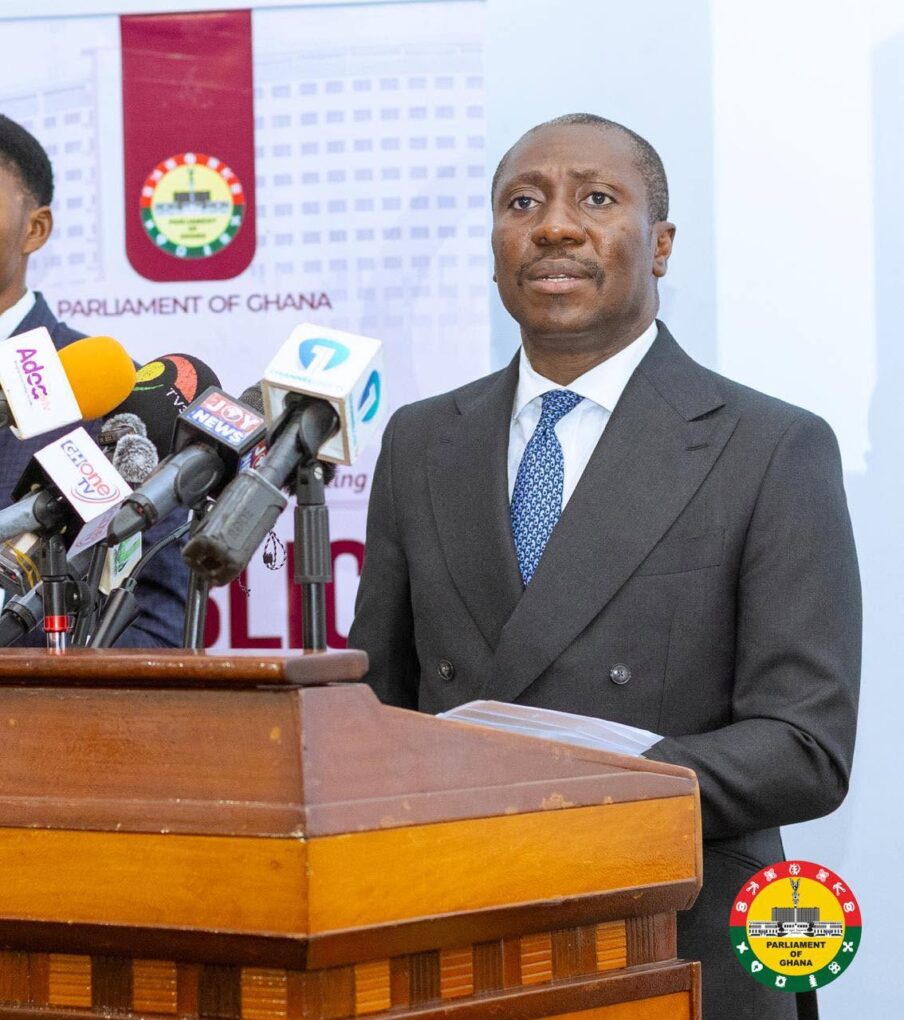
Minority Leader Alexander Afenyo-Markin has criticised the government’s 2027 Budget Statement, arguing that claims of economic recovery and stability have yet to translate into meaningful job opportunities, lower living costs and improved economic conditions for ordinary Ghanaians.
Describing the National Democratic Congress (NDC) administration as a “sloganeering government,” the Effutu MP accused the government of prioritising economic statistics and political slogans instead of addressing unemployment, rising food prices and the challenges confronting businesses.
Mr Afenyo-Markin made the comments while speaking to journalists on Thursday, November 12, 2026, following the presentation of the 2027 Budget Statement and Economic Policy by Finance Minister Dr Cassiel Ato Forson in Parliament.
He argued that despite government claims of improved macroeconomic indicators, many households and businesses continued to struggle with the high cost of living.
“Let Ghanaians know that this NDC government is a sloganeering government. What they came to do was to subject us to another round of slogans and no jobs,” he stated.
The Minority Leader maintained that economic stability should be reflected in affordable food prices, employment opportunities and improved living standards rather than figures presented in the national budget.
“Stability on paper, hardship in our pockets,” he added.
Afenyo-Markin Questions Food Prices and Cost of Living
The Minority Leader raised concerns about persistent food price pressures in markets across the country, citing Techiman, Tamale, Kumasi Asafo, Winneba Central and Makola as examples.
He questioned whether the government’s economic policies had delivered sufficient relief to consumers, farmers and businesses struggling with the cost of food and other essential commodities.
He also expressed concerns about government support for farmers and the reduction in the cocoa farmgate price, arguing that the development contradicted promises made by the NDC while in opposition.
According to him, unemployment and the rising cost of living cannot be addressed through political messaging without practical economic interventions.
“You cannot rebrand unemployment. They cannot slogan away the cost of living,” he said.
Minority Demands Details of US$10 Billion New Economy Programme
Mr Afenyo-Markin also questioned the implementation strategy for the government’s flagship New Economy programme, which proposes an investment of US$10 billion between 2027 and 2030.
He demanded clarification on the amount expected to be invested in 2027 and the specific infrastructure, industrial and economic development projects scheduled to receive funding.
The Minority Leader further questioned how the New Economy agenda would complement the government’s 24-Hour Economy policy.
He argued that the 2027 Budget needed to provide clearer information on the implementation arrangements, financing structure and expected economic benefits of the two initiatives.
Afenyo-Markin Welcomes DDEP Bondholder Payments but Questions Unpaid Obligations
On government debt management, the Minority Leader welcomed Finance Minister Ato Forson’s announcement that the government was prepared to meet its payment obligations to bondholders under the Domestic Debt Exchange Programme (DDEP).
He described the commitment as positive news for investors whose savings and interest payments had been affected by the domestic debt restructuring exercise.
However, he questioned why similar assurances had not been provided regarding outstanding payments and financial obligations involving public sector workers.
He specifically mentioned the Judicial Service Staff Association of Ghana (JUSAG), teachers and nurses, as well as funding for additional public sector recruitment.
“They claim that they have money to pay domestic debt exchange programme bondholders, those whose savings were postponed and whose payments were deferred. They say they have money to pay. That is good news. We welcome that,” he stated.
“But the question is: where is the money to pay JUSAG, the money to pay teachers, the money to pay nurses, and the money to recruit?”
His comments highlight the Minority’s concerns about government expenditure priorities, public sector compensation and the settlement of outstanding financial obligations.
Minority Questions Government’s Job Creation Figures
The Minority Leader also challenged the government to provide clear statistics on the number of jobs created since assuming office.
He argued that Ghanaians were more interested in tangible employment opportunities and improvements in household incomes than economic performance figures that did not directly address their daily challenges.
“It is not data that Ghanaians are going to consume. Ghanaians want jobs, jobs, jobs,” he emphasised.
He maintained that job creation must remain a central measure of the government’s economic performance, particularly amid continuing concerns about youth unemployment and limited employment opportunities.
Women’s Bank, Electricity Tariffs and Private Sector Concerns
Mr Afenyo-Markin further raised questions about the government’s proposed women’s bank, noting that the initiative had featured in previous budget presentations but was missing from the latest budget announcement.
He called for clarity on the status of the proposed financial institution and the government’s plans to support women entrepreneurs and businesses.
He also expressed concerns about electricity costs and what he considered inadequate incentives for private sector operators.
According to the Minority Leader, high operating costs and limited business support could undermine investment, industrial expansion and employment creation.
He stressed that private businesses play a critical role in driving economic growth and providing jobs, insisting that government policies must create an enabling environment for entrepreneurs and investors.
“Without the private sector, the economy cannot grow,” he said.
Minority to Conduct Further Assessment of 2027 Ghana Budget
Mr Afenyo-Markin indicated that the Minority Caucus would undertake a detailed examination of the 2027 Budget Statement and Economic Policy before presenting its comprehensive position.
He said the Minority would assess the government’s proposed expenditure, revenue measures, economic programmes and policy commitments during its budget workshop.
The Minority’s assessment is expected to provide further insight into its position on the government’s economic priorities, debt management strategy, job creation agenda and proposed development initiatives.
Source: newsthemegh.com