
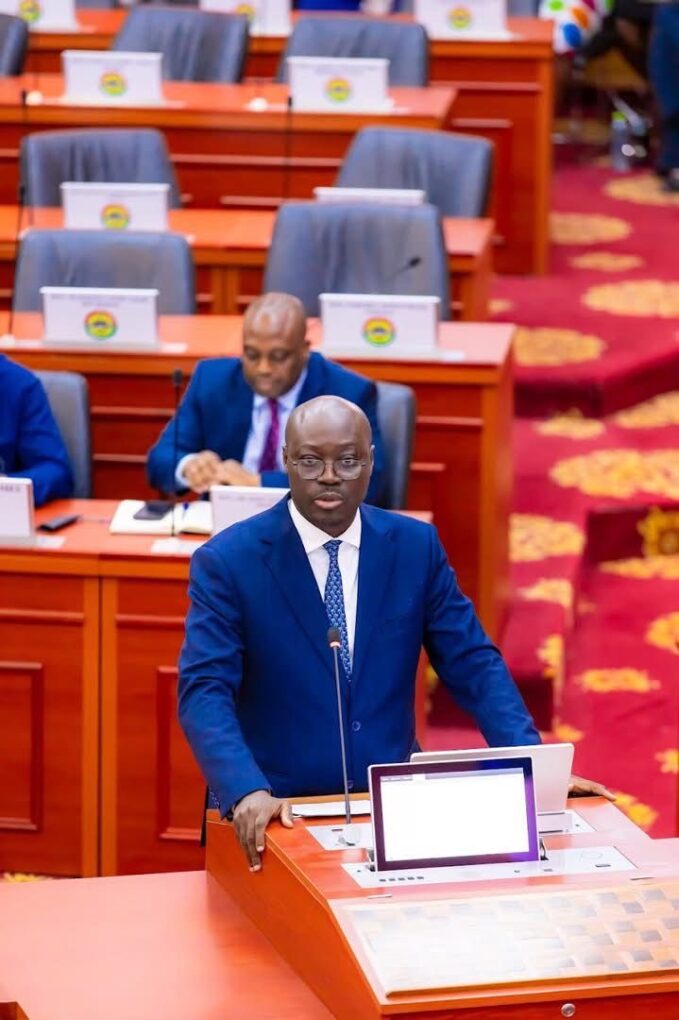
The government has projected total expenditure of GH¢389.2 billion for the 2027 fiscal year, representing 21.6 per cent of Ghana’s Gross Domestic Product (GDP), with a major focus on infrastructure development, productive investments, job creation and early debt repayment.
Finance Minister Dr Cassiel Ato Forson announced the expenditure plan while presenting the 2027 Budget Statement and Economic Policy to Parliament on Thursday, November 12, 2026.
According to the Finance Minister, GH¢100.4 billion has been earmarked for capital expenditure on a cash basis, representing 5.6 per cent of GDP.
He explained that the allocation reflects a deliberate shift in government spending priorities from consumption-driven expenditure towards investments that can expand production, create employment opportunities and improve household incomes.
Dr Forson noted that when capital expenditure financed through transfers to other government institutions is included, total capital investment increases to GH¢120.5 billion, equivalent to 6.7 per cent of GDP.
He stressed that the government intends to channel more public funds into productive economic activities and infrastructure projects capable of supporting long-term economic growth.
Capital Expenditure Exceeds Interest Payments
The Finance Minister highlighted that the GH¢100.4 billion allocated for capital expenditure is significantly higher than the GH¢61 billion budgeted for interest payments.
The capital expenditure allocation exceeds the interest payment provision by more than GH¢37 billion, representing an increase of approximately 61 per cent.
It is also GH¢5.6 billion higher than the GH¢92.7 billion allocated for wages and salaries.
Dr Forson disclosed that total compensation for government employees is projected at GH¢104.1 billion, while interest payments are estimated at GH¢61 billion.
Of the interest payment allocation, GH¢51.5 billion will go towards domestic debt obligations, while GH¢9.5 billion has been earmarked for external debt servicing.
The government has also allocated GH¢76.5 billion for statutory and earmarked funds, alongside GH¢13.9 billion to clear outstanding government arrears.
The arrears clearance provision includes GH¢4.3 billion for legacy payments owed to Independent Power Producers (IPPs).
Ghana Projects GH¢323.4 Billion in Revenue for 2027
To finance the proposed GH¢389.2 billion expenditure, government expects to generate GH¢323.4 billion in total revenue and grants during the 2027 fiscal year.
The projected revenue represents 17.9 per cent of GDP.
Based on the expenditure and revenue projections, the overall budget deficit on a cash basis is expected to reach GH¢65.8 billion, equivalent to 3.6 per cent of GDP.
On a commitment basis, the overall fiscal deficit is projected at GH¢51.9 billion.
The government is also targeting a primary budget surplus of GH¢9 billion, representing 0.5 per cent of GDP.
The primary surplus indicates that government revenue is expected to exceed non-interest expenditure, reflecting its commitment to fiscal consolidation and improved public financial management.
Government to Repay GH¢29 Billion DDEP Bonds Early
One of the major highlights of the 2027 Budget is the government’s decision to accelerate domestic debt repayment by redeeming GH¢29 billion in Domestic Debt Exchange Programme (DDEP) bonds scheduled to mature in February 2027.
Dr Forson announced that the early repayment offer takes effect from November 12, 2026, following the government’s accumulation of sufficient funds in the Cedi Sinking Fund Account to cover the entire principal amount.
He further explained that the government intends to settle additional debt obligations, including a US$590 million Eurobond payment due in January 2027, before the end of December 2026.
Together, the two repayments are expected to clear more than GH¢36 billion in debt obligations ahead of their original maturity dates.
The Finance Minister described the move as evidence of improved fiscal discipline and the government’s determination to strengthen debt sustainability, restore investor confidence and prevent a recurrence of Ghana’s previous debt crisis.
GH¢30 Billion for New Economy and GH¢29.8 Billion for Big Push
The 2027 Budget also provides substantial funding for the government’s flagship economic development programmes and key public institutions.
Under the expenditure framework, GH¢30 billion has been allocated to the New Economy programme, while GH¢29.8 billion will support the Big Push infrastructure development initiative.
The Ministry of Education has received an allocation of GH¢48 billion to support educational programmes and improve access to quality education.
The Ministry of Health will receive GH¢40.3 billion to strengthen healthcare delivery, improve medical services and support the country’s health sector.
Other major expenditure allocations include GH¢104.1 billion for employee compensation and GH¢13.7 billion for the procurement of goods and services.
The allocations reflect government’s priorities in infrastructure development, education, healthcare, employment generation and economic transformation.
Overall, the 2027 Budget is designed to strengthen Ghana’s economic recovery through increased productive investment, improved revenue mobilisation, responsible public spending and accelerated debt repayment.
Source: newsthemegh.com