
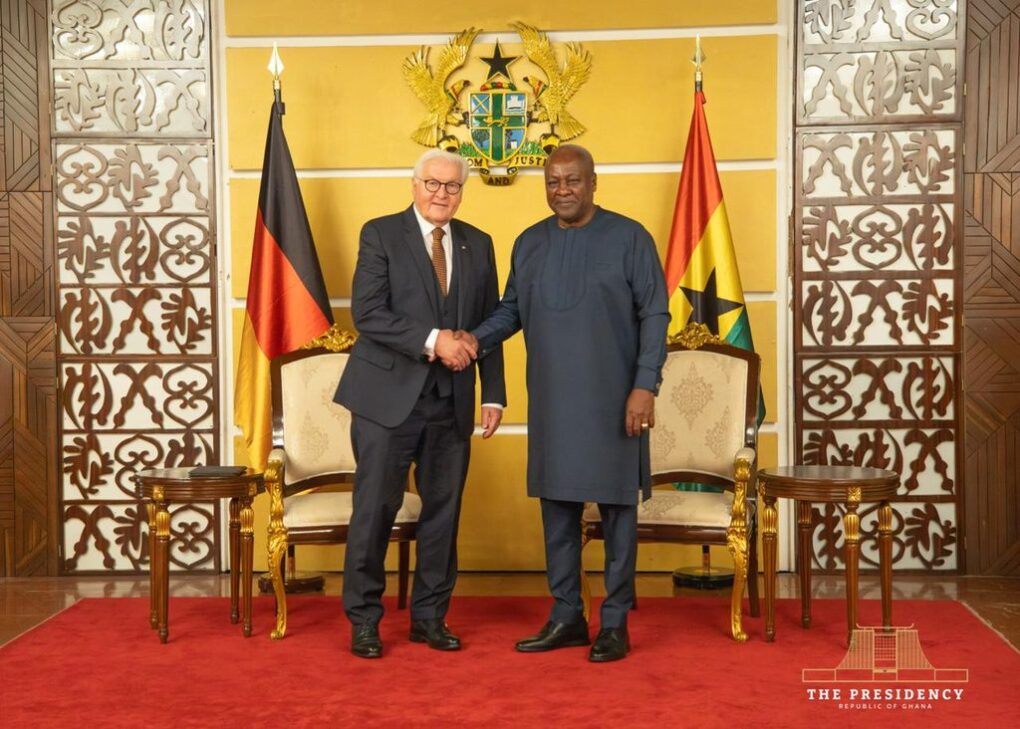
President John Dramani Mahama and Germany’s President, Dr Frank-Walter Steinmeier, have called for stronger economic cooperation between Africa and Germany, emphasising the need for increased trade, foreign investment, technology transfer and industrial development.
The two leaders made the appeal at the opening of the 2026 German-African Business Summit (GABS) in Accra, which brought together political leaders, policymakers, business executives, investors and development partners from Germany and across Africa to explore investment opportunities and strengthen economic relations.
The German-African Business Summit is Germany’s leading business and investment event on the African continent. The sixth edition was jointly organised by the Sub-Saharan Africa Initiative of German Business (SAFRI) and the Delegation of German Industry and Commerce in Ghana.
The summit focuses on major economic sectors, including energy, infrastructure, manufacturing, agriculture, logistics, financial services and digital transformation.
Addressing participants, President Mahama stressed the need for Africa and Germany to move beyond traditional development assistance and establish mutually beneficial partnerships driven by international trade, industrial cooperation, private sector investment, technology transfer and local value addition.

He explained that changing global economic conditions, geopolitical uncertainties, technological advancements and shifting international supply chains presented Africa with an opportunity to strengthen its position as a competitive destination for foreign investment, manufacturing and innovation.
According to President Mahama, Africa has the natural resources, youthful population and expanding consumer markets required to support large-scale industrialisation. However, he noted that the continent must transform its natural wealth into productive businesses capable of generating sustainable employment and long-term economic prosperity.
“We must process what we produce. We must manufacture what we consume, and compete effectively in regional and global markets,” he emphasised.
The President highlighted Germany’s expertise in engineering, advanced manufacturing, technological innovation and vocational training as important areas that could support Africa’s industrial transformation.
He therefore encouraged German companies to partner with African businesses by combining their technological capabilities, investment resources and industrial knowledge with the continent’s natural resources, entrepreneurial potential and growing consumer markets.
President Mahama also positioned Ghana as a strategic investment destination and gateway to the wider African market, particularly because Accra hosts the Secretariat of the African Continental Free Trade Area (AfCFTA).
He noted that the continental trade agreement provides access to a combined African market of approximately 1.4 billion people, with a Gross Domestic Product exceeding US$3.5 trillion.
The President urged German investors to view Africa as an integrated economic and production destination rather than a collection of separate national markets, arguing that the AfCFTA offers businesses significant opportunities to expand operations across the continent.
Mahama highlights Ghana’s economic recovery and investment opportunities
President Mahama also pointed to Ghana’s improving economic performance as evidence of renewed macroeconomic stability and growing attractiveness to international investors.
He disclosed that the Ghanaian economy recorded six per cent growth in 2025, while year-on-year economic growth also reached six per cent in the second quarter of 2026.
He further indicated that inflation had declined significantly from 23.8 per cent in December 2024 to 5.2 per cent in September 2026.
According to the President, Ghana’s international reserves also increased from US$8.9 billion in December 2024 to approximately US$12.94 billion in June 2026.
He added that the country’s GDP had exceeded US$100 billion, making Ghana the eighth-largest economy in Africa and the second-largest in West Africa.
As part of efforts to accelerate industrial development and attract private sector investment, President Mahama announced plans to invest US$10 billion between 2027 and 2030 under the government’s New Economy Programme.
The programme will prioritise strategic sectors such as agriculture, agro-processing, manufacturing, energy, infrastructure, pharmaceuticals, tourism, creative industries, digital innovation and mineral beneficiation.
The initiative is expected to strengthen Ghana’s productive capacity, expand local manufacturing, create employment opportunities and position the country as a competitive destination for international business.
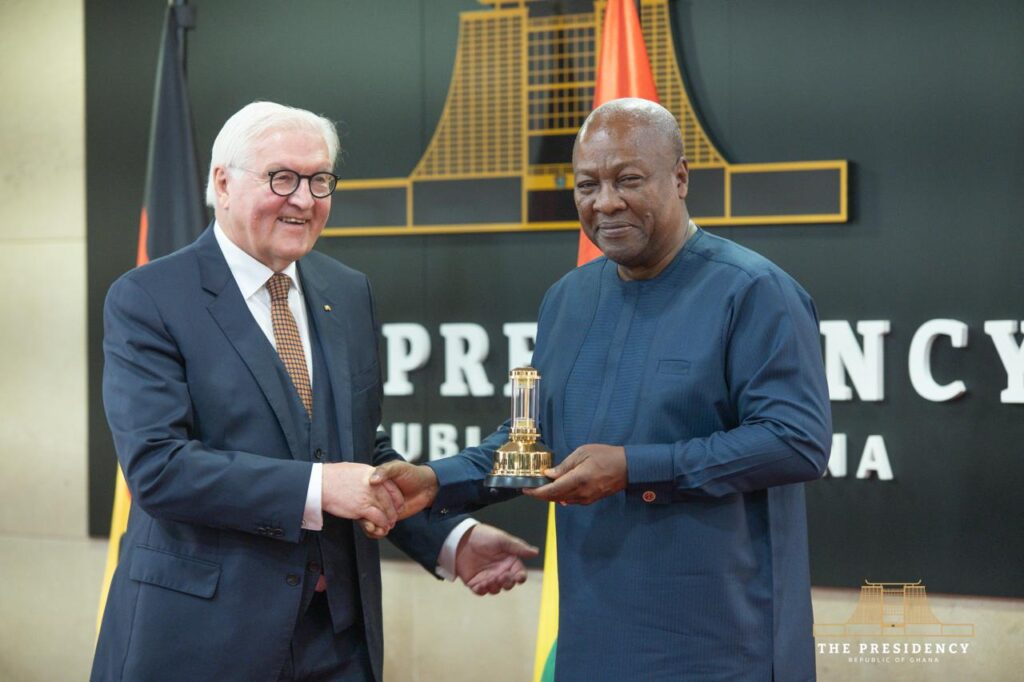
German President urges businesses to explore Africa’s investment potential
In his remarks, German President Dr Frank-Walter Steinmeier said Germany and Africa needed stronger partnerships to address pressing global challenges, including climate change, poverty, food insecurity and the rapid technological changes associated with artificial intelligence.
Reflecting on his numerous visits to Africa over the past two decades, he said he had developed a strong conviction that the continent possessed enormous entrepreneurial potential, particularly among its young population.
He encouraged German businesses to take advantage of emerging investment opportunities across Africa, explaining that geopolitical developments had made it increasingly important for Germany to diversify its traditional export markets and establish reliable economic partnerships.
President Steinmeier disclosed that trade between Germany and African countries increased by approximately 10 per cent in the previous year, reaching a new record.
However, he maintained that existing trade relations remained below their full potential, urging businesses on both sides to pursue greater commercial cooperation and investment opportunities.
He also called on African governments to implement economic reforms, simplify trade procedures and strengthen regional integration to create a favourable business environment for international investors.
The German President described the AfCFTA as an important initiative for promoting economic integration, expanding intra-African trade and accelerating sustainable development across the continent.
With his tenure as Germany’s Federal President approaching its end, Dr Steinmeier further emphasised the importance of dependable international partnerships in promoting economic cooperation and protecting the rules-based global order.
He also called for stronger African representation in international institutions, particularly the United Nations, arguing that the continent deserved a greater voice in global decision-making.
SAFRI chairman calls for stronger Africa-Germany business partnerships
Meanwhile, Thomas Schäfer, Chairman of the Sub-Saharan Africa Initiative of German Business (SAFRI), said economic relations between Africa and Germany had reached an important turning point.
He stressed that both regions needed to translate years of diplomatic engagement and positive relations into practical business partnerships, increased investment and measurable economic benefits.
According to him, German companies are increasingly searching for new growth opportunities, resilient markets and dependable international business partners, while African businesses are expanding their operations across the continent and beyond.
Mr Schäfer called for a major shift in Germany’s perception of Africa, urging German businesses to move beyond viewing the continent primarily as a destination for development assistance.
Instead, he encouraged investors to recognise Africa as a major market for international trade, private sector investment, industrial expansion and entrepreneurship.
The discussions at GABS 2026 underscore growing efforts by Ghana, Germany and other African countries to strengthen economic partnerships, attract foreign direct investment, expand manufacturing and promote technology-driven industrial development.
The summit is expected to provide a platform for building long-term business relationships and identifying investment opportunities capable of delivering employment, economic growth and shared prosperity across Africa and Germany.
Source: newsthemegh.com