
PR & COMMS UPDATES – MOTAI
The government’s commitment to repositioning the agricultural sector as a key pillar for Ghana’s industrial transformation and the intended 24-hour economy has been reiterated by Hon. Sampson Ahi, Deputy Minister for Trade, agricultural, and Industry.
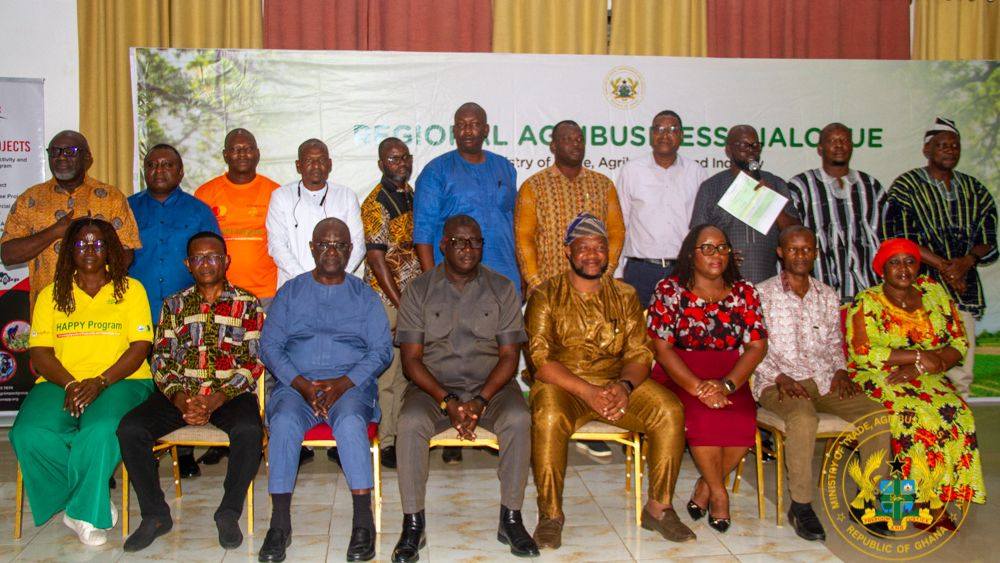
The address was read during the Regional Agribusiness Dialogue on Tuesday, December 9, 2025, at the Global Dreams Hotel in Tamale. It was given on his behalf by Mr. George Owusu Ansah Amoah, Director of Research, Statistics and Information Management Directorate (RSIM) of the Ministry.
Speaking to academics, industry leaders, development partners, and agricultural stakeholders, the Deputy Minister pointed out that Ghana is in a pivotal position as global agribusiness prospects keep growing.
He cited estimates that the global agricultural market, which is currently estimated to be worth between US$3.4 trillion and US$3.5 trillion, will grow to between US$4.4 trillion and US$5.8 trillion by 2033.
“We have a unique opportunity to tap into this expanding market through innovation, value addition, contract farming and sustainable agribusiness practices,” he said.
According to Hon. Ahi, the Ministry’s reorganization from the Ministry of Trade and Industry to the Ministry of Trade, Agribusiness and Industry represents a conscious government move to improve ties between industry and agricultural.
He states that because of poor value chains, post-harvest inefficiencies, and restricted access to raw materials, many local industries continue to run below ideal capacity, with some operating at 30 to 40 percent.
He stated that in order to stop this tendency and boost Ghana’s industrial competitiveness, agricultural systems must be strengthened.
The Deputy Minister emphasized three key initiatives as catalysts for Ghana’s industrial growth: the Accelerated Export Development Program, the Rapid Industrialization Program, and the Feed the Industry Program.
He clarified that through a hub-and-spoke system that connects smallholder farmers, commercial farms, and processors through contract farming, the Feed the Industry initiative is anticipated to increase industrial capacity utilization to between 70 and 80 percent and improve raw material supply consistency for factories.
Four pillars will serve as the program’s foundation:
1. Commercial Farmer Development and Value Chain Integration
2. Post-Harvest Solution Centers and Processing Infrastructure
3. Industrial Linkages and Market Development
4. Programme Management and Institutional Development
Hon. Ahi unveiled a two-phase plan for farm machinery access to promote agro-industrialization.
“In the short term, government will waive taxes on agro-processing machinery to lower costs and incentivize investment,” he disclosed.
Through capacity building at the GRATIS Foundation under the Ministry’s Rural Enterprise Program, in partnership with IFAD, the government will increase local manufacturing of agro-processing machines in the medium to long term.
In order to direct the future of the industry, the Deputy Minister also revealed that the Ministry is creating a National Agribusiness Policy. To create a policy that is inclusive, sustainable, and in line with national development goals, region-specific priorities are gathered through regional consultations, such as the one that took place in Tamale.
In order to create a robust agribusiness ecosystem, Hon. Ahi urged stakeholders to take charge of the new policy framework and collaborate.
“If we work together, we can unlock the full potential of agribusiness, create jobs, boost exports, and secure a prosperous future for Ghana,” he stated.
A comprehensive national policy framework for agribusiness-led industrial growth is being shaped through continuing engagements around the nation, including the Regional Agribusiness Dialogue.
The Northern Regional Minister, Ali Adolf John, stressed that “In the Northern region our Agribusiness sector is not only a source of livelihood for thousands but also plays a crucial role in food security and national growth” in a speech read on his behalf.
He described agribusiness as more than just a means of subsistence, emphasizing that it is an integral part of Ghana’s economy and a key driver of local development.
In order to guarantee the sustainability and inclusivity of the agribusiness strategy to benefit everyone and help reset the agribusiness space, Mr. Daniel Acquaye, Group CEO of Agri Impact Limited, asked stakeholders to contribute their experience.
He also advocated for the development of agricultural and agribusiness infrastructure to boost the industry and assure value for money.
The Tamale forum is part of a series of dialogues organized by the Ministry and its partners to gather and solicit ideas and contributions for an inclusive policy that would guide and align with the industry.
The Tamale debate addressed current Agribusiness challenges, including as market access and trade opportunities.
Source: newsthemegh.com