

Lucy Anning | The writer is with the DevAfrica Institute.E-mail: [email protected]
On a typical dry afternoon, Accra presents a dazzling spectacle of progress, from the gleaming glass towers of the Airport City and the freshly painted road medians along ceremonial routes to the smiling politicians cutting ribbons at new interchanges, while bold real estate billboards promise “luxury living” to eager investors and returning diaspora families.
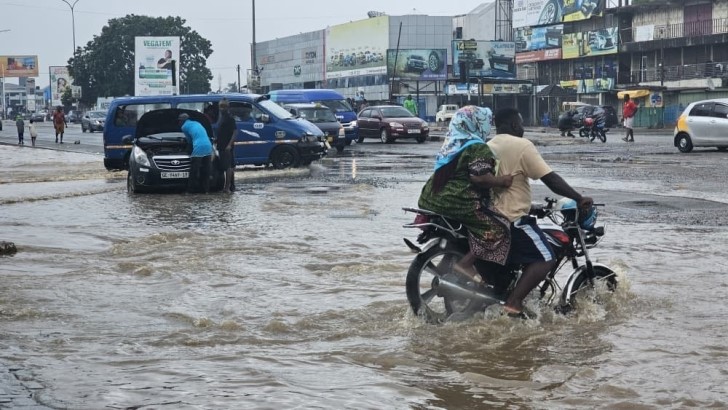
However, the moment a single heavy downpour breaks the skies, this same glamorous capital transforms within 30 minutes into a haunting tableau of submerged vehicles, desperate commuters wading through faecal-contaminated floodwaters and frightened schoolchildren stranded on classroom rooftops, all abandoned to the mercy of rising waters.
This bitter and recurring contrast forces a provocative question that every Ghanaian, from the corridors of the Jubilee House to the markets of Madina, must finally confront.
The core question here is, why does a capital that shines so brightly for foreign investors and visiting dignitaries become utterly invisible to urban planners and policymakers the moment the clouds open?
The answer, as the rainy season reveals each year, is not a weather problem but a national development crisis coded in seasonal glamour.
Data cannot be ignored
When we move beyond emotions and examine the hard evidence from the Ghana Meteorological Agency, a sobering pattern emerges over the past five to seven years.
Although total annual rainfall has not necessarily doubled, the intensity of hourly rainfall has increased so dramatically that our ageing drainage infrastructure is utterly defeated within the first hour of any major storm.
In addition to this climatic shift, the known flood-prone zones, including the Kwame Nkrumah Circle, Adabraka, parts of East Legon and Kasoa, are not remote or insignificant areas but locations representing some of the most sought-after prime real estate corridors where families have poured generations of savings into homes and small businesses.
Consequently, the economic toll reaches staggering proportions because the United Nations Development Programme (UNDP) has revealed that Ghana loses over GH¢300 million annually to floods, with the Greater Accra Region alone accounting for nearly GH¢200 million of these losses each year.
Most devastating of all is the human cost, given that the June 3, 2015 flood disaster alone affected 53,000 people, while claiming nearly 200 lives and caused damage estimated at 55 million USD with reconstruction costs reaching 55 million with reconstruction costs reaching 105 million USD.
Untold story?
In light of the above, we must acknowledge that behind every flooded street lies a deeper question of accountability, because the drains in most of Accra were designed for rainfall intensities expected only once every 10 to 20 years, yet current storms already exceed those outdated thresholds with alarming regularity.
This brings us to the first contradiction.
While Ghana has invested billions in visible road overpasses and flashy interchanges, the primary storm drains remain chronically neglected and underfunded.
Compounding this design failure is the unspoken sanitation crisis, since plastic waste, silt and construction debris now reduce drain capacity by a staggering 40 to 60 per cent, meaning that Accra shines on billboards, while its drains tell a bitter story of enforcement failure.
Furthermore, new housing developments in peri-urban areas such as Ayimensah, Amrahia, and parts of Dawhenya are routinely approved without proper stormwater impact assessments, so homes are built directly on natural watercourses, only for residents to cry for help every other rainy season between May, June and July.
Ultimately, we must confront the political cycle in which flooding dominates the national conversation only during the rainy season and then completely disappears from public discourse by October, leaving us to ask where the parliamentary committee reports are and where the follow-up audits have gone.
Imperative conclusion
The core irony is impossible to ignore, because Accra clearly possesses enough resources to dazzle investors during the dry season, yet somehow lacks the honesty and political will to prepare adequately for the rainy season. This leads us to three immediate and realistic demands that are not merely rhetorical.
First, publish the official drainage map so that every citizen with the fundamental right to know which areas are flood-prone is informed before buying land or building a home.
Second, mandate a rainy-season audit that requires an independent, publicly announced pre-rain inspection of all primary drains, with the full report published on national media portals by March each year.
Third, ban building on waterways by enforcing existing laws through visible, named prosecutions rather than the issuance of toothless warnings.
Ghana does not need another dry-season promise but urgently requires rainy-season accountability because a city that shines only when the sun is out is not truly a city but a mirage.
Source: graphic.com.gh