
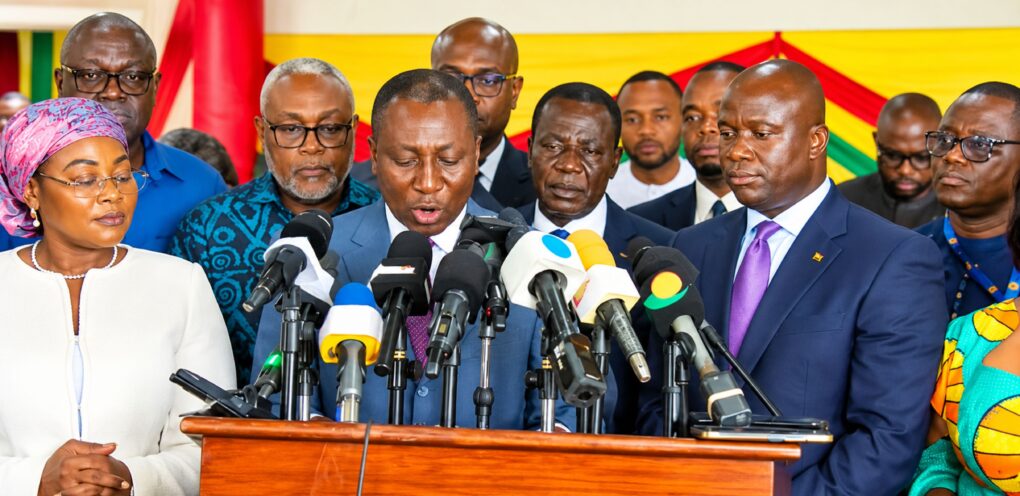
Minority Leader in Parliament, Alexander Afenyo-Markin, has called on the government to prioritise indigenous Ghanaian businesses in its New Economy agenda, insisting that local entrepreneurs must play a leading role in the country’s industrialisation and economic transformation.
He argued that although attracting foreign direct investment (FDI) remains important for economic growth, the government must first establish the necessary financial and policy environment to help Ghanaian-owned businesses expand, compete internationally and create more employment opportunities.
The Effutu Member of Parliament made the remarks following an announcement by Nigerian billionaire Aliko Dangote at the Invest Ghana Summit that he plans to establish sugar and cocoa processing factories in Ghana after receiving an invitation from the government.
Speaking to the media, Afenyo-Markin questioned the government’s emphasis on attracting major foreign investors while comparatively less attention was being given to strengthening the capacity of indigenous businesses.
“It is good to attract investors, but it is better to grow your own,” he stated.
Afenyo-Markin Calls for Financial Support for Local Entrepreneurs
The Minority Leader maintained that Ghanaian businesses possess the technical expertise, experience and technological capacity to undertake large-scale industrial projects but require adequate financial backing and government support to achieve their full potential.
He proposed that institutions such as the Ghana Infrastructure Investment Fund (GIIF), the Minerals Income Investment Fund (MIIF) and commercial banks should collaborate to provide financing for local businesses.
According to him, these financial institutions can develop strategic funding arrangements to help indigenous companies access the capital required to establish factories, expand production capacity and participate in major industrial projects.
“If they don’t have the capital, that is why we set up Ghana Investment Infrastructure Fund. That is why we have MIIF. That is why we have the banks in Ghana. They can come together and support,” he said.
Afenyo-Markin acknowledged that foreign investors such as Aliko Dangote could bring valuable expertise, technology and investment capital into Ghana. However, he stressed that foreign participation should complement rather than overshadow the development of local businesses.
He reiterated that Ghana’s industrialisation strategy would achieve greater long-term benefits if indigenous entrepreneurs were adequately supported to build competitive businesses.
“So it is good to bring in others with experience. But it is better to grow your own,” he added.
Minority Leader Warns Against Political Interference in Business
Afenyo-Markin also called for a non-partisan approach to private sector development, warning that associating business owners with particular political parties could discourage investment, weaken entrepreneurship and affect job creation.
He argued that Ghanaian companies should have equal opportunities to secure government contracts, access financial support and participate in national development projects, regardless of the political administration under which they began operating.
The Minority Leader insisted that political affiliations should not influence government decisions concerning businesses, adding that a fair and predictable business environment was essential for sustainable economic growth.
Afenyo-Markin Challenges Mahama to Empower Ghanaian Businesses
The Effutu MP urged President John Dramani Mahama to use his current term in office to introduce policies that place Ghanaian entrepreneurs at the heart of the country’s economic development agenda.
He called for stronger financial support, improved access to investment capital and policies that encourage local businesses to expand into manufacturing, agro-processing and other strategic industries.
According to Afenyo-Markin, empowering indigenous companies would strengthen Ghana’s private sector, create sustainable jobs, increase local production and reduce dependence on imported goods.
He maintained that Ghana’s New Economy agenda should not focus solely on attracting international investors but must also provide opportunities for homegrown businesses to grow into major industrial players.
Source: newsthemegh.com