
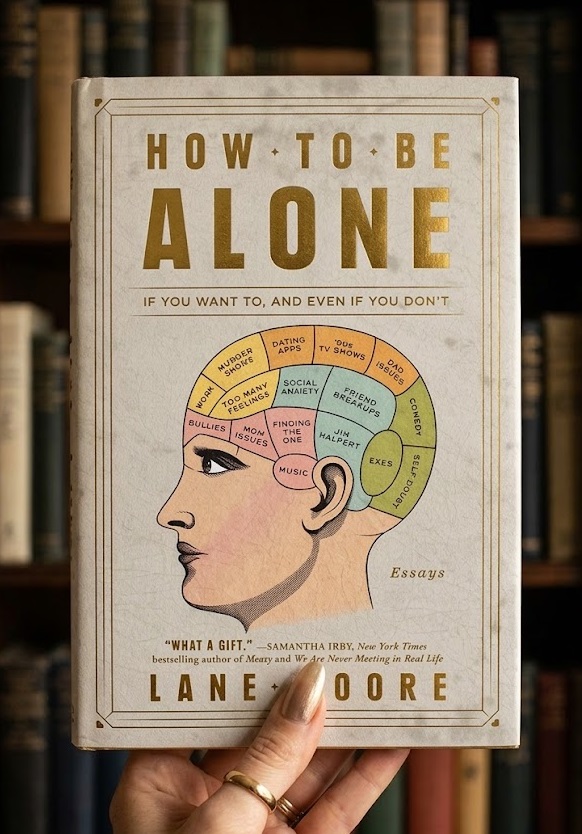
By Lane Moore – Reading Life
“When you have a lot of shine to you, as so many bighearted people often do, you can attract a lot of people easily, because people are drawn to it, that kind of light. But when you spend so much of your earliest years being told you have no shine at all, even though you’re pretty sure maybe you do, and someone finally tells you they see it too, you want to give them everything.”
Lane Moore wrote that, and the first time I heard it in the audiobook, narrated in her own voice, with all the weight of someone who has actually lived every syllable of it, I had to pause and just breathe for a moment.
Because Lane does not write like an author trying to impress you.
She writes like a friend who has been waiting her whole life for permission to tell you the truth. And when she finally does, something in you breaks open, not in the painful way, but in the way a window breaks open on a stuffy day and suddenly you can breathe again.
This book is not a self-help manual. It is not a checklist. It is a woman sitting across from you, looking you directly in the eyes and saying, I see you.
I have been you. And you are going to be okay. If you have ever felt like the odd one out, the one who loves harder than they are loved back, the one who has survived things that would take most people out, this book is your main character moment. Here are five lessons that will live in your chest long after the last word fades. MS NOW
1. The loneliness you carry is not a character flaw. It is the evidence of love that was never properly given to you.
Lane opens up about a childhood that most people would not survive with their capacity for love still intact. She was essentially her own parent, navigating emotional abandonment in a home that looked like a home from the outside but felt like a waiting room on the inside. She writes with a raw honesty that most people reserve for their closest friends, “I have never felt loved in the way I imagine many of you have, in my entire life. I wish I had felt loved. It seems pretty cool.” And somehow, in the audiobook, hearing her say that in her own voice, with that particular mix of humor and ache that is purely Lane, does not make you feel sorry for her. It makes you feel seen in your own story. Because so many of us are walking around with a loneliness we have never been given language for, a loneliness that started long before adult heartbreak, long before any situationship or toxic friendship ever happened. Lane names it. And when something painful finally gets a name, it loses some of its power over you. ASCO Post
2. Survival is not the same as healing, and you are allowed to grieve the childhood you deserved but never received.
Lane is one of those people who, on paper, turned out fine. She built a career, moved to New York, made people laugh for a living. And yet she is very intentional about not letting the world use her achievements as proof that everything is okay now. She writes, “At times I’ve struggled to feel seen, to have my history feel seen, because I turned out great. But that doesn’t mean that I am fine. I am working every day, tirelessly, like you wouldn’t believe, on being fine.” This hit me like a wall. Because we live in a world that loves a redemption arc so much that it skips straight to the part where you are thriving and forgets to honor the part where you were just trying to make it through the week. Lane gives you full permission to grieve the family dinners that never happened, the birthday that nobody remembered, the hug that never came. You do not have to be broken to grieve. You do not have to be failing to still be healing. Both things can be true at the same time, and that is not weakness. That is just being human. MS NOW
3. The desperate hunger for friendship and connection, when it comes from childhood wounds, will keep leading you back to people who cannot love you the way you need.
This is the lesson that will make you pause the audiobook, stare at the ceiling, and think about three specific people from your past all at once. Lane writes that when you do not have the affection and attachment you should have at home growing up, you become someone who is obsessed with friendships, and unlike kids with stable home lives who make friends in that casual, take them or leave them way, you will want to make friends with an intensity that frightens even you. She describes chasing connections that drained her, staying in friendships and relationships long past their expiry date because leaving felt like proving every person who had already left her right. Hearing her narrate this herself, in that voice that somehow makes you feel like you are being gently roasted and deeply understood simultaneously, is the kind of gut punch that actually heals something. Because the moment you understand why you chase unavailable people is the moment you stop blaming yourself for the chasing. ASCO Post
4. Being your own best friend, your own parent, your own safe place, is not a consolation prize. It is the most important skill you will ever build.
Lane said in an interview that she wanted to write a book about how to embrace feelings of loneliness and learn to be your own friend, your own partner, and your own parent if you need to be, because even in the best circumstances, all of us greatly benefit from learning that. “Even if you have the best family, partner, friends,” she said, “they could change or leave or die. Learning how to be alone with yourself, how to love yourself and like yourself, so that people can come and go but you always have yourself, is invaluable.” In the audiobook, when she talks about the small rituals she built for herself, the ways she learned to show up for herself the way nobody had shown up for her growing up, it does not sound sad. It sounds like freedom. It sounds like the most quietly revolutionary act a person can perform in a world that keeps telling you that you are only complete when someone else chooses you. Lane is here to tell you that you already chose yourself, and that counts for everything. Stanford
5. Your capacity to still believe in love, after everything you have been through, is not naivety. It is your superpower.
Even as Lane felt increasingly cut off from others, she looked to her childhood heroines like Anne of Green Gables and her romantic heroes like Jim Halpert from The Office, to remain a hopeless romantic and believe that she could create for herself the family she never had. That detail is everything to me. A woman who had every reason to go cold, to decide that love was a lie, to build walls so high that nothing could get in, chose instead to stay soft. To stay open. To keep believing that the love she had always wanted was real and worth waiting for, even when the evidence around her suggested otherwise. She writes, “One of the perks of being alone this long, I guess, is I never want anyone to feel as awful as I have, even for a second.” That is not the sentence of a broken person.
That is the sentence of someone who walked through fire and came out the other side not hardened but somehow more tender, more compassionate, more determined to make sure nobody else feels as invisible as she once did.
If you are still soft after hard seasons, if you still believe in love after being let down, do not let anyone call that foolishness. Lane Moore is proof that it is the bravest thing in the world.
Source: newsthemegh.com