

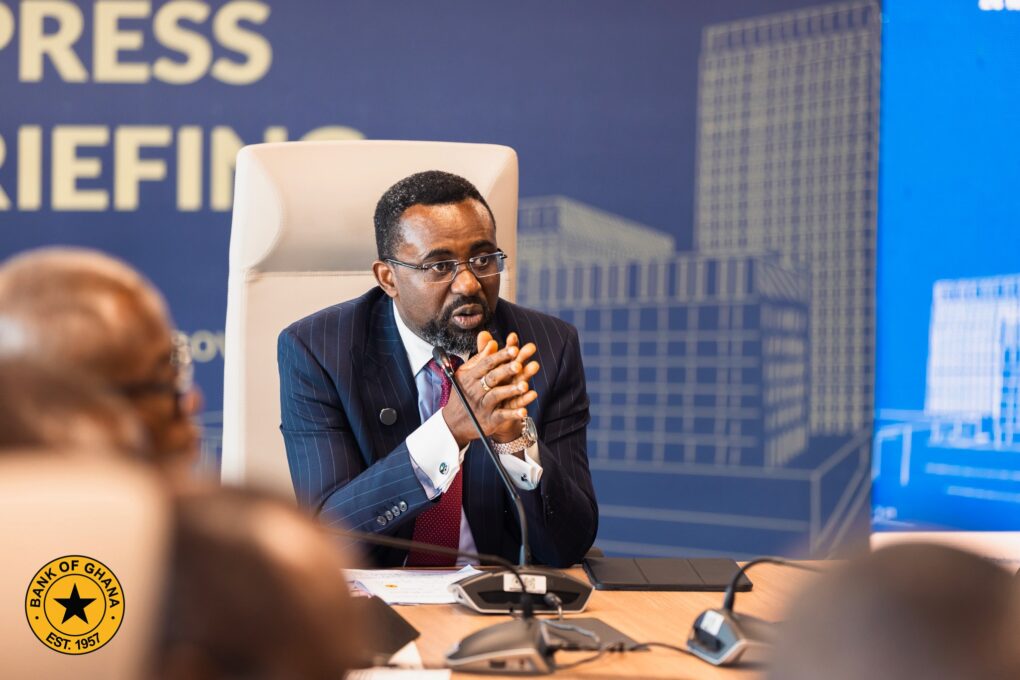
Dr. Johnson Asiama, Governor of the Bank of Ghana, has warned that growing Middle East tensions could jeopardise Ghana’s progress toward disinflation, despite recent improvements in the country’s macroeconomic indicators.
Speaking at the start of the 129th Monetary Policy Committee (MPC) meeting, the Governor stated that the changing geopolitical climate could influence the central bank’s policy decisions in the following days.
“The external environment has changed since our last meeting. A significant external development has entered the picture, and that has to do with the escalation of the conflict in the Middle East.
“This conflict is disrupting key energy and shipping corridors. It is increasing volatility in global oil markets and introducing new uncertainty into the trajectory of global inflation,” he said.
The governor explained that increased import costs could have an impact on Ghana’s domestic economy due to rising oil prices brought on by geopolitical tensions.
“For Ghana, the transmission channels are clear. Sustained oil price increases could raise the risk of imported inflation and could also tighten global financial conditions,” he pointed.
He did, however, add that Ghana might benefit from the uncertainty in the form of higher gold prices.
“Geopolitical uncertainty tends to support gold prices. You know the role of gold in our equation. This could benefit our trade balance,” he continued.
He cautioned that the overall risk outlook is still inflationary notwithstanding this possible benefit.
“Taken as a whole, the net balance of risks from this external shock could be inflation, and hence this has to be considered in our deliberations.”
The Governor also emphasised that Ghana’s inflation has now dropped below the target range set by the central bank, posing a new policy challenge for the committee.
“At 3.3 percent, inflation is not just simply within the band; it is below the lower band.”
He stated that the MPC will have to carefully consider how the current course of policy fits with changing economic circumstances.
“For an economy such as ours, where activity is trending and credit is beginning to recover, the committee must assess how the current policy stance interacts with the evolving macroeconomic conditions.”
The government’s recently announced Ghana Accelerated National Reserve Accumulation Programme (GANRAP), which intends to greatly bolster the nation’s external buffers, is another important matter before the committee.
The governor stated, “It seeks to raise international reserves to 50 months of import cover by 2028, compared to current levels of around 5.8 months of import cover.”
Stronger reserves are essential for macroeconomic resilience, he said, but these programs also bring up significant policy issues.
“Initiatives of this scale raise questions regarding liquidity conditions, the impact on the central bank’s balance sheet, and the interaction between reserve accumulation and monetary policy operations.”
The governor also mentioned the banking industry’s contribution to the efficient transmission of monetary policy.
He stated that Ghana’s banking system is still sound and well-capitalized.
“The banking sector remains sound, profitable and well capitalised, with asset quality improving meaningfully over the past year.”
He did acknowledge, though, that credit growth is still comparatively poor, a problem the committee would thoroughly investigate.
“We need to evaluate whether the constraint is from the supply side, whether it is on the side of banks in terms of risk appetite, capital buffers or non-performing loans, or whether it is from the demand side in terms of weak borrower demand.”
Dr. Asiama underlined that policymakers need to exercise caution even though Ghana’s macroeconomic indicators have significantly improved.
“The question before the committee is not whether conditions have improved. They have indeed, significantly and across the board.”
He emphasised that the central bank had to balance emerging global dangers with domestic success.
“We must make our decision at the intersection of domestic success and growing external uncertainty.”
The 129th MPC meeting will look at inflation trends, macroeconomic conditions, and global developments before the Bank of Ghana makes its next Monetary Policy Rate decision on March 18, 2026.
Source: newsthemegh.com