
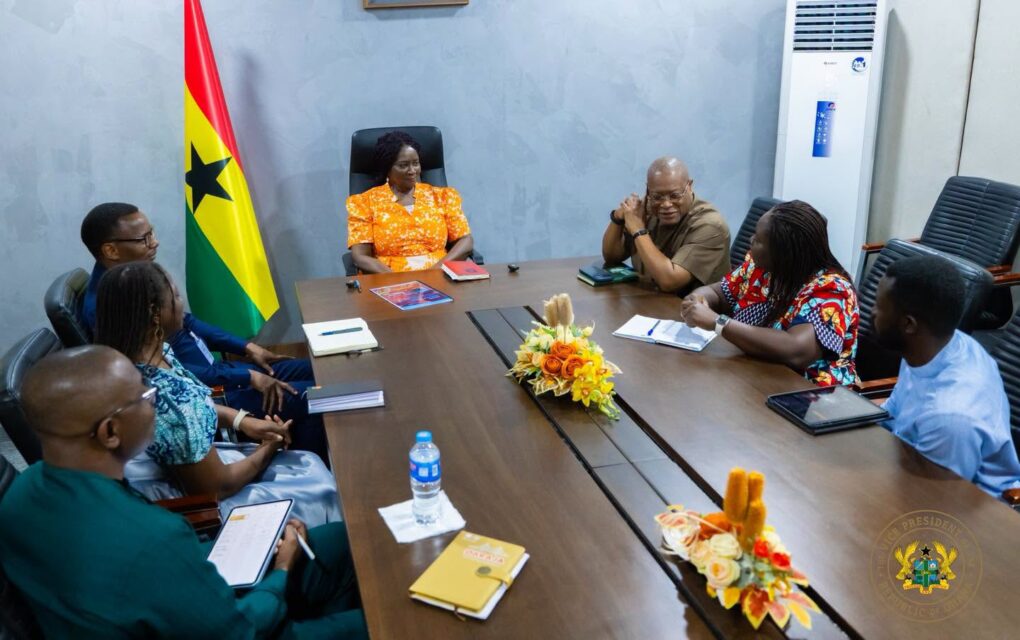
Vice President Jane Naana Opoku-Agyemang has held discussions with a delegation from the Mastercard Foundation led by its Country Director, Paul Kasanga, on strengthening skills development and creating more productive opportunities for young people in Ghana.
The Vice President commended the Mastercard Foundation Ghana for its long-standing investments and development initiatives across the country.
Reflecting on her previous experience with the Forum for African Women Educationalists, she noted that she had personally witnessed the impact of the Foundation’s support and the results that can be achieved through effective development partnerships.

Skills Training Must Lead to Jobs
A major focus of the engagement was the need to ensure that skills acquired through training translate into meaningful employment and economic opportunities.
Vice President Opoku-Agyemang stressed that skills development programmes in Ghana must go beyond training by connecting graduates and apprentices to productive opportunities that meet the changing needs of the economy.
She emphasised the importance of designing training programmes around actual labour market demand so that young people can acquire skills that improve their chances of securing decent and sustainable employment.
Expanding Skills Training Beyond Major Cities
The Vice President also drew on Ghana’s experience with distance education at the University of Cape Coast, suggesting that similar approaches could be applied to vocational and technical skills development.
She advocated for bringing trainers, apprenticeship opportunities and practical skills programmes closer to communities instead of requiring young people to move to major cities in search of employment and training opportunities.
According to her, decentralising skills training and apprenticeship programmes could make technical education more accessible to young people across Ghana.
This approach could also help reduce the pressure on major urban centres while creating opportunities for young people to develop careers within their own communities.

Linking Skills Development to Local Economies
Vice President Opoku-Agyemang further stressed that skills development programmes should take into account the economic potential and specific needs of different communities.
She cited agricultural communities as an example, explaining that training in such areas should be connected to opportunities across the agricultural value chain.
These areas could include agricultural production, food processing, machinery operation, storage, packaging and other related businesses.
By linking vocational training to local economic opportunities, young people could find productive work closer to home while contributing to the growth of local economies.
Mastercard Foundation Investments in Tertiary Education
The Vice President praised the Mastercard Foundation’s investments in Ghanaian tertiary institutions, acknowledging the contribution of such initiatives to education and skills development.
However, she stressed that efforts to expand opportunities should also extend to the large number of young Ghanaians who may never have the opportunity to attend university.
She said these young people should equally have access to quality vocational training, apprenticeships, financing and credible pathways to decent and dignified employment.
The Vice President’s position highlights the importance of creating multiple pathways to economic participation, ensuring that access to university education is not the only route to achieving sustainable employment.

Creating More Opportunities for Young Ghanaians
The engagement between the Vice President and the Mastercard Foundation comes amid growing attention to youth employment, skills development and economic opportunities in Ghana.
Strengthening technical and vocational education, expanding apprenticeship programmes and improving access to financing could help equip more young people with practical skills needed by businesses and industries.
The discussions also underline the importance of closer collaboration between government, development partners, educational institutions and the private sector in creating sustainable employment opportunities.
Vice President Opoku-Agyemang reaffirmed the need for development programmes to focus not only on training but also on what happens after training.
She indicated that connecting skills to local economic opportunities, access to finance and decent work could help ensure that more young Ghanaians turn their training into sustainable livelihoods.
The government is therefore expected to continue working with development partners such as the Mastercard Foundation to expand access to education, skills training, apprenticeships and employment opportunities for young people across Ghana.


Source: newsthemegh.com