
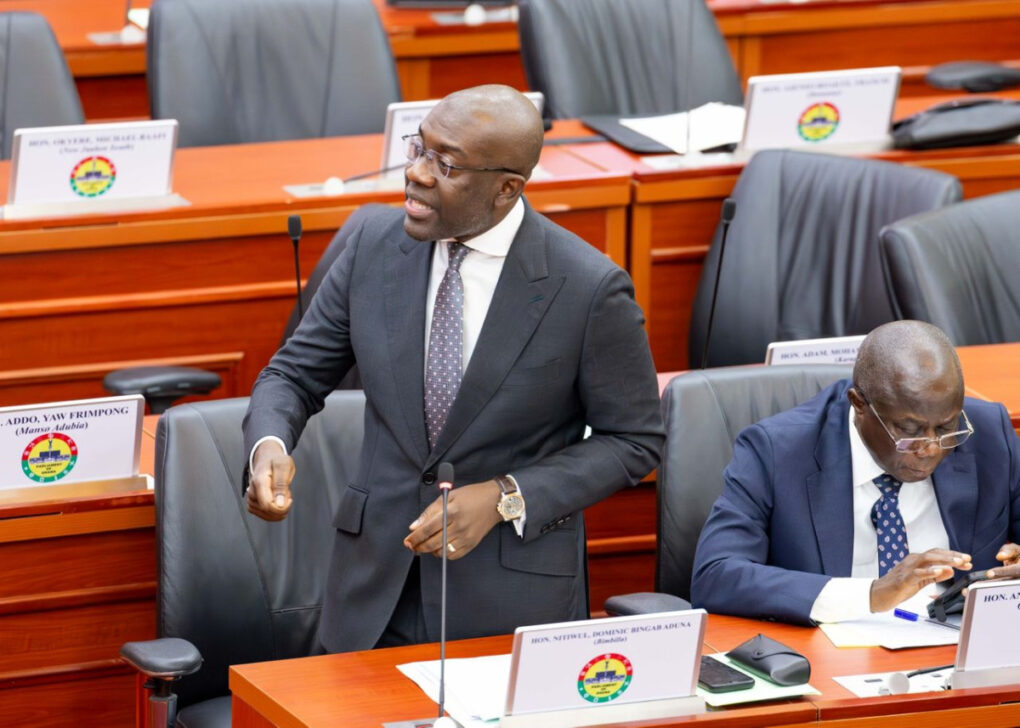
The Bank of Ghana (BoG) has been accused by the Minority Caucus in Parliament of concealing the full extent of its financial losses in 2025, and they have warned that the central bank’s situation is significantly more precarious than official statistics indicate.
Kojo Oppong Nkrumah, Ranking Member on the Economy and Development Committee, indicated at a press conference in Accra on Sunday, May 3, 2025, that the BoG’s reported loss of GH¢15.6 billion undervalued what he called a considerably deeper financial decline.
A thorough evaluation of the Bank’s audited books, he claimed, indicates a total loss of almost GH¢44 billion.
The Minority argues that the disparity results from one-time revenue sources and accounting modifications that mask the Bank’s true performance.
The BoG’s core operations reported a GH¢34.9 billion deficit, according to the caucus, although the headline amount was lowered by measures like gold transaction revenues.
It further asserted that gold sales accounted for GH¢9.6 billion of the Bank’s reported operational income, implying that the central bank would have recorded a deficit position in the absence of this action.
The organization also highlighted an extra GH¢19.3 billion listed under other comprehensive revenue, which it claimed ought to be taken into account when evaluating the Bank’s overall financial situation.
The Dynamic Cash Reserve Ratio and cedi-equivalent reserve requirements, among other monetary policy initiatives, were condemned by the Minority for what it claimed was a reversal that had led to an increase in sterilisation costs.
It also questioned modifications to the nation’s system for buying gold, claiming that these had benefited intermediate institutions while causing the central bank to suffer large losses.
The amount of interest that the BoG paid to commercial banks was one of the main issues brought up by the caucus.
It stated that while lending to the private sector shrank by 13.9%, the central bank paid GH¢14.61 billion on its debts in 2025, a development it claimed had boosted banking sector earnings.
The tendency, according to the minority, is a transfer of resources from the public balance sheet to private financial institutions.
The caucus contended that gains in macroeconomic metrics had not resulted in improved living standards, linking the Bank’s financial situation to more general economic outcomes.
It listed decreased industrial output, growing youth unemployment, and delays in public sector wage payments as indicators that economic stability was still unequal.
“Stability of numbers is not the same as stability of livelihoods,” Mr. Oppong Nkrumah emphasised.
The group also cited KPMG’s auditors’ concerns about the preparation of the accounts.
It contended that relying on internal accounting procedures instead of strictly adhering to International Financial Reporting Standards could erode trust in the numbers that are disclosed.
Beyond the financial data, the Minority warned that political meddling might further damage institutional credibility and accused the government and the ruling National Democratic Congress of compromising the central bank’s independence.
While the opposition maintains that immediate reforms are required, the majority has dismissed the minority’s allegations as a misreading of the facts.
It has promised to present recommendations meant to improve the Bank’s financial standing, increase openness, and guarantee that monetary policy promotes the expansion of the real economy.
Source: newsthemegh.com