
by William Narh
The Ranking Member on Parliament’s Economy and Development Committee, Kojo Oppong Nkrumah, has questioned the implementation of the NDC government’s flagship 24-Hour Economy programme, arguing that despite Parliament approving about GH¢650 billion in public spending over nearly two years, there is little evidence the policy has delivered its promised results.
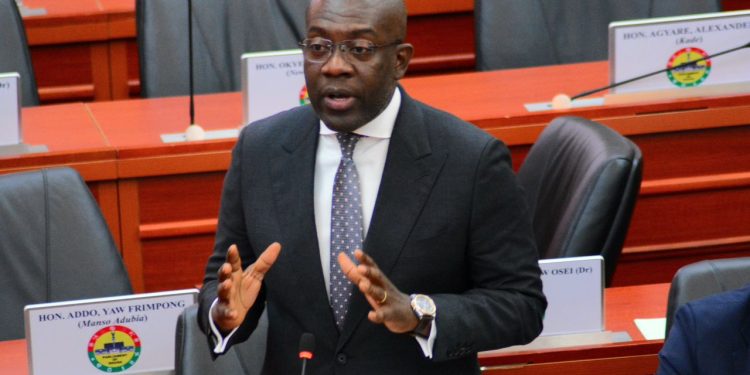
Speaking on the floor of Parliament while seconding a motion for the House to adopt the report of the Economy and Development Committee, the former Ofoase-Ayirebi MP said the government’s much-publicised 24-Hour Economy policy has yet to produce a single identifiable beneficiary operating under the model that was promised to Ghanaians during the 2024 election campaign.
According to Mr. Oppong Nkrumah, the 24-Hour Economy was marketed as a transformative industrialisation and employment programme built around a simple concept of “one job, three people, three shifts”—popularly referred to as the “1-3-3” model—which was expected to create thousands of new jobs through round-the-clock production in both the public and private sectors.
He recalled that since assuming office, the government has repeatedly been urged by the Minority to present its major policy documents to Parliament for scrutiny.
He noted that apart from the annual economic policy statements, the 24-Hour Economy policy document remains one of the few substantive policy frameworks officially submitted to the House, despite the administration nearing its second anniversary in office.
Mr. Oppong Nkrumah said Parliament has appropriated close to GH¢650 billion over the past two years to finance government programmes and interventions, yet the flagship policy that dominated the government’s campaign narrative has failed to demonstrate practical implementation.
He argued that after nearly two years, the government has not been able to identify even a single public institution operating under the promised “one job, three shifts” framework, describing that reality as the clearest indication that the programme has fallen short of the expectations created during the election campaign.
“For all the stories that were told and all the promises that accompanied the 24-Hour Economy, almost two years after assuming office, there is not one government agency implementing the one-three-three model,” he told Parliament.
The Ofoase-Ayirebi legislator said discussions during committee deliberations revealed that government is now shifting attention to two new pillars of the programme—constructing 24-hour markets and designing incentive packages for private sector operators.
He questioned whether building new markets would automatically result in continuous economic activity when many existing markets across the country already struggle to attract traders beyond designated market days.
Drawing from his own constituency, Mr. Oppong Nkrumah said Ayirebi already has a modern market that does not operate around the clock, adding that similar situations exist in many districts where markets become active only once a week.
According to him, simply constructing additional markets without expanding economic activity, production and consumer demand would not guarantee 24-hour trading.
He argued that government appears to be relying on assumptions rather than practical economic realities by expecting new infrastructure alone to transform commercial activity.
The Ranking Member also criticised government for admitting that the incentive framework expected to encourage private companies to adopt round-the-clock operations is still under development nearly two years after taking office.
He described this as evidence that the administration’s priorities have been misplaced.
According to him, while government has devoted considerable political attention to other legislative and governance matters, including constitutional and judicial issues, the incentives that could make the flagship economic programme operational remain outstanding.
Mr. Oppong Nkrumah said the delay undermines confidence in the programme because private investors require clear fiscal and regulatory incentives before committing to additional shifts, new production lines and expanded employment.
He further argued that the introduction of the 24-Hour Economy effectively displaced the One District, One Factory (1D1F) initiative, which, according to him, was already delivering measurable industrial outcomes.
Citing the National Development Planning Commission’s Annual Progress Report for 2024, published in June 2025, he said the official government document confirmed that at least 150 One District, One Factory projects were operational by the end of 2024.
He stressed that those figures did not originate from the Minority but from the NDPC’s own assessment of government programmes.
According to him, the policy architecture that supported the expansion of local manufacturing has since been abandoned and replaced by a programme whose key implementation components—including markets and incentives—are still being developed.
Mr. Oppong Nkrumah therefore urged government to reconsider its approach by returning to the One District, One Factory initiative while introducing reforms to address any weaknesses that may have existed in the programme rather than abandoning it altogether.
He maintained that government could improve and modernise the policy instead of replacing it with what he described as an unproven framework.
The Minority MP warned that the delay in implementing an effective industrialisation strategy carries significant consequences for employment, particularly among young people.
Quoting figures from the Ghana Statistical Service, he said youth unemployment has risen to approximately 32.4 per cent, arguing that every day without a functioning industrial policy translates into lost employment opportunities for thousands of young Ghanaians.
He said the suspension of One District, One Factory without a fully operational replacement has created a policy vacuum that is slowing industrial expansion and job creation.
Mr. Oppong Nkrumah also pointed to the automobile assembly programme introduced under the previous administration, noting that incentives granted to vehicle assembly companies formed part of the broader industrialisation strategy but have since been suspended under the government’s economic reset agenda.
According to him, companies operating in Ghana’s emerging automotive sector have already expressed concerns about the withdrawal of those incentives.
While supporting Parliament’s adoption of the committee’s report, Mr. Oppong Nkrumah concluded by urging government to urgently revisit its industrial policy direction, restore investor confidence, accelerate job creation and implement practical measures capable of addressing the country’s worsening youth unemployment challenge.
He maintained that the industrialisation agenda cannot afford prolonged delays, insisting that economic transformation must move beyond campaign promises to measurable results that create factories, expand production and provide sustainable employment for the country’s growing youth population.
Source: citinewsroom.com