

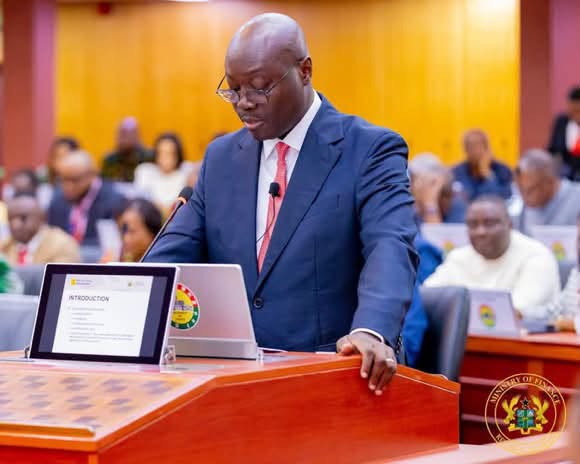
Dr. Cassiel Ato Forson, Ghana’s finance minister, has refuted claims that the country’s debt restructuring program and the International Monetary Fund’s (IMF) assistance are the only reasons for the country’s recent economic recovery, contending that policy changes and prudent economic management have been the primary forces behind stability.
Speaking to Parliament during the presentation of the 2026 Mid-Year Fiscal Policy Review, Dr. Ato Forson stated that while the IMF program and the Domestic Debt Exchange Programme (DDEP) offered significant assistance, they were unable to independently restore economic stability in the absence of solid policy implementation.
He added that while an IMF program might offer a framework, it could not take the place of sound economic management.
“Debt restructuring may create fiscal space, but it does not create fiscal discipline,” he stated.
The Finance Minister claimed that the government’s intentional reform program, which has been in place since January 2025 to stabilise the economy and restore investor confidence, has been the driving force behind Ghana’s recovery.
Physician Ato Financial institutions, private investors, retirees, and both local and foreign bondholders experienced large losses as a result of the last debt restructuring effort, according to Forson, who acknowledged its terrible effects.
He stated that bondholders suffered “crude and painful haircuts” as a result of the restructuring process, with many losing a percentage of their lifetime savings.
According to the Finance Minister, the economic crisis also caused job losses, business closures, company relocations, and increased difficulty for people who had previously been able to leave poverty.
He explained that the current administration’s predicament is the result of poor economic management, excessive borrowing, insufficient accountability, and fiscal indiscipline.
Dr. Ato Forson said the experience should serve as a reminder of the need to protect Ghana’s macroeconomic stability and prevent a repeat of the crisis.
He stated that the government acted swiftly to enact fundamental reforms after taking power, claiming that the economy needed more than short-term fixes.
He addressed Parliament, “The progress Ghana is recording today did not happen by chance,” emphasising that the improvements were the result of conscious policy decisions rather than just outside influences.
According to the finance minister, maintaining the recovery will require strong economic reforms, credible policies, and ongoing fiscal restraint.
He maintained that in order to avoid future fiscal vulnerabilities and excessive borrowing, Ghana must learn from the economic crisis.
Source: newsthemegh.com