

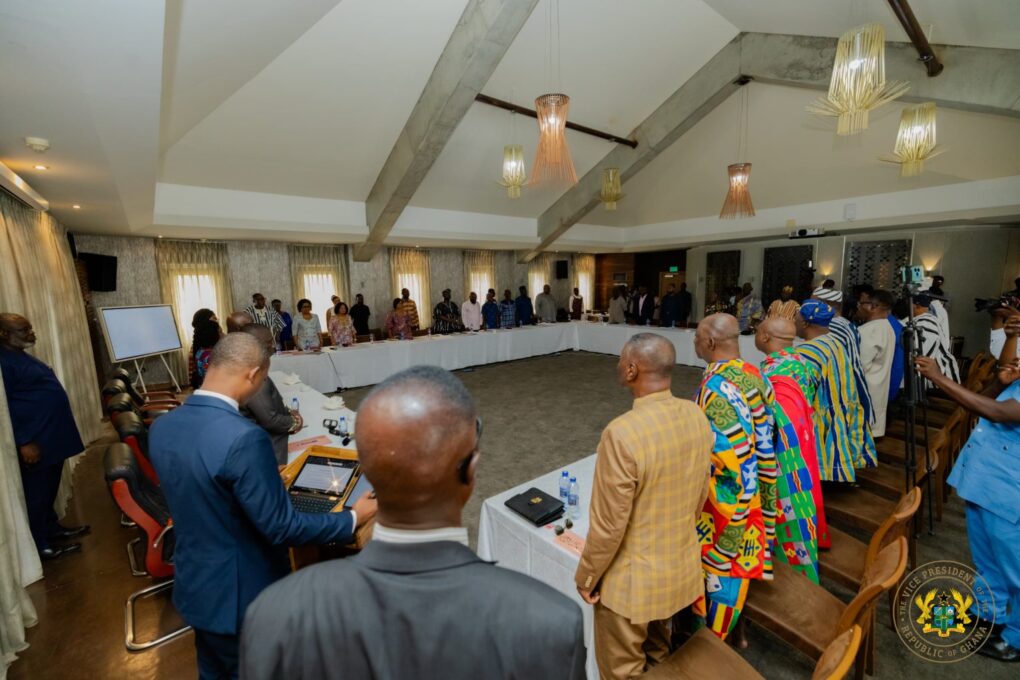
The Council of State has expressed strong support for the Bank of Ghana’s economic stewardship and urged the central bank to launch a sustained public education campaign to bring the story of Ghana’s economic recovery to a wider national audience, following a comprehensive briefing by Governor Dr. Johnson Asiama.
Members of the 31-member constitutional advisory body participated actively and substantively in the session, which was led by the Council’s Chairman and former Speaker of Parliament Edward Doe Adjaho. The topics covered ranged from exchange rate frameworks and regulation of digital finance to the transmission of macro stability into household living costs.
The Governor presented the Council with a thorough explanation of the Bank’s policy history and quantifiable results. As of March 2026, inflation has dropped to 3.2 percent for the fifteenth consecutive month after starting 2025 at 23 percent.
At a record-breaking US$14.5 billion, gross overseas reserves can cover imports for 5.8 months. In a same vein, the GDP grew by 6.0% and the cedi increased by about 41% over 2025.
Direct public interaction emerged as a major subject in the conversation that followed. Members of the council strongly urged the central bank to explain the mechanics of reserve accumulation, the reasons behind disinflation, and the policy decisions that have supported the cedi’s recovery to Ghanaians of all demographics in plain, understandable language.
They also urged the central bank to establish a meaningful space where the public can ask questions and be heard.
Governor Asiama spoke about the Bank’s financial situation, stating that expenses that are the direct accounting equivalent of the stabilisation attained will be shown in the 2025 accounts.
The income from the Bank’s government securities portfolio was decreased by the Domestic Debt Exchange Programme (DDEP).
Interest costs have been associated with open market operations used to reduce inflation. However, the initial cost of the gold purchasing program has decreased and it has produced significant returns.
The value of foreign-currency assets was adjusted as a result of the cedi’s increase.
The Governor made it clear that none of these elements affect the Bank’s ability to operate or carry out its mandate.
Beyond the Bank’s finances, Council members welcomed the chance to discuss forward-looking priorities, such as improving regulatory clarity for virtual assets and digital currencies, strengthening exchange rate management frameworks, and addressing the impact of import prices on household budgets. They stated that a shared commitment is essential to ensuring that macroeconomic gains are increasingly felt in citizens’ daily lives.
Regarding the future, the Governor informed the Council that oil prices above $100 per barrel are a new obstacle and that the world environment has grown more unpredictable.
However, he pointed out that Ghana has more robust external safeguards going into this phase than at any other time in recent memory.
The Governor also stated that the Bank’s goals for 2026 include the consolidation of stabilisation gains, export financing development, banking sector governance, and control of credit quality.
Former heads of state, regional delegates, and other notable citizens make up the Council of State, a constitutional advisory body created under Article 89 of Ghana’s 1992 Constitution.
It acts as a formal consultative forum on important policy issues and advises the President on subjects of national concern.
Source: newsthemegh.com