
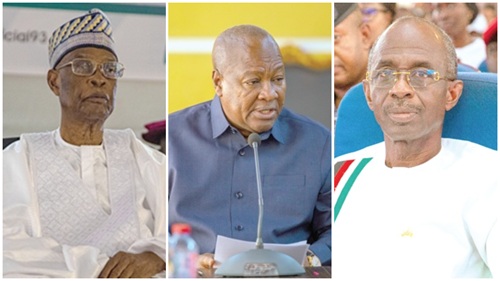
Kester Aburam Korankye | The writer is the Presidential Affairs Correspondent of the Daily
It happened in Doli, near Bole.
In the President’s own hometown.
In the heartland of the Savannah Region.
And if you were not at that event, where President John Dramani Mahama cut the sod for the construction of the Bole College of Education, you missed the most candid political signal of the post-election season.
I was there. During President John Dramani Mahama’s ongoing #ResettingGhana Tour, with senior government officials gathered, the Minister of Education, Haruna Iddrisu turned to the President, and said words that cut through the event’s diplomatic air: “If no one will say it, I will.”
What followed was a pointed remark directed at NDC National Chairman, Johnson Asiedu Nketiah, whose thank-you tour had been drawing quiet but growing unease within party ranks.
Mr Iddrisu drew a sharp distinction between President Mahama’s official post-election thank you tour and what he termed a “curtain raiser”, an apparent reference to the separate tour being conducted by Mr Nketiah.
Haruna’s message was unmistakable: the chairman’s tour was beginning to look less like gratitude and more like groundwork.
The coach who wants to play
Mr Nketiah has long described himself as the coach, the man who builds the team, prepares the strategy, and sends the players onto the field.
It is a brand he has cultivated carefully across decades of NDC’s internal politics.
But something has shifted. His visibility in recent months has carried a different energy.
The thank-you tour, sustained well beyond any ceremonial justification, reads in political circles as a man testing the temperature of his own presidential ambitions.
The NDC Council of Elders, chaired by Alhaji Mahama Iddrisu, apparently reached the same conclusion.
A cease and desist notice issued just days ago was not subtle.
“At this critical stage of national reconstruction and renewal, every member of the party is expected to devote his or her energies, resources, and commitment to supporting the government’s efforts to reset the country and improve the lives of Ghanaians, rather than engaging in activities that have the potential to create division, distraction, or unnecessary internal competition,” a statement from the Elders said.
“These include all forms of campaigning, mobilisation, endorsements, publicity, or related activities intended to advance the presidential ambitions of any prospective candidate,” it added.
In NDC’s political culture, the elders do not move without consensus, and they do not issue public rebukes lightly.
That intervention was a message delivered with institutional weight: know your lane.
Whether Mr Nketiah heeds it remains to be seen. His grassroots capital is real and should not be underestimated. He knows where every delegate sits and can move party structures with a phone call. But a chairman who has been publicly checked by elders loses a measure of the mystique that makes kingmakers powerful.
The question is no longer whether he wants to run.
The question is whether the party will let him.
The most interesting politician in the room
Which brings us back to Haruna Iddrisu, and why the Doli moment matters beyond its immediate drama.
Haruna is the only prominent figure in Ghana’s political space who has publicly and repeatedly named Naana Jane Opoku Agyemang as his preferred next president.
He has done so more than once, without prompting, and without the hedging that characterises most political speech in this country. In a field full of men carefully positioning themselves, that kind of declarative selflessness is either deeply genuine or deeply strategic, and in politics, the two are rarely as different as they seem.
Consider what it signals. A man who names someone else for the top job while simultaneously demonstrating the boldness to challenge a powerful party chairman in the President’s own hometown is not fading into the background. He is building a profile: principled, courageous, capable of speaking truth to power.
That is the profile of a running mate, or of a flagbearer patient enough to wait his turn.
The battle NDC has not yet named
What is unfolding inside the NDC is not yet a declared succession contest.
No one has formally declared.
No campaign offices have opened.
But the manoeuvring is real, the signals are deliberate, and those with eyes on the party know it.
The Finance Minister, Ato Forson, brings economic credibility and a fighting record in opposition that the grassroots remember.
The Chief of Staff, Julius Debrah, commands quiet influence from the machinery of government.
Naana Jane carries the weight of a winning ticket and the historic possibility of Ghana’s first female president.
Each represents a distinct vision of what NDC’s next chapter looks like.
But what happened in Bole must inform us that the succession conversation has already left the private rooms and entered the public space, even if no one is ready to call it what it is.
When a senior minister says “if no one will say it, I will,” the succession war has begun. NDC just has not announced it yet.
Source: graphic.com.gh