
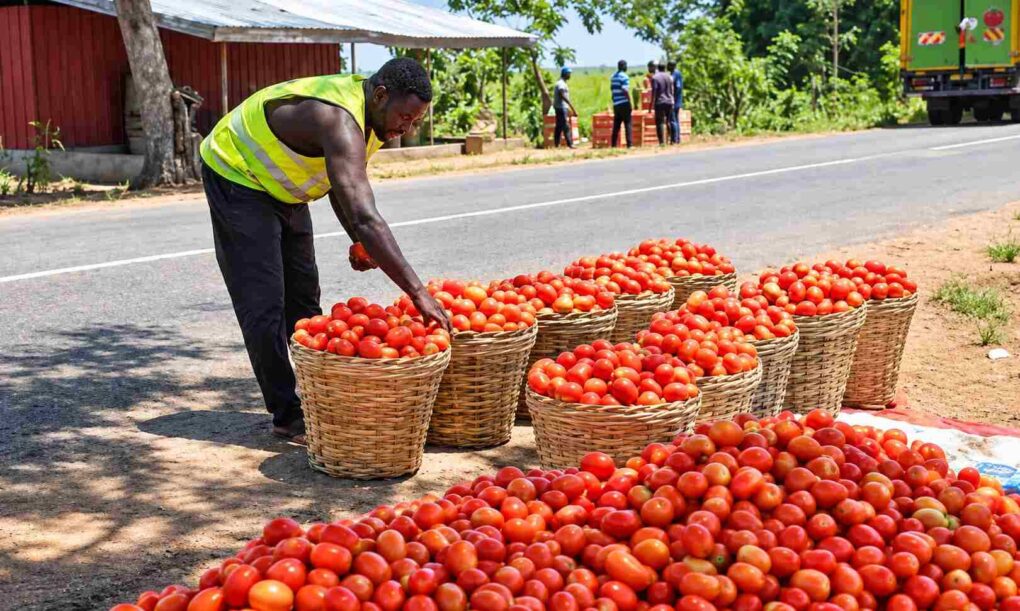
Fresh tomatoes, rent payments and ginger were the biggest contributors to Ghana’s 5.2% inflation rate in September 2026, highlighting significant differences in the cost of living despite the country’s sharp decline in inflation over the past year.
Data from the Ghana Statistical Service (GSS) show that fresh tomatoes alone contributed 20.3% to the overall September inflation rate. Rent payments followed with 13.9%, while ginger accounted for 9.9%.
Other major contributors included cooked rice at 7%, while bus and trotro fares and yam each contributed 5.4%.
Fresh Tomatoes Record 153.4% Price Increase
Presenting the latest Ghana inflation data, Government Statistician Dr. Alhassan Iddrisu explained that the national inflation rate does not fully capture the different price experiences faced by consumers across individual products and markets.
He noted that while Ghana recorded a national inflation rate of 5.2% at the end of September 2026, households experienced significantly different price changes depending on the goods and services they purchased.
Fresh tomatoes recorded the highest inflation rate among the items tracked, with prices increasing by 153.4% year-on-year.
This means the price of fresh tomatoes was approximately two and a half times higher in September 2026 than it was a year earlier.
Ginger recorded the second-highest increase, with inflation of 100.4%, indicating that its price had roughly doubled over the same period.
Other products with substantial price increases included shrimps at 62.8%, mangoes at 46.6%, and packing space and related services at 40%.
Food Supply Remains Key Inflation Concern
The sharp increases in tomato and ginger prices have renewed concerns about the impact of fresh food supply and agricultural production on Ghana’s inflation rate.
According to the Government Statistician, tomatoes and ginger alone accounted for approximately 30% of the national inflation rate, underscoring the importance of improving food supply chains and addressing domestic production challenges.
The figures suggest that food availability, transportation, storage and distribution could continue to influence food prices and the cost of living in Ghana.
Some Food Prices Fall Sharply
While several food products recorded significant price increases, other commodities became considerably cheaper compared with September 2025.
Lime recorded the biggest price decline at 29.9%, followed by maize at 26.4%, foreign apples at 24.1%, bambara beans at 21.7%, and carrots at 21.5%.
The contrasting price movements demonstrate the wide differences in consumer experiences across Ghana’s markets.
Services Inflation Remains High at 8.3%
The services sector has also emerged as a major source of inflationary pressure in Ghana.
Services inflation reached 8.3% in September 2026, significantly higher than goods inflation of 4.2%. This means prices for services were increasing at nearly twice the rate of prices for goods.
Housing, rent, restaurants and transportation were among the services contributing to the higher inflation rate.
Dr. Alhassan Iddrisu described services inflation as one of the key remaining challenges that must be addressed to achieve greater price stability.
Local Products Drive Majority of Ghana’s Inflation
The latest GSS figures also indicate that Ghana’s inflation is being driven largely by domestically produced goods and services.
Local items accounted for approximately 86% of total inflation in September 2026, while imported products made up the remaining share.
The development suggests that domestic production costs, food supply, transportation, housing and other local economic factors are playing a bigger role in determining consumer prices.
The Government Statistician said the trend should inform government policies aimed at addressing food supply challenges, domestic production costs and cost-of-living pressures.
Inflation Varies Widely Across Ghana’s Regions
The national inflation figure also masks substantial regional differences in price movements.
The Ashanti Region recorded the highest inflation rate at 9.8%, while the Western Region recorded negative inflation of -0.5%.
The wide gap demonstrates how the cost of living can differ significantly depending on where consumers live in Ghana.
Dr. Iddrisu said the regional inflation data should help government, businesses and households identify areas experiencing the strongest price pressures.
GSS Advises Government, Businesses and Households
The Ghana Statistical Service has encouraged policymakers to use the official Consumer Price Index (CPI) when developing budgets, subsidies and targeted economic support programmes.
Businesses have also been advised to rely on official inflation statistics when making pricing decisions and negotiating contracts instead of depending on market rumours.
For households, the moderation in food inflation provides some relief. Food inflation declined to 4% in September 2026, compared with 11% a year earlier.
The reduction could provide households with greater room to plan their spending, manage household budgets and increase savings, even as rising prices for selected food items, rent and services continue to create cost-of-living challenges.
Overall, the September inflation figures show that while Ghana’s headline inflation has improved significantly, price pressures remain uneven, with fresh food, housing and services continuing to weigh heavily on household finances.
Source: newsthemegh.com