

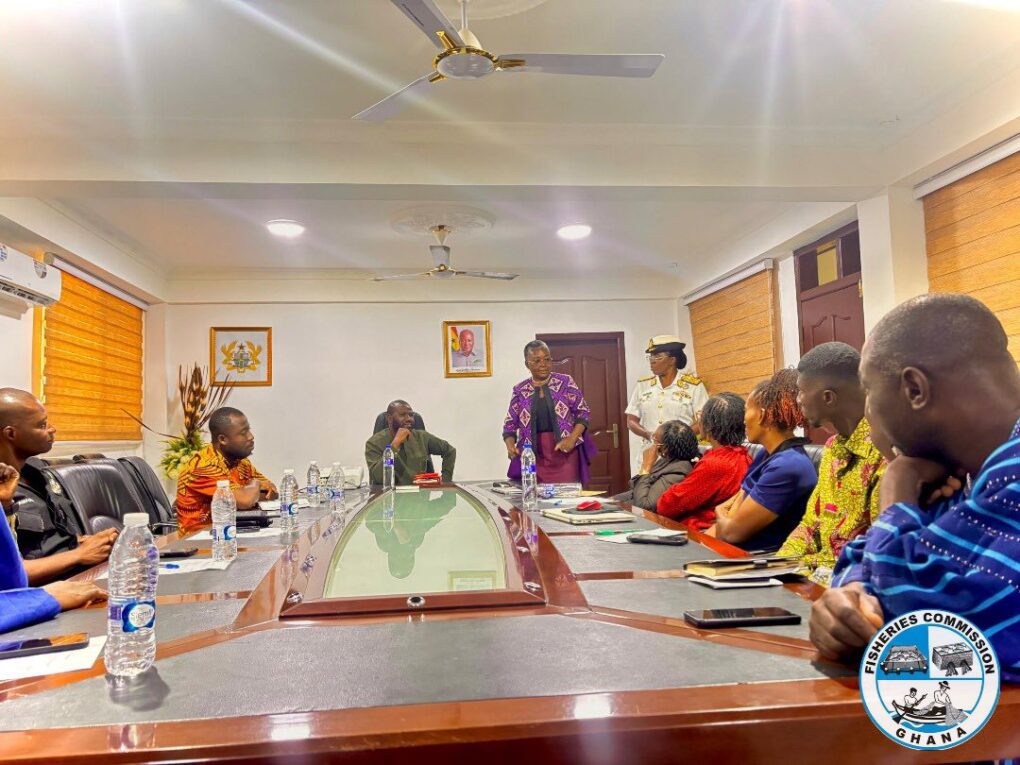
A stakeholder engagement meeting was convened at the Ministry of Fisheries and Aquaculture conference room by the Fisheries Commission and important partners to discuss the low license compliance among operators of inshore fishing vessels.
During his speech, Professor Benjamin Campion, the Commission’s Executive Director, reaffirmed the Commission’s efforts to guarantee that all semi-industrial (inshore) fishing vessels are fully licensed as required by the Fisheries Act, 2002 (Act 625) in Ghanaian waters.
In addition to being a legal need, he underlined that licensing is an essential tool for controlling fishing activity, preserving our fish stocks, and securing livelihoods for coming generations.
Unfortunately, there are still a lot of boats operating without the proper permissions.
According to the ED, this undercuts group efforts to manage marine resources sustainably, resulting in lost state revenue and unfair competition for fishermen who comply.
The Executive Director told the group that the Commission is collaborating closely with the Ghana Inshore Fishers Association, the Navy, the Marine Police, traditional leaders, the Ministry of Fisheries and Aquaculture, and civil society partners to:
I. Identify and document unlicensed vessels
ii. Engage fishing communities on the importance of compliance
iii. Strengthen enforcement operations at sea and landing sites
iv. Promote policy solutions that make licensing more transparent and efficient
A few issues facing the subsector were brought up by the inshore operators in attendance, and they were urged to submit a position paper to the Commission for review.
In his concluding remarks, Professor Campion expressed gratitude to the inshore operators for accepting the invitation and called on all parties involved to cooperate in order to guarantee that all vessels have licenses, that all fishermen are aware of their rights, and that our marine resources are preserved for future generations.
Source: newsthemegh.com