

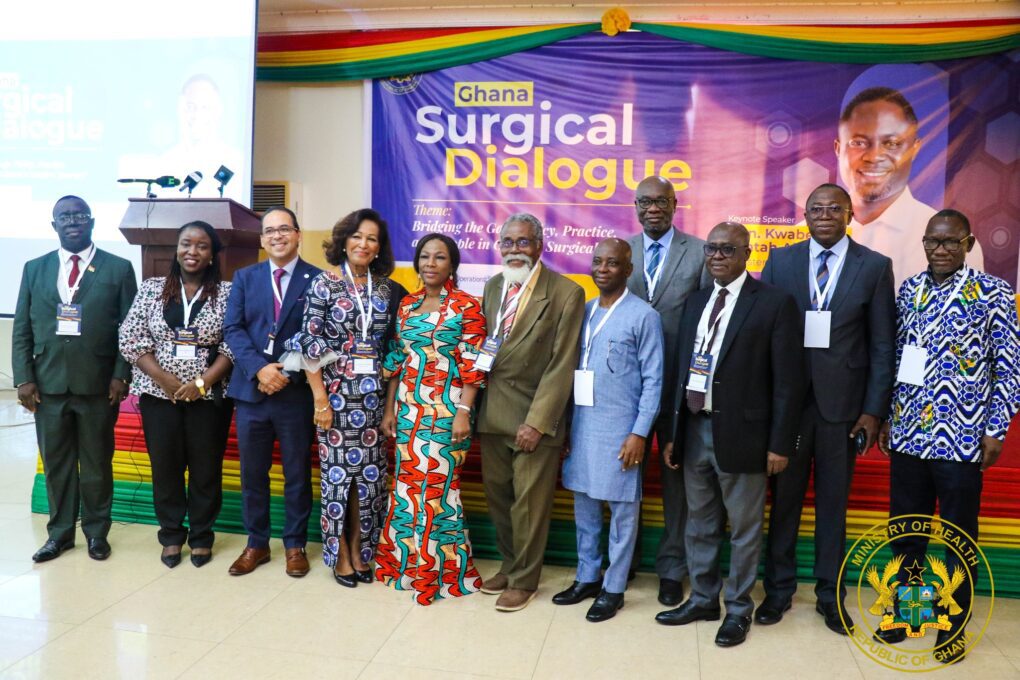
The Ministry of Health has organized a two-day Surgical Dialogue in collaboration with Operation Smile and Mercy Ships to discuss the main issues affecting Ghanaian surgical, obstetric, trauma, and anesthesia (SOTA) delivery care.
Taking place under the theme “Bridging the Gap: Policy, Practice, and People in Ghana’s Surgical Journey,” the event brought together stakeholders to discuss urgent topics such as clinical practices, national surgical policies, and how to prioritize surgical treatment for people.
Deputy Minister Hon. Prof. Dr. Grace Ayensu-Danquah, speaking on behalf of the Hon. Minister for Health, highlighted the importance of training and deploying more specialists, such as surgeons, anesthetists, cardiologists, oncologists, nurses, biomedical engineers, and other professionals whose skills are essential to managing complex conditions and non-communicable diseases (NCDs).
“We know that surgery saves lives. It restores dignity, prevents disability, and offers hope where once there was despair,” she said.
Over the past 20 years, Ghana has achieved significant strides in enhancing medical education, developing emergency response systems, and growing healthcare infrastructure because of strategic investments, dedicated leadership, and solid cross-sector relationships, according to Prof. Dr. Ayensu-Danquah.
She did, however, draw attention to the continuing serious deficiencies, including the fact that many rural areas lack access to even basic surgical treatments and that the surgical personnel is dispersed unevenly, leaving certain areas without sufficient coverage.
According to the Deputy Minister, the upcoming Mahama Cares program is a bold and revolutionary health endeavor that will completely change how Ghana prevents, diagnoses, and treats noncommunicable diseases.
“Mahama Cares places prevention at the forefront, integrating screening and early detection into primary healthcare, expanding access to essential medications, and improving referral systems for specialist care,” she added.
She also exhorted the medical community and professional associations to uphold the highest standards of care and lead with integrity going forward.
Mr. Desmond Boateng, the chief director of the Ministry of Health, pointed out that many Ghanaians still do not have access to reasonably priced and safe surgical procedures.
“The disparities between urban and rural care, the delays in treatment, and the financial burden on patients highlight the urgent need for systemic change,” he said.
Dr. John Nkrumah Mills, the immediate past president of the Ghana College of Physicians and Surgeons and the chairman of the Implementation Steering Committee of the country’s National Surgical Obstetrics and Anesthesia Plan (NSOAP), urged governments to take decisive action and integrate the NSOAP into the national health system. To get UHC, SOTA care must be a right rather than a privilege.
A high-level panel discussion on influencing surgical policy, funding surgical care in Ghana, and advancements in SOTA care delivery was also included in the debate.
Surgeons, nurses, anesthetists, biomedical engineers, healthcare professionals, policymakers, researchers, advocates, and international development partners from the Ghana Health Service across the Regions and Districts, CHAG, WHO, Ghana College of Physicians and Surgeons, Ghana College of Nurses and Midwives, National Cardiothoracic Center, NHIA, Ministry of Finance, PHFAoG, Banks, and other organizations were among the participants.
Operation Smile and Mercy Ships, working closely with the Ministry of Health and with assistance from Stanbic Bank Ghana, provided funding for the Ghana surgical dialogue.
For additional details, collaborations, and partnerships about Ghana’s NSOAP implementation, please reach out to the Ministry of Health’s NSOAP Desk (HRHD – TDU) via email at [email protected] or by WhatsApp at +233244729050.


Source: newsthemegh.com