

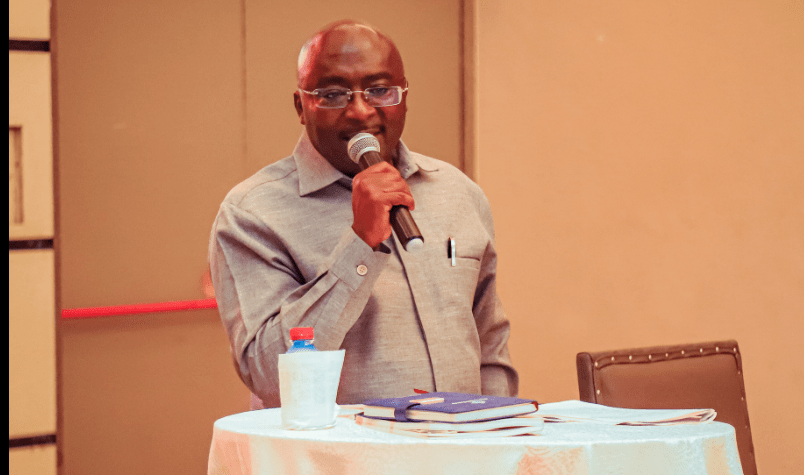
Former Vice President Dr. Mahamudu Bawumia has called on Ghanaians to prepare for higher taxes and criticized the NDC government for enacting a new tax after opposing the E-levy and then repealing it.
At the conclusion of his Central Region ‘Thank You Tour’, he spoke in Cape Coast and accused the NDC of misleading Ghanaians during the 2024 election by making false promises and acting in a way that was inconsistent with their statements.
“The NDC has told a lot of lies. Everyone sees their lies every day. Last night, I hope you all saw it. They have introduced a dumsor Levy.”
He claims that the recently implemented fuel tax is significantly more expensive than the e-levy that was abandoned.
“Initially, they said they would scrap the E-Levy we had introduced, and they’ve done that. But now, they have introduced the Dumsor Levy, and it is eight times the E-Levy. Now, when you buy one litre of petrol, you will pay one cedi as tax,” he stated.
Dr. Bawumia illustrated the new tax’s greater cost by contrasting the two levies. “If you buy 1,000 cedis worth of fuel, you will pay 83 cedis as tax. With the E-Levy, if you sent 1,000 cedis to someone, you would only pay 10 cedis. But under them, for 1,000 cedis worth of fuel, you’ll pay 83 cedis.”
Additionally, he cautioned Ghanaians that the present government will likely increase taxes even further.
“And more is yet to come. By the time we get to 2028, Ghanaians will see that they have truly lied to us,” he said.
Dr. Bawumia said he was confident Ghanaians would eventually demand that the NPP take back power. By then, he continued, “I think they’ll ask us to return and properly govern Ghana.”
The recently approved GH¢1.00 petroleum levy has been supported by John Jinapor, Minister for Energy and Green Transition, who claims that it is the appropriate time to implement it and that it is a responsible fiscal intervention required to stabilize the nation’s energy sector.
Mr. Jinapor clarified in an interview on Joy FM’s SMS on Wednesday, June 4, that the government decided against enacting the charge when it took office since petroleum goods were so expensive at the time.
Source: newsthemegh.com