

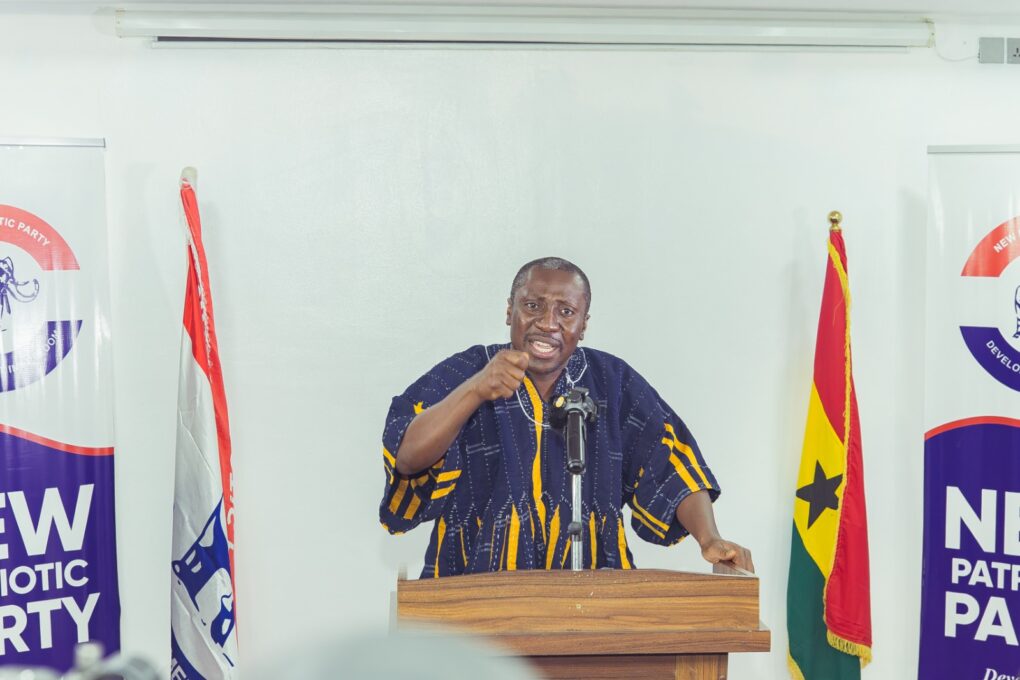
Alexander Kwamena Afenyo-Markin, the minority leader and Member of Parliament (MP) for Effutu Osahen, vehemently denounced Abronye’s arrest and custody, calling it a “constitutional outrage” and a grave danger to free expression and democratic governance in Ghana.
He contended that the prosecution and denial of bail for the Bono Regional Chairman of the New Patriotic Party (NPP) are strikingly similar to the intimidation and repression connected to the military junta of the Provisional National Defence Council (PNDC), which gave rise to the current National Democratic Congress (NDC).
Due to an antiquated legislation, Abronye was detained and placed under two weeks of remand by an Accra Circuit Court for vehemently characterising a judge’s rulings as politically motivated.
The Minority Leader said that the treatment of the NPP regional chairman amounted to political persecution during a press conference on Sunday, May 17, 2026.
He insisted that Abronye be freed from the Bureau of National Investigations’ (BNI) custody right away.
He gave notice that the NPP legal team would launch a comprehensive constitutional challenge to these persecutions, including a challenge to the use of Act 29’s Sections 207 and 208, which allow for the wanton detention of people who voice their ideas.
He contended that these archaic clauses prohibit political speech and that those who feel defamed have access to sufficient civil remedies.
Osahen Afenyo-Markin also challenged the court’s decision to deny Abronye bail, calling it illegal and at odds with the presumption of innocence and liberty.
He said that the prosecution objected bail on the basis that Abronye would conduct similar crimes if freed, which he claimed essentially punishes a citizen for what he “might say” rather than what he has been shown to have done.
“A citizen imprisoned not for what he did, but for what he might say. That is not law. That is censorship from the bench,” he said.
He contended that Abronye’s charges are misdemeanours, pointing out that the accused has a fixed residence, obligations to his family, and recognised sureties.
Denying bail in these situations, according to the Minority Leader, violates Articles 14 and 19 of the Constitution, which protect individual freedom and the assumption of innocent.
Osahen Afenyo-Markin also requested that the Constitutional, Legal, and Parliamentary Affairs Committee of Parliament summon the Inspector General of Police and the Director-General of the BNI to publicly answer for all decisions made in this case.
“Ghana’s civil society, independent media and legal profession must add their voices now. The time to defend freedom is always before it is fully lost. Never after. We call upon the High Court to take urgent cognisance of Mr. Abronye’s detention and the reported absence of a signed and certified remand order. The writ of habeas corpus exists for precisely this moment. The judiciary is the last line of defence between the citizen and the unchecked power of the Executive. We call upon it to stand and be counted,” the Minority leader reiterated.
He asserts that it is an abuse of governmental authority and a violation of constitutional rights to prosecute a person for remarks they make in public.
On May 13, 2026, Abronye was arraigned in Circuit Court 9 in Accra on two charges under the Criminal Offences Act, 1960: publishing false information and engaging in obnoxious behaviour conducive to a breach of peace.
The accusations are based on a social media video in which the vocal NPP regional chairman questioned the impartiality and behaviour of a Circuit Court judge while performing judicial duties.
Osahen Afenyo-Markin contended that the 1992 Constitution’s Article 21(1)(a), which ensures freedom of speech and expression, protects criticism of public authorities, including judges.
He accused the state of trying to make political criticism illegal and insisted that the case was without merit.
“Since when did criticising a judge become a criminal offence in Ghana?” he enquired.
The Minority Leader further argued that the prosecution must demonstrate that the accused intentionally published false material in order for the false publishing allegation to be upheld.
Asserting that the state intelligence agency is not a remand prison, the Effutu MP expressed additional reservations with the decision to place Abronye DC under the BNI’s control.
He wondered why a political commentary issue had been turned into what seemed to be a national security concern.
Osahen Afenyo-Markin further noted that the defence team had not received a signed and certified remand order through the court registry four days after it was issued.
He lamented that the Ghana Police Service’s decision to place Abronye under BNI custody creates significant legal and constitutional issues.
Remand orders are not spoken directives. He emphasised that the impairment of a citizen’s liberty must be based on this formal legal instrument.
The Minority Leader cautioned that the imprisonment might constitute an illegal deprivation of liberty in violation of Article 14 of the Constitution if the lack of a signed remand order is verified.
Osahen Afenyo-Markin’s speech was primarily concerned with what he called moves by the current administration to indirectly reintroduce criminal libel legislation.
He described the removal of Ghana’s seditious and criminal libel laws in 2001 under former President John Agyekum Kufuor as a historic democratic move supported by former Attorney General Nana Addo Dankwa Akufo-Addo.
He says that the current administration is using regulations pertaining to false publishing and offensive conduct to attack opposition voices because it is unable to publicly reinstate criminal libel legislation.
“The charges against Abronye DC and others are, in substance and effect, criminal libel prosecutions. The only difference is the label on the charge sheet,” he contended.
He warned against what he saw as a slow return to the “culture of silence” and accused the government of using public institutions as weapons against political opponents.
David Essandoh, Baba Amando, Alfred Ababio Kumi (Adenta Kumi), and Assin South MP John Ntim Fordjour were allegedly arrested and investigated in a number of recent incidents involving opposition individuals and NPP communicators, according to the Minority Leader.
He condemned these instances as part of a larger pattern of intimidation intended to silence government critics.
He declared, “This is state-sponsored political persecution, and it must stop.”
Osahen Afenyo-Markin emphasised that the courts must act as protectors of liberty rather than as tools of state authority and called on the judiciary to maintain its independence and withstand political pressure.
Additionally, he urged the media, the legal profession, and civil society organisations to speak out against what he called the “shrinking democratic space.”
Osahen Afenyo-Markin issued a warning against any attempt to weaken Ghana’s constitutional liberties.
He stated that political intimidation should not be allowed to undo the nation’s hard-won transition from authoritarian control to constitutional democracy.
“The culture of silence is not coming back to Ghana. Not now. Not on our watch. Not ever,” he said.
Source: newsthemegh.com