

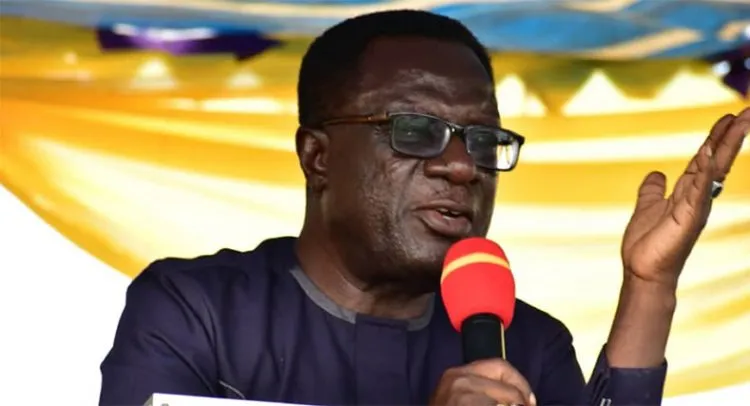
The High Court in Accra has granted GH¢10 million bail to Professor Christopher Ameyaw-Akumfi, the former Board Chairman of the Ghana Infrastructure Investment Fund (GIIF). Two sureties are included with the bail, and each must provide evidence of Accra-based landed property.
The 80-year-old statesman and scholar, who was a cabinet member under President John Agyekum Kufuor, is accused of being involved in the $2 million Sky Train project that collapsed and is now facing four charges. On Monday, May 26, 2025, he entered a not guilty plea to all counts.
Professor Ameyaw-Akumfi’s bail requirements include reporting to the police once a week and depositing his passport and all other travel documents with the court registry.
Justice Afia Serwah Asare-Botwe, the presiding judge, called a case management meeting for June 10 at 10:00 a.m. to establish deadlines for pre-trial motions and lay out the course of what is expected to be a significant legal battle.
The professor’s attorney made a compelling bail application, pointing out his advanced age and declining health, and the court’s ruling followed. The attorney informed the court that the accused had willingly provided his passport to the registry and was not a flight risk.
The submission of supporting medical records verified that the professor had recently had a coronary angiography and hip surgery. Additionally, he is reportedly controlling his mobility issues and hypertension.
“He is a man of high repute and long-standing public service, who has always cooperated with investigative authorities,” the defence counsel argued.
Professor Ameyaw-Akumfi, who lives in Pokuase in the Greater Accra Region, has held important positions in the past, such as chair of state organizations like the Public Procurement Authority and GIIF, Minister of Education, and Minister of Ports and Harbours.
The charges include
The former GIIF board chair is facing the following charges:
Count 1: Conspiracy to commit a crime — wilfully causing financial loss to the state.
Count 2: Wilfully causing financial loss to the state.
Count 4: Conspiracy to commit a crime — intentional dissipation of public funds.
Count 6: Intentional dissipation of public funds.
All of the costs are related to a $2 million payment that GIIF made to Africa Investor Holdings Limited in 2019 for preparatory work on the light rail system that was never built, the Accra Sky Train.
State prosecutors claim that GIIF’s internal governance protocols were broken and that the payment was authorized without the required board permission. The money was intended for a project that lacked fundamental due diligence and was just in the conceptual stage.
Professor Ameyaw-Akumfi is on trial alongside Solomon Asamoah, the former CEO of GIIF, who has been granted bail and is facing similar allegations.
The fees are related to GIIF’s $2 million payment to Africa Investor Holdings Limited in 2019 for preparatory work on the Accra Sky Train project. The urban rail project, which was promoted as a revolutionary public transportation option, was never put into action.
The Attorney General’s Department claims that neither internal governance protocols nor appropriate board authorization was followed in making the payment.
Earlier this month, charges were brought against Mr. Solomon Asamoah, who was the CEO of GIIF at the time, and Prof. Ameyaw-Akumfi.
The payment, according to the prosecution, broke important clauses of the Public Property Protection Decree and the Criminal Offenses Act.
The Sky Train and National Service Scheme (NSS) ghost-names investigation is one of the most well-known financial malfeasance cases in which the government has stepped up attempts to hold public officials accountable.
Earlier this month, charges were brought against Mr. Solomon Asamoah, who was the CEO of GIIF at the time, and Prof. Ameyaw-Akumfi.
The payment, according to the prosecution, broke important clauses of the Public Property Protection Decree and the Criminal Offenses Act.
The Sky Train and National Service Scheme (NSS) ghost-names investigation is one of the most well-known financial malfeasance cases in which the government has stepped up attempts to hold public officials accountable.
Source: newsthemegh.com