

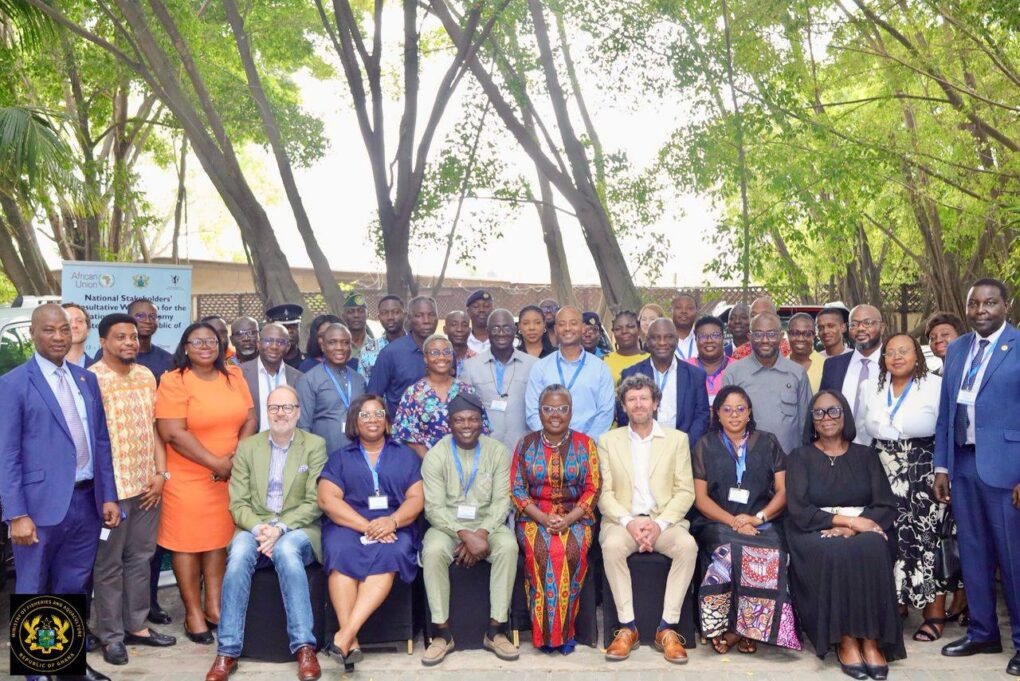
The Ministry of Fisheries and Aquaculture, in collaboration with the African Union Inter-African Bureau for Animal Resources (AU-IBAR), will hold a three-day technical workshop at the La Villa Boutique Hotel from December 15th to 17th, 2025, to finalise Ghana’s Blue Economy Strategy’s Implementation Plan and cost-estimating framework.
The Strategy, titled “A Strategic Framework to Sustainably Develop Ghana’s Marine, Coastal, and Inland Aquatic Assets,” was created after Cabinet approved a coordinated national approach to harnessing Ghana’s marine, coastal, and inland water resources.
The goal is to foster long-term economic growth, food security, climate resilience, job creation, particularly among women and youth, and increased access to blue finance.
The Strategy was validated through national stakeholder sessions in September 2025 using an evidence-based and participatory approach. To guarantee successful implementation, a thorough strategy and draft implementation plan were created and are currently undergoing final technical evaluation, prioritising, and costing.
The workshop’s main goal is to evaluate and improve the implementation framework in order to make it practical, realistic, and in line with national development priorities.

Speaking on behalf of the Ghanaian government, Hon. Emelia Arthur, Minister for Fisheries and Aquaculture, stressed the significance of posing pertinent questions in order to prioritise the Implementation Plan.
She pointed out that this method will assist in getting the right answers needed for precise costing and successful implementation of Ghana’s Blue Economy Strategy.
She emphasised that a credible and workable approach must be built around these driving questions.
The Minister also asked participants to focus especially on creating an institutional architecture for the proposed Blue Economy Commission, which would include hiring personnel, setting up offices, and appointing a governing board and an executive director.
She thanked AU-IBAR for its ongoing assistance and significant contributions to Ghana’s efforts to develop a strong Blue Economy Strategy.
Key Ministries, Departments, and Agencies (MDAs) with mandates pertaining to ocean governance, coastal management, fisheries, maritime security, environmental protection, climate resilience, transportation, and other blue economy sectors are among the participants in the workshop.
H.E. Dr. John Mikal Kvistad, the Norwegian ambassador, Ms. Linda Amorngeh-Oje Etta from the African Union Commission (AUC), and Mr. Obinna Anozie from AU-IBAR are among the dignitaries in attendance at the workshop’s opening.
A revised, costed, and prioritised implementation plan that would direct Ghana’s Blue Economy Strategy’s successful deployment is anticipated to be produced by the workshop.


Source: newsthemegh.com