
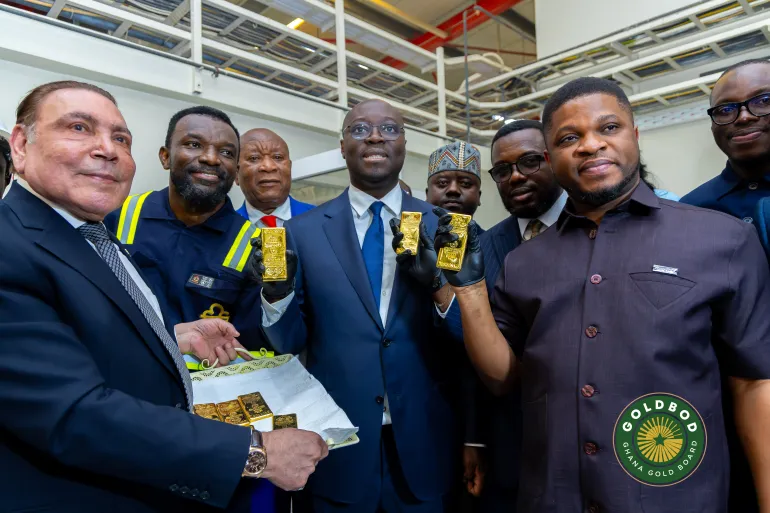
The Ghana Gold Board (GoldBod) has introduced a new requirement compelling certain gold exporters to refine gold dore in Ghana before exporting it, as the government intensifies efforts to retain more value from the country’s lucrative gold industry.
The directive, which took effect on September 1, 2026, applies to Self-Financing Aggregators (SFAs). GoldBod has barred SFAs from exporting gold dore purchased under arrangements with approved offtakers unless the gold has first undergone local refining in Ghana.
The directive was issued by GoldBod’s Compliance Directorate on August 24, 2026, under the Ghana Gold Board Act, 2025 (Act 1140).
The legislation established GoldBod as the authority responsible for overseeing key aspects of Ghana’s gold industry, including the buying, selling, assaying, refining and export of gold.
Ghana Seeks More Value From Gold Industry
Clement Edem Asare Morjah, Chief Executive Officer of United Gold International Limited, a licensed Self-Financing Aggregator, described the new policy as a major shift in Ghana’s approach to managing its natural resources.
According to Morjah, the local refining requirement could enable Ghanaian companies to retain profits and processing margins that have traditionally gone to foreign refineries.
He said the policy represents a deliberate attempt by the government to correct a longstanding gap in Ghana’s gold value chain.
However, Morjah noted that the short implementation timeline could create difficulties for businesses with existing gold supply and offtake agreements, some of which may need to be renegotiated.
Gold Exporters Face New Compliance Requirements
GoldBod directed Self-Financing Aggregators to amend their existing offtake agreements by August 31, 2026.
Under the new requirements, gold export applications will only be processed after GoldBod confirms that the gold has been refined locally, all applicable charges have been paid and other regulatory requirements have been satisfied.
Prince Kwame Minkah, GoldBod’s Media Relations Officer, said the policy is designed to ensure Ghana captures a larger share of the economic benefits generated by its gold resources.
He stressed that value addition is central to the government’s strategy for developing a stronger domestic gold industry.
The policy is also aligned with President John Dramani Mahama’s vision of ensuring that Ghana’s natural resources are exported with a greater level of value addition by 2030.
Local Gold Refining Could Create Jobs
GoldBod believes expanding local refining could have significant economic benefits for Ghana.
Increasing domestic gold processing could create employment opportunities, reduce the amount of foreign exchange spent on overseas refining and provide high-quality refined gold for industries such as jewellery manufacturing.
GoldBod also plans to develop a gold village modelled on Dubai’s Gold Souk, as part of efforts to establish Ghana as a major hub for gold trading and value addition.
Ghana’s Gold Refinery Capacity
Ghana currently has four licensed gold refineries, including Gold Coast Refinery and Royal Ghana Gold Refinery.
Gold Coast Refinery, which began operations in 2016, has a stated processing capacity of up to two tonnes of gold per week.
Royal Ghana Gold Refinery, commissioned in August 2024, has a reported capacity of approximately 400 kilogrammes per day.
GoldBod has supply agreements with both refineries. Under its arrangement with Gold Coast Refinery, GoldBod supplies at least one metric tonne of gold every week.
Gold Coast Refinery also maintains a partnership with South Africa’s Rand Refinery.
GoldBod has further disclosed plans to develop what it describes as the largest gold refinery on the African continent in Ghana.
Ghana Gold Production and Export Earnings Rise
Ghana’s gold industry recorded strong growth in 2025, with the country producing nearly six million ounces of gold, equivalent to approximately 185 tonnes.
Small-scale mining contributed about 3.1 million ounces, or 96 tonnes, compared with approximately 1.9 million ounces, or 59 tonnes, recorded in the previous year.
Meanwhile, Ghana’s gold export earnings reached approximately $20 billion in 2025, nearly double the $10.3 billion recorded in 2024.
Total merchandise exports for the year stood at approximately $31.1 billion, highlighting the critical role of gold in Ghana’s foreign exchange earnings and overall economy.
The strong performance has increased government efforts to bring a larger portion of the gold value chain under domestic control.
Experts Welcome Gold Refining Policy
Gold and minerals expert George Darkwa described the local refining requirement as a positive development for Ghana’s mining industry.
He said the policy could improve value retention and formalisation within the gold sector while encouraging international investors to participate in the development of Ghana’s domestic gold industry.
GoldBod Warns Exporters of Sanctions
GoldBod has warned that exporting or attempting to export unrefined gold dore in violation of the new requirements could constitute a breach of licensing conditions.
Potential sanctions include the refusal or suspension of export approvals, suspension or revocation of licences, administrative penalties and other enforcement measures.
The Board says the directive is intended to strengthen regulation of Ghana’s gold sector while ensuring that more economic value is retained locally through gold refining and other value-addition activities.
For gold industry stakeholders, the policy could represent an important step towards transforming Ghana from primarily a gold-producing and exporting country into a stronger gold refining, processing and trading hub in Africa.
Morjah urged stakeholders to give the policy time to deliver its intended benefits, stressing that businesses should consider the broader economic interests of Ghana alongside their individual commercial interests.
Source: newsthemegh.com