
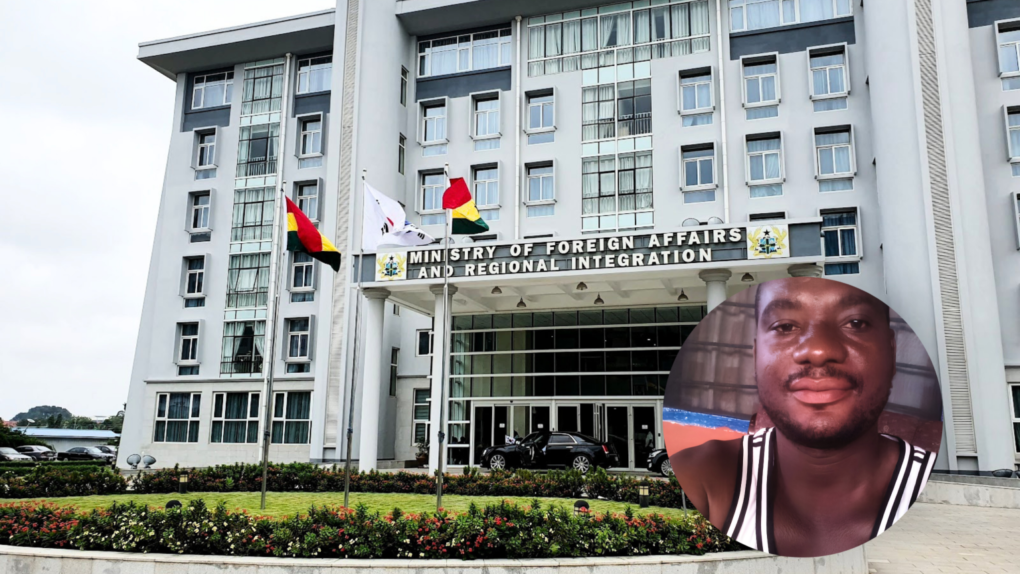
What should cost GHS200 at Ghana’s Ministry of Foreign Affairs is allegedly costing desperate visa applicants as much as GHS1,200 through unofficial middlemen.
An investigation by The Fourth Estate found that applicants seeking attestation and validation of documents at the Legal Department of the ministry – a requirement for some visa applications – were being routed to individuals charging fees inflated far above the official rate under the guise of providing expedited services.
“The receptionist directed me to a man in a suit claiming to be in the legal department to work on my documents,” a victim of the scheme says. “He charged me GHS1,000 and told me that my documents would be ready in a week. But when I got my documents, only a GHS200 receipt was issued.”
The investigation focused on document attestation services required by some embassies in Ghana, including the Egyptian Embassy, which, as of October 2025, required visa applicants to have bank statements and invitation letters validated through the Foreign Affairs Ministry.
Victims told The Fourth Estate that applicants arriving at the ministry were routinely directed by front-desk staff to “men in suits” within the ministry, who offered to “facilitate” the process.
To test the claims, The Fourth Estate sent a disguised reporter to the ministry with a forged invitation letter to attend an event in Egypt.

At the front desk, the receptionist referred the applicant to one Michael Gomeh, who ostensibly wore a staff tag of the Foreign Affairs Ministry. Mr Gomeh charged our applicant GHS900 to facilitate the attestation of the visa application documents. The validated documents were eventually delivered within a week, accompanied by an official receipt showing a payment of just GHS265.

Even with forged documents, the undercover applicant still received endorsed papers on the official letterhead of the Ministry of Foreign Affairs, signed by John Kwasi Boakyi, the Director of the Consular and Humanitarian Affairs Bureau.


The findings appeared to confirm allegations that unofficial charges were being imposed on applicants while only the approved fee was formally receipted.
Ministry distances itself from unofficial payments
The Ministry, in a letter dated May 12, 2026, and signed by Audrey Naana Abayena, Director of Legal and Treaties Bureau, said the approved fee for attestation and validation services remained GHS200 under the Fees and Charges Regulations, 2025.
“Any payment made to unauthorised persons, intermediaries, facilitators, or third parties was neither sanctioned nor recognised by the ministry,” the letter stated.
The ministry also acknowledged receiving complaints about excessive charges and said preliminary investigations suggested many of the incidents involved “third parties”. It further said it had introduced safeguards, including the publication of approved fees, issuance of official receipts, and complaint channels for reporting suspected misconduct.
In another letter to The Fourth Estate dated August 7, 2026 and signed by Chief Director Khadija Iddrisu, for the Minister, the Ministry of Foreign Affairs explained that the primary responsibility for confirming the authenticity of a document rests with the issuing authority, and the Notary Public or Commissioner of Oaths.
The documents, the ministry said, are subsequently forwarded to the Judicial Service for attestation of signatures and seals affixed by the Notary Public or Commissioner of Oaths.
“The Ministry’s attestation process only goes to verify the genuineness of the seals and signatures affixed by the Judicial Service to the document submitted to the Ministry for attestation,” the letter stated.
The Ministry also stated that Mr Michael Gomeh is not their employee. But The Fourth Estate, through its engagement with the Ministry, realised that he is a staff member seconded from the National Security.
The Ministry says that it convened a consultative meeting on August 6, 2026, with stakeholders to harmonise data-sharing and establish a cross-institutional verification network. The meeting, according to the Ministry, was held among institutions including the Judicial Service, Ghana Police Service, the Birth and Death Registry, Office of the Registrar of Companies, and the Accra Metropolitan Assembly.
Still, the investigation leaves troubling questions unanswered.
How were phony documents successfully endorsed? Why were applicants being openly redirected to unofficial facilitators from within ministry premises? And how did a fee of GHS200 evolve into a lucrative underground operation charging applicants up to five times the approved amount?
Systemic failures
Anti-corruption advocates say the situation points to deeper systemic failures.
Commenting on The Fourth Estate’s findings, Mary Awelana Addah, the Executive Director of Transparency International, Ghana, said, “No citizen should be compelled, directly or indirectly, to pay unofficial fees to access public services.”
She questioned where the excess money collected from applicants was going and warned that the allegations suggested possible collusion, abuse of office, and breaches of public trust. She called for tighter supervision, stronger internal controls, and clearer public communication on official charges.
***
The reporter, Prinsella Vera Aidoo, is a 2026 Fellow of the Next Generation Investigative Journalism Fellowship (Cohort 8) at the Media Foundation for West Africa.
Source: thefourthestategh.com