

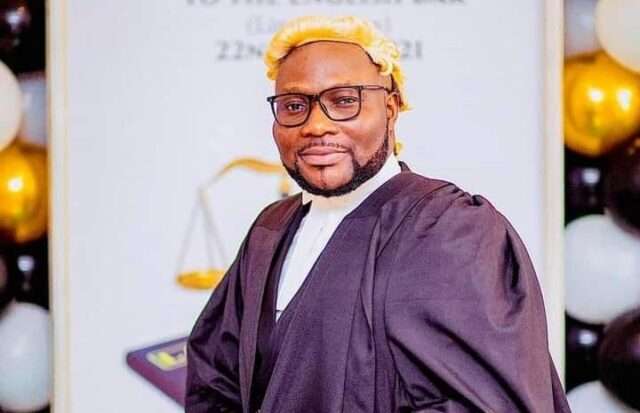
By Lawyer Richard Dela Sky
Respectfully, I write, not in agreement with the prevailing governmental silence, but in principled departure from it.
The matter before the conscience of the Republic is neither trivial nor forgettable. It is the confirmed appointment—or attempted appointment—of an individual whose academic and professional credentials, once held out as exemplary and sold to the unsuspecting public via national television, now appear fundamentally suspect, or so it has been alleged. And it is the government’s response, or rather its studied refusal to fully respond, that compels this dissent.
A Clarification of Intent
From the outset, may I state without ambiguity: this piece is not an attempt to condemn or convict Anne Sansa Daly in the court of public opinion. Far from that. It is, rather, a reasoned interrogation of the facts as they are currently constituted—and an appeal to accountability on the part of two institutions I continue to hold in high regard: the Presidency and the Council of State. The issues raised herein are not partisan grenades, as some ill-informed minds would soon suggest in their insular responses, but civic questions that demand serious institutional reflection. On the basis of current facts, I do not (for now) believe that the Minister for Health acted improperly in this matter—particularly when one considers the legal superstructure that governs appointments to the National Health Insurance Authority (NHIA) Board under the National Health Insurance Act and Article 70 of the Constitution. It is therefore important for public commentators and political critics to halt any unfounded attacks on the Minister, and to respectfully direct their attention instead to the systemic inconsistencies and constitutional contradictions that this appointment—and its quiet revocation—has laid bare.
The Daly Scandal: a Summary of the Relevant Facts
The facts are plain and unsettling. A Presidential letter, signed and issued on official letterhead, appoints Daly to the Board of the NHIA. In that appointment, dated 19th May, 2025, she is identified as a medical doctor with “expertise in health insurance”. Disputed documents in the public sphere had claimed she trained at Johns Hopkins University, one of the world’s most revered institutions of medical education. But on inquiry, both Ghana’s Medical and Dental Council and the relevant authorities in the United States, have reportedly disavowed any record of her medical qualification or licensure. The credentials do not appear to hold up. The claim collapses, although her lawyers have authored a public rebuttal, asserting her qualification to practice medicine in the United States of America.
And yet, the government’s reaction to this grave irregularity has been one of subtle retreat, not forthright repudiation. It now contends that, though the appointment letter is authentic, Ms. Daly was never sworn in. As if the absence of an oath nullifies the presence of institutional faux pas. As if rescinding a misjudgment without naming it absolves the state of its duty to truth and transparency.
Such a posture, with respect, cannot stand. It offends the principles of accountability that ought to guide democratic governance. Well, my Ewe elders say that “Du aɖe woƒe gbagbã yae nye du aɖe woƒe tutu,” meaning “it is the collapse of some nations that help other nations rise. “And so, when Daly’s appointment caved in, Prof. Dr. (Med) Ernest Yorke, a distinguished authority within the field of healthcare, benefited. He was named “to replace (Daly) as a member of the Board.” It is a worthy development.
A Matter of Law, Not Just Morals
Let the law speak, not in whispers, but in the full voice of the Republic Nkrumah founded.
Under Section 48 of the Health Professions Regulatory Bodies Act, 2013 (Act 857), it is an offence to:
i. Make a false declaration for registration as a medical or dental practitioner;
ii. Falsely use the title “Dr.” or any designation suggesting professional licensure in medicine;
iii. Practice or receive payment for medical services without being duly registered.
Further, under Act 29 (Criminal Offences Act, 1960):
i. Section 131 criminalizes defrauding by false pretence;
ii. Section 133 defines a false pretence as knowingly misrepresenting facts with intent to defraud;
iii. Section 158 defines forgery as the making of false documents;
iv. Section 164 deals presenting a forged document knowingly.
On current facts, each of these provisions is potentially implicated in the Daly affair. And each demands more than silence.
Violation of NHIA Board Appointment Standards
Section 4 of the National Health Insurance Act, 2013 (Act 857) provides that board members, including health professionals, are to be appointed under subsection 2 by the President under Article 70 of the Constitution, and revoked where necessary by written notice under section 5(4) of Act 857.
Article 70 of the 1992 Constitution itself mandates that such appointments be made by the President “acting in consultation with the Council of State.”
It is precisely here that another troubling inconsistency arises.
The Disparity that Screams
It is, quite frankly, mind-boggling that in the same Republic, a distinguished Chief Justice is being railroaded through a constitutionally questionable removal process, triggered by vague and amorphous allegations of misconduct, and yet a matter involving serious and well-documented claims of false credentials and possible criminal conduct—as in the case of Ms. Daly—attracts not even a whimper from the corridors of power.
One would expect that a Republic capable of summoning such constitutional machinery against its most senior judge would, at the very least, express a modicum of institutional outrage and or regret when confronted with prima facie evidence of deception at the highest levels of public appointment. But no. The Daly affair has been met with silence, deflection, and quiet revocation—as though the real offence were public scrutiny, and not the conduct itself.
This glaring disparity does not simply offend the principles of equal accountability; it raises an uncomfortable question about what truly animates state action in this country—law, or selective convenience?
A Council of State in Contradiction
On the one hand, Article 70 of the 1992 Constitution requires that the President consult the Council of State before making appointments to public boards, including the National Health Insurance Authority (NHIA). In that capacity, the Council’s advisory role formed—at least formally—part of the process that culminated in the now-discredited appointment of Dr. Anne Sansa Daly, a person whose professional claims could not withstand the most elementary verification. She slipped through the net.
As a matter of law, there is a presumption that official acts are regularly performed (see section 37 of the Evidence Act 1975). Let us, in keeping with that presumption, assume that some form of background check was carried out. Yet, on the facts presently available, that presumption appears to have suffered serious harm. Indeed, the failure to flag such a glaring issue raises doubts about the rigour—or even the existence—of any vetting at all. That said, I am mindful of the Supreme Court’s decision in Ghana Bar Association v. Attorney-General, Richard Sky and Others, which affirmed that the recommendations of the Council are not binding on the President. But that is beside the point. The issue here is not binding authority—it is institutional diligence.
On the other hand, the same Council of State, under Article 146, plays a decisive constitutional role in determining whether a prima facie case exists for the removal of superior court justices, including the Chief Justice. In the current proceedings against Justice Gertrude Torkornoo, it was this very Council—silent in the face of Daly’s alleged misrepresentations—that concluded a prima facie case had been made out, thereby triggering an impeachment process. That determination has since become a sealed event, closed to scrutiny, shielded from challenge, and insulated from public interrogation.
And so, Ghanaians are now asked to believe that the very Council that either failed to detect—or failed to act upon—a manifestly questionable appointment, is also the arbiter of constitutional discipline, legal integrity, and procedural fairness at the highest levels of our judiciary.
Respectfully, on what basis are we to trust that its judgment was diligent, its motives pure, and its process fair? Why should citizens accept that the Council’s unexplained prima facie assessment of the Chief Justice is beyond question, when its silence over a brazen public deception like Daly’s goes unexamined?
Collapse of the Vetting System
What makes this scandal most alarming is that it exposes a dangerous hollowness at the centre of state vetting processes. Was there no verification at all? If not, it is a dereliction of duty. If yes, and the appointment still proceeded, then it borders on institutional fraud. There must be consequences.
This is not the first time a regime has appointed an individual with suspect credentials. But it must be the last time we permit such cases to end with a whispered revocation rather than a national reckoning.
With the highest regard for the Office of the President and the constitutionally sacred role of the Council of State, it must still be said—firmly and without deference to convenience—that the contradictions now exposed are too glaring, too consequential, and too injurious to public trust to be left unchallenged. These institutions are the twin pillars upon which appointments to high office are built, and removals from those offices are initiated. Their judgments, therefore, must reflect consistency, rigour, and fairness.
And yet, what we witness is an unsettling dissonance: a woman whose credentials collapse under the lightest scrutiny is quietly offered a public appointment under their collective watch, while a sitting Chief Justice is dragged into a constitutional inquisition over claims yet to be tested by any transparent standard. This is not a mere lapse. It is a failure of institutional coherence—one that risks converting processes meant to uphold the Republic into instruments of selective discretion. To respect these offices is not to shield them from robust criticism, but to insist that they rise to the standards their mandates demand. This piece is, thus, a call not to disrespect the council or the presidency but a call to demand consistency, transparency, and institutional integrity.
Let it also be clearly stated that this piece does not suggest that the Chief Justice, or any public officer for that matter, is immune from lawful and fair investigation or accountability. If Justice Gertrude Torkornoo has, in fact, engaged in conduct that is truly egregious and constitutionally impeachable, then the processes of the Republic must take their fair and lawful course. No individual, however exalted, is above the Constitution. But justice demands consistency, transparency, and good faith. What this commentary challenges is not the right of the state to inquire lawfully and fairly into judicial misconduct, but the troubling contrast in how that power is wielded—the opacity surrounding the prima facie determination against the Chief Justice, the obvious lack of a publicly auditable Constitutional Instrument to govern the process, and the silence that greeted a far more straightforward case of public deception. It is that inconsistency that endangers public trust, not the lawful exercise of constitutional oversight.
A Response from Daly’s Lawyers
In the interest of fairness, it must be noted that Daly, through her lawyer Peter Nartey Okudzeto, reportedly issued a formal response dated 23 May 2025, strongly rejecting the claims raised in the public square about his client. Describing the claims as “subterfuge to perpetuate mischief, odium and ridicule,” Mr. Okudzeto stated emphatically that while Dr. Daly is not registered with the Ghana Medical and Dental Council (GMDC), she is fully certified to practise internal medicine in the United States.
“My client is excessively qualified to hold herself as a Medical Doctor anywhere in the world and does not need certification from the Ghana Medical and Dental Council to do so,” the statement said. It further challenged the suggestion that non-registration with the GMDC implies the absence of professional legitimacy, asserting that such a view is, “with all due respect, a proposition of fuliginous obscurity… its foundations lie on mechanical reasoning devoid of logic.”
Respectfully, the response, while spirited, does not address the circumstances surrounding the public appointment or the lack of official verification from credentialing authorities raised by Ghanaian regulatory bodies. Nonetheless, it has been included here in the spirit of balance, fairness, and the right of reply—principles this column holds as essential to public accountability and responsible commentary.
Final Words: A Dissent
In a republic governed by law and guided by trust, truth must be the first condition of public office. That condition was not met here. And the refusal of the state to name the wrong, let alone correct it openly, reveals a disturbing tolerance for alleged deception.
This was a moment for accountability—not abstraction; for investigation—not evasion; for courage—not convenience. And yet, in a troubling inversion of justice, we now witness a Chief Justice—whose decades of distinguished service have been defined by fidelity to law and reform—dragged through the image and career shattering machinery of removal on the basis of questionable complaints, while a far more straightforward case involving alleged false credentials and public deception is brushed aside with bureaucratic indifference. If there is any moment that calls for the guardians of our Republic to act with transparency, consistency, and honour, it is this one. “If the law is the law is the law,” if law still binds, if truth still matters, if public office is still a trust—not a trophy—then we must say without fear of any contradiction that the standards being applied are uneven, and the silence being observed is unjust.
It is for all the foregoing reasons—and in defence of truth, fairness, and the constitutional integrity of our democratic institutions—that I humbly dissent. Not in bitterness. Not in anger. But in the solemn conviction that principle must not perish in the face of politics.
#HARDlaw
#SkyDissenting
Source: newsthemegh.com