

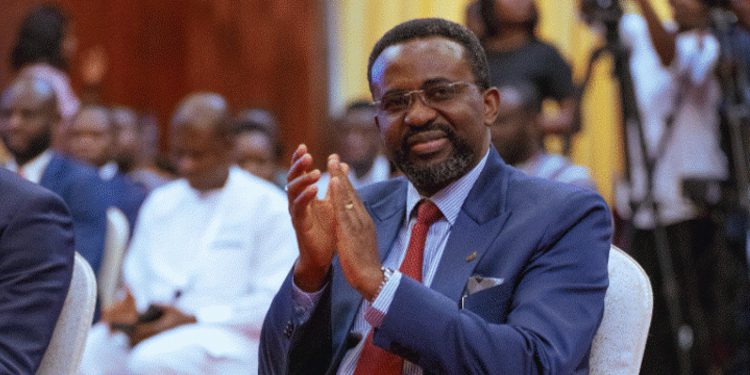
The 24-hour economic concept, according to Dr. Johnson Asiama, Governor of the Bank of Ghana (BoG), is a springboard for maximising the potential of the Volta Economic Corridor for observable results.
He claimed that working quicker, smarter, and more connected—rather than merely putting in more hours—was the idea that held the strategic priority to maximising the Corridor’s potential.
According to him, the goal of the 24-Hour Economy concept was to establish a Ghana where business, finance, and production run constantly.
Speaking on the topic of “Harnessing the Volta Economic Corridor Potentials for the 24-Hour Economic Policy Take-off at the Reddington Beach Hotel, Whuti, in the Anloga District,” at the inaugural Volta Economic Forum, known as the Hogbetsotsoza Edition.
According to Dr. Asiama, the idea might improve trade, logistics, and manufacturing in Ghana and the ECOWAS area.
He pointed out that the Volta Economic Corridor was intended to be a dynamic artery that connected farmlands, marketplaces, energy supplies, and border trade routes rather than merely a geographic line.
According to the governor, relocating border checkpoints to allow trade, improving road networks and logistics hubs, and establishing Ho and Keta as transportation and industrial hubs are all necessary for infrastructure and connectivity.
He stated that the establishment of energy and industrial clusters, the use of the Volta Basin’s renewable energy potential, 24-hour processing parks, ICT hubs, and light manufacturing powered by wind, solar, and hydropower were all necessary.
Human capital development, according to Dr. Asiama, is essential to establishing a workforce prepared for the 24-hour economy and preparing the next generation of workers for the workforce of the future through education and mentality changes.
He said that in order to bundle regional potential to draw in both domestic and foreign investment, as well as to guarantee policy coherence, regulatory clarity, and competitive tax structures, a robust private sector involvement was necessary.
The government alone, he added, could not fulfil the potential of the 24-hour vision.
The Governor underlined that the Bank of Ghana’s responsibilities included stabilising the macroeconomic environment, establishing a stable value for the cedi through prudent policy, fostering digital finance by promoting platforms such as GhanaPay, and facilitating 24/7 commerce.
Once more, he stated that BOG would facilitate FinTechs that are beneficial to small and medium-sized businesses, change credit systems, and make digital lending possible.
“We shall ensure sectoral resilience and signaling Ghana’s stability and openness through green finance and reserves building,” he added.
Dr. Asiama urged the region’s assemblies, educational institutions, and traditional authorities to support the 24-hour vision, stating that reform was co-created rather than imposed by law.
“Everyone, from government to financial institutions to community leaders, has a role,” he stated.
Dr. Asiama praised the VRCC and partners for their leadership and stated that the conference was more than simply a discussion; it was a springboard for concrete results, such as factories, financial centres, and larger projects.
He promised that the Central Bank will remain steadfast in its efforts to make the Volta Corridor the beating heart of Ghana’s round-the-clock economy.
Madam Oye Bampoe Addo, the Deputy Chief of Staff (Administration), represented Chief of Staff Mr. Julius Debrah, who praised the team’s leadership and reaffirmed the government’s unwavering support for this transformative program.
Under President John Dramani Mahama’s 24-Hour Economy plan, Volta Regional Minister Mr. James Gunu underlined the stakeholders’ shared vision and willingness to guide Ghana’s next stage of economic change.
“We are unlocking opportunities in agriculture, energy, logistics, and tourism to create sustainable jobs and attract significant investment into our region,” he stated, referring to the Volta Economic Corridor.
This project is anticipated to generate over one million jobs and more than one billion dollars in investment on more than two million hectares of productive land.
“Our goal is clear, to make the Volta Region the hub of agro-industrial productivity, renewable energy, logistics efficiency, and tourism excellence. We are building an economy that works 24 hours a day, driven by innovation, technology, and the hard work of our people.”
“Indeed, as we work together as government, private sector, and international community, we are proving that when vision meets collaboration, prosperity follows.”
A number of ministers, ambassadors, development partners, members of parliament, chief executives of municipalities and districts, investors, and traditional leaders were also welcomed to the conference. All of them indicated a strong desire to work together to establish the Volta Region as a hub for sustainable economic growth.
Source: newsthemegh.com